
This post contains affiliate links. I may earn a small commission if you buy through them — at no extra cost to you. My scores are never influenced by this.
TL;DR: Fly By Jing wins this one. Momofuku’s coconut sugar sweetness overwhelms everything else in the jar, making it a two-dimensional experience — sweet and spicy, nothing more. Fly By Jing has less crunch but more flavor complexity and actual layering. If you’re choosing between these two originals, Fly By Jing is the better chili crisp.
Two of the most recognizable chili crisp brands in American grocery stores. Two originals. Momofuku Chili Crunch and Fly By Jing Sichuan Chili Crisp both sit on the same shelf, target the same buyer, and claim the same spot in your fridge. This Momofuku vs Fly By Jing comparison puts them side by side on ingredients, flavor, texture, heat, and value — with a clear winner.
I reviewed both individually — Momofuku Chili Crunch and Fly By Jing Original. Both landed at AVERAGE in their individual reviews. But head to head, one of them pulls ahead, and the reason comes down to what happens after the first bite. If you’re new to chili crisp, this comparison helps you skip the wrong jar.
At a Glance
Momofuku vs Fly By Jing Chili Crisp Comparison Table
Tiers reflect in-context comparison performance. Individual review tiers may differ.
| Fly By Jing Original | Momofuku Chili Crunch | |
|---|---|---|
| Category | Chili Crisp | Chili Crunch |
| Size | 6 oz | 5.5 oz |
| Oil Type | Rapeseed + soybean + sesame (3 oils) | Grapeseed oil (1 oil) |
| Key Ingredients | Dried chili, fermented soybean, mushroom powder, seaweed powder | Puya chili, coconut sugar, sesame seed, mushroom powder, 3 chili varieties |
| Heat | 3/5 — Sichuan peppercorn numbing + chili burn | 3/5 — Chili burn, no peppercorn numbing |
| Crunch | Minimal — small bits, oil-softened | Moderate — uniform chili flakes and seeds |
| Dominant Flavor | Salt, umami, fermented tang | Sweetness (coconut sugar), then spice |
| Sugar | No | Yes — coconut sugar, 3rd ingredient |
| Fermented | Yes (fermented soybean) | No |
| Refrigeration | Yes (after opening) | Not specified |
| Tier | GOOD | AVERAGE |
Visual Comparison
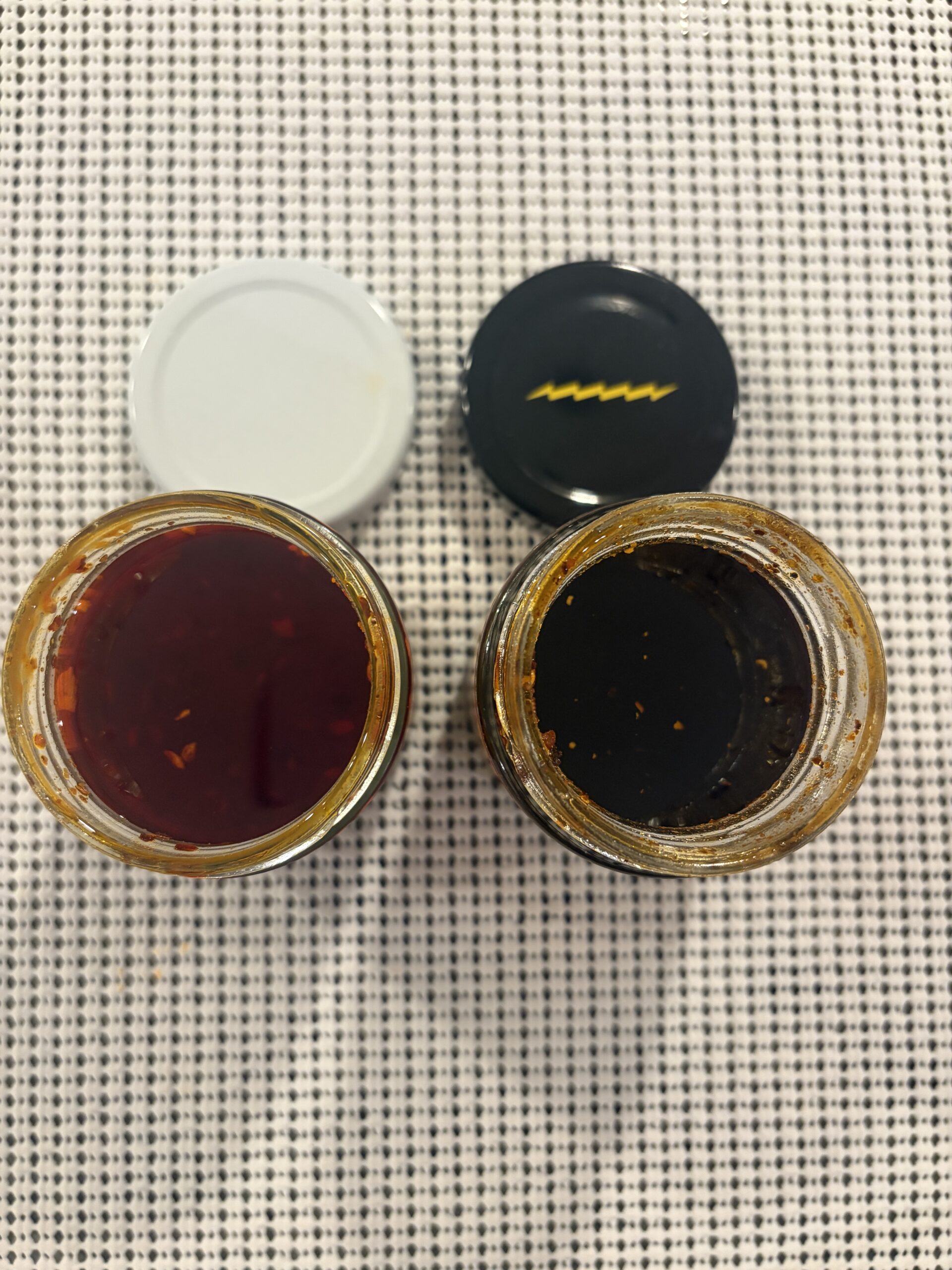
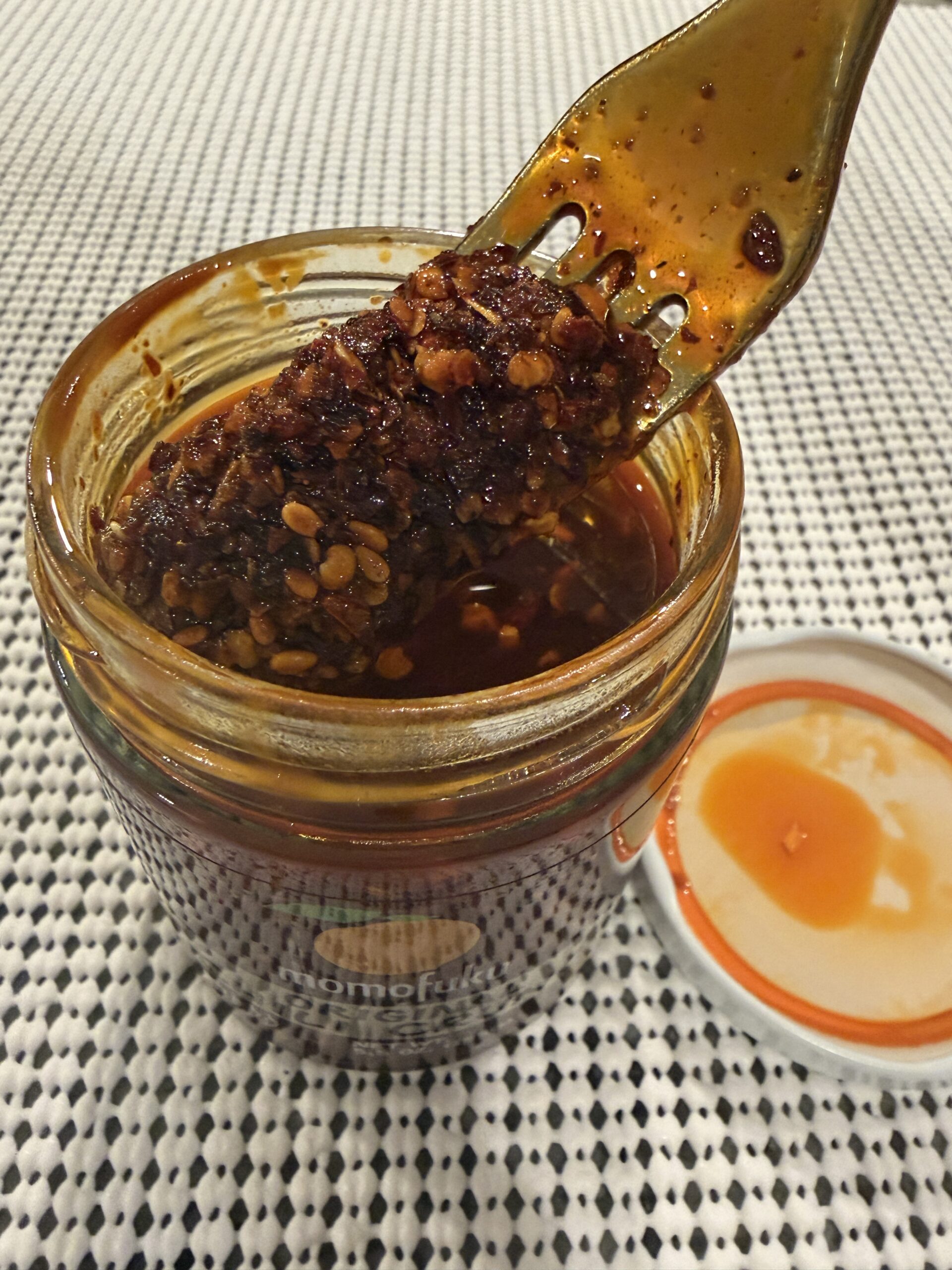
You can tell these are different products before you taste anything. Momofuku is red — aggressively, uniformly red. The oil is orange-reddish, and the contents of the jar are a wall of chili flakes and seeds, all crushed to a very consistent size. It looks like someone put dried chilies in a food processor and hit pulse until everything was the same dimension. There’s a uniformity to it that signals industrial consistency.
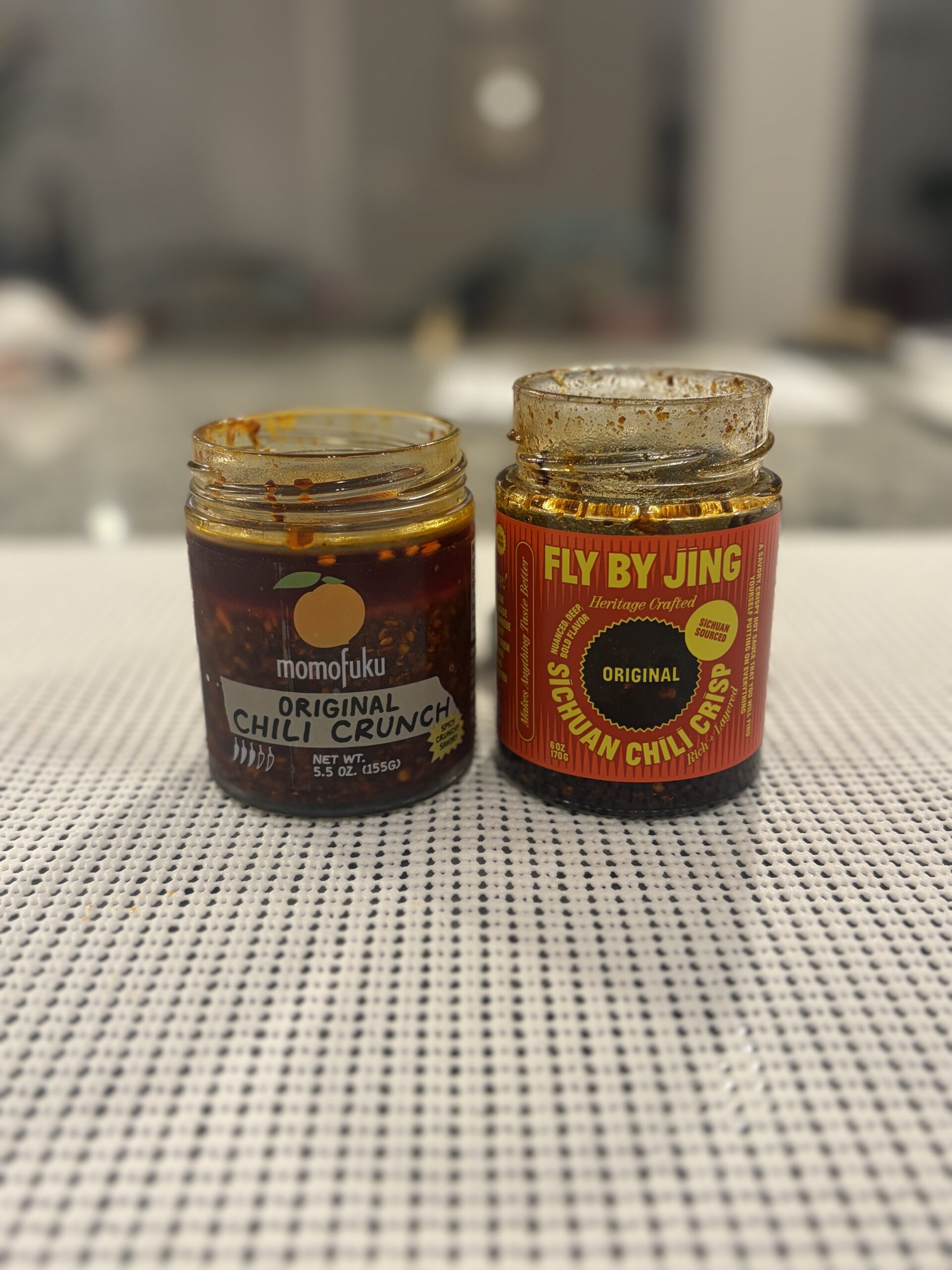
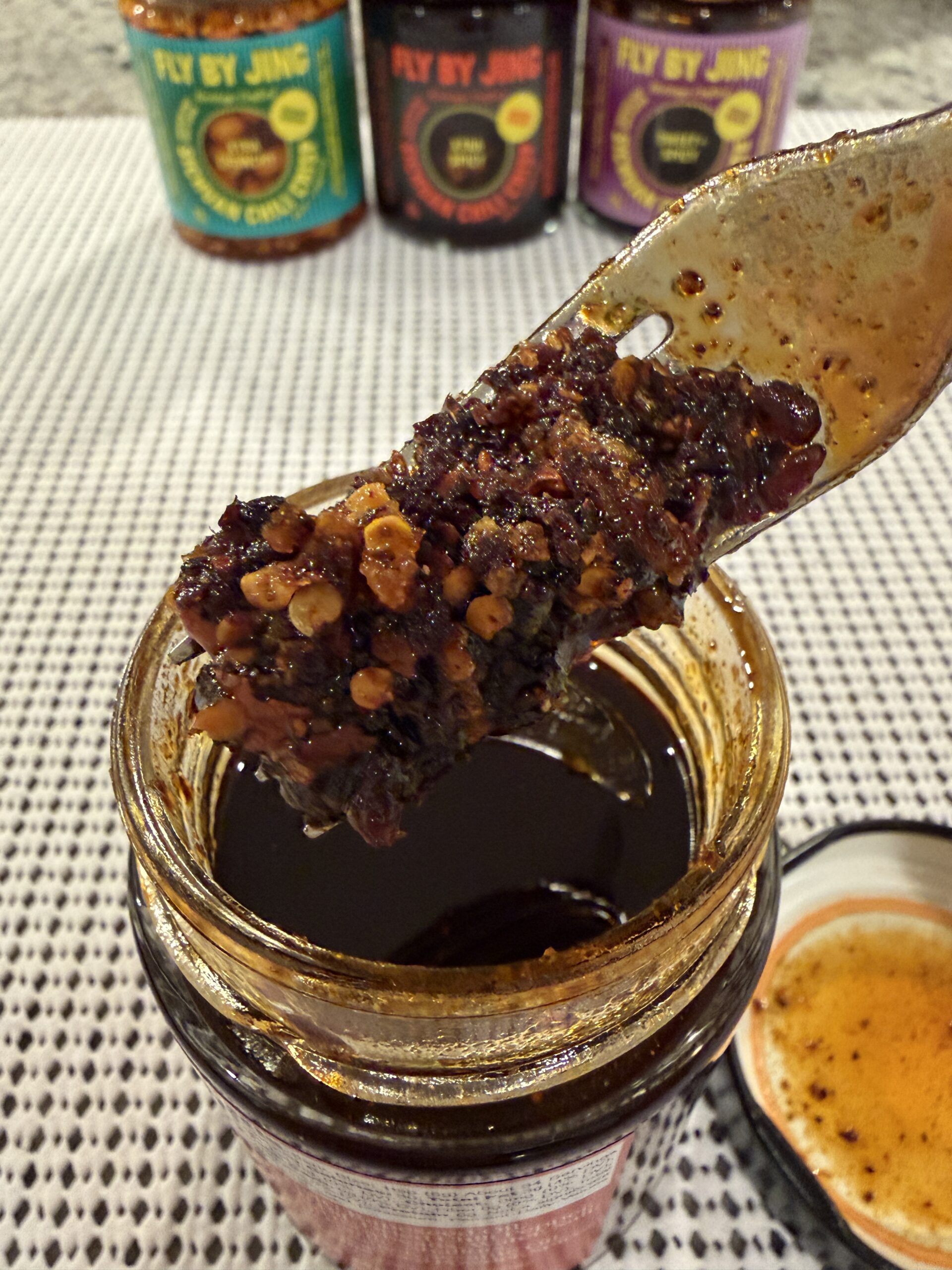
Fly By Jing is brown. Dark brown, almost black in places, with the color coming from the fermented soybeans and the sesame oil blending with the rapeseed base. Looking down into the jar, you can see soybeans scattered through the bits, fragments of chili, and powdery particles suspended in the oil. It’s less uniform, more organic, and the color alone tells you there’s fermentation at work.
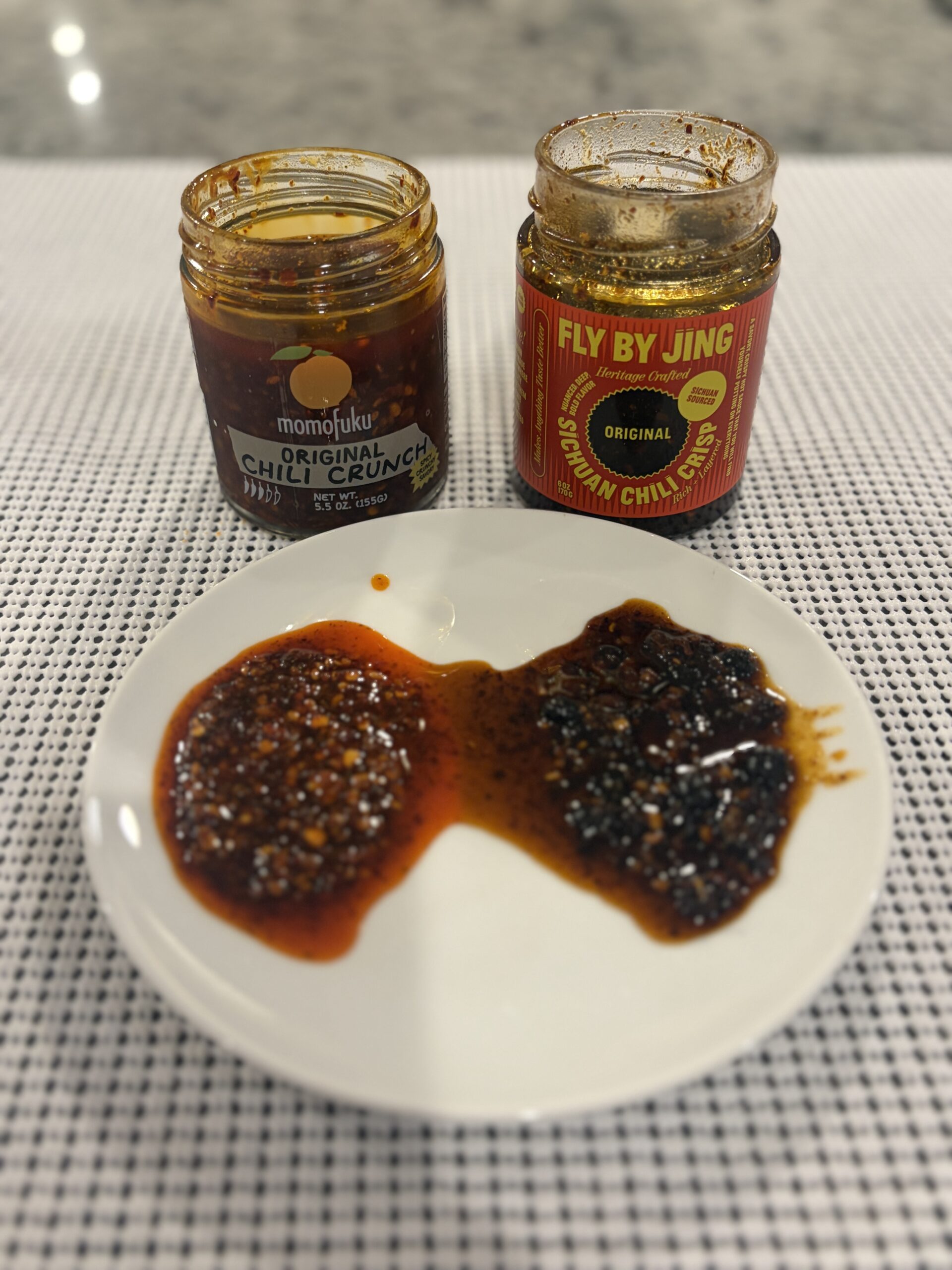
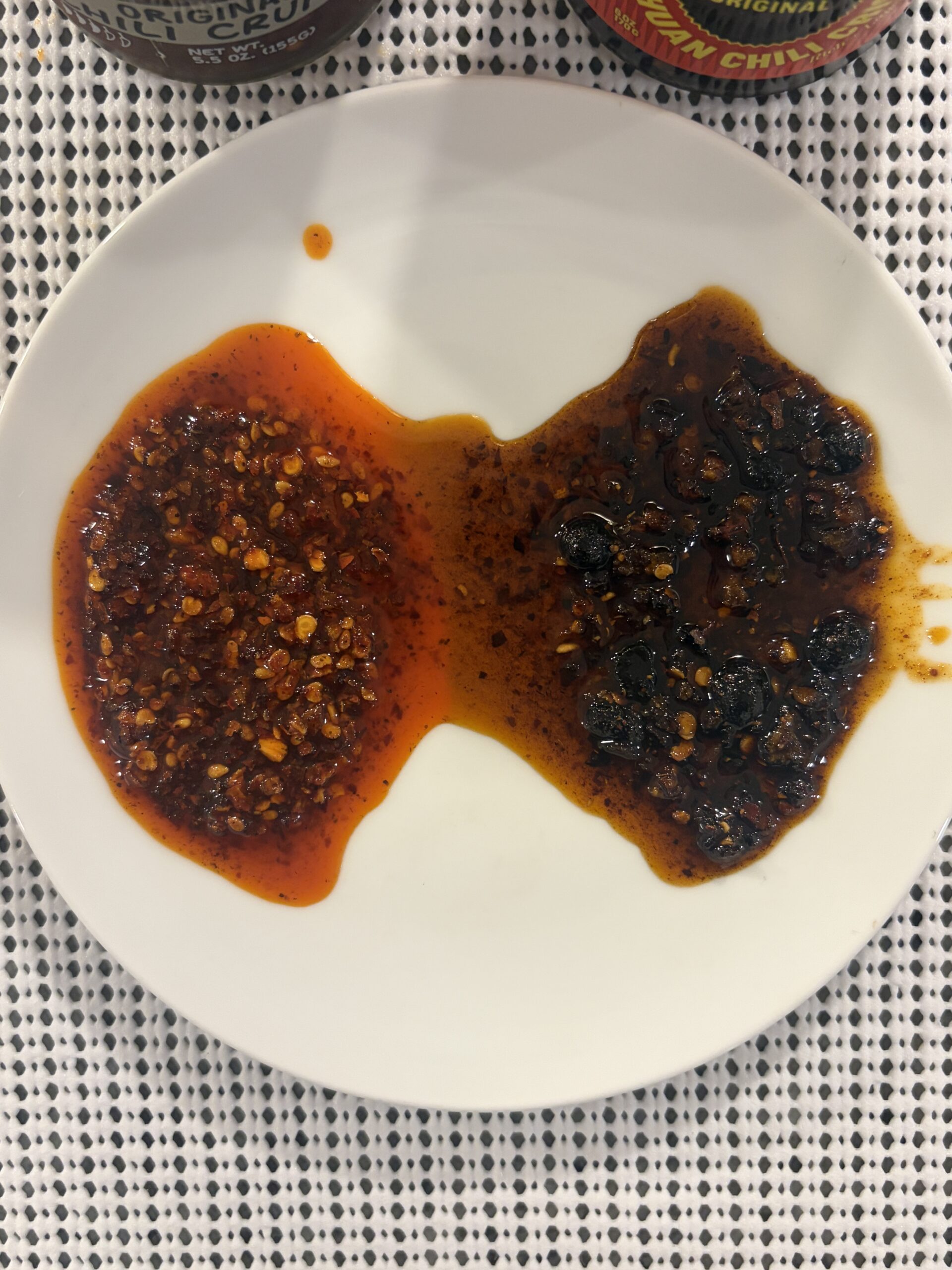
Spread both on a white plate and the difference is even sharper. Momofuku’s oil spreads clean — a clear, orange-reddish hue with the bits clustered together. Fly By Jing’s oil carries fine particles with it, little specks of spice and powder that travel through the liquid. The oil itself is doing more work in the Fly By Jing jar because it’s carrying flavor with it, not just sitting around the solids.
Ingredients Side by Side
| Position | Fly By Jing Original | Momofuku Chili Crunch |
|---|---|---|
| 1st | Rapeseed oil | Grapeseed oil |
| 2nd | Non-GMO soybean oil | Puya chili |
| 3rd | Dried chili pepper | Coconut sugar |
| 4th | Fermented soybean | Sesame seed |
| 5th+ | Garlic, shallots, mushroom powder, ginger, sesame oil, salt, Sichuan pepper, seaweed powder, spices | Onion, garlic, mushroom powder, chili de arbol, Chaponese chili, salt, red pepper, shallot, yeast extract, seaweed |
Two completely different approaches to chili crisp, visible right on the label. Fly By Jing builds its flavor on fermentation — fermented soybean in the fourth position, Sichuan peppercorn for numbing heat, and three oils creating a complex fat base. Nothing sweet in the list. The depth comes from fermented ingredients and the mushroom/seaweed umami stack.
Momofuku builds its flavor on chilies and sugar. Three different chili varieties (puya, arbol, Chaponese) explain the deep red color and the broad heat. But coconut sugar sitting in the third position — ahead of sesame, ahead of garlic, ahead of everything else that could add complexity — is the decision that defines this jar. There’s nothing fermented in Momofuku’s list. The umami has to come entirely from mushroom powder and yeast extract, which are both quiet ingredients fighting against a very loud sugar presence.
Both jars include mushroom powder and seaweed for savory background. But what sits around those shared ingredients tells you everything. In Fly By Jing, it’s fermented soybean and Sichuan peppercorn — ingredients that add funk, tang, and numbing heat. In Momofuku, it’s sugar and three varieties of chili — ingredients that add sweetness and burn. The foundation stories are different, and they lead to different eating experiences.
The Sweetness Problem
This is the section that decides the comparison. Coconut sugar as the third ingredient in a chili crisp is a choice — and it dominates the Momofuku jar. The first thing you taste is sweetness. Not chili, not garlic, not sesame. Sweet. Then spicy. Those two notes play on repeat through every bite, and for all the ingredients listed on the label, it’s hard to distinguish anything beyond those two dimensions. The mushroom powder and yeast extract that should be building umami underneath are buried. The three chili varieties that could be creating a complex heat profile get flattened into a single sensation: burn.
Sweetness in a chili crisp isn’t automatically disqualifying. GUIZ has sugar near the end of its ingredient list and it barely registers. Some products use a touch of sweetness to balance heat and round out the overall profile. The problem with Momofuku is that the sugar isn’t balancing — it’s leading. It’s the first thing that arrives and the last thing that leaves, and it pushes everything else into the background. The jar smells like honey butter. A chili crisp should not smell like honey butter.
Fly By Jing has no sugar in its ingredient list. Zero. The flavors that hit first are salt and peppercorn, followed by fermented tang from the soybean and a slow umami build from the mushroom and seaweed. You don’t have to fight through a sweetness layer to find the actual chili crisp flavors. They’re right there from the start.
Flavor Profiles
Fly By Jing: Layered and Fermented
Fly By Jing leads with salt and oil, then the Sichuan peppercorn shows up and starts working — a tingling numbness that spreads across your lips and the front of your tongue. Behind that, the fermented soybean adds a tang and chewiness. The mushroom powder and seaweed build a quiet savory base that holds everything together. There are layers to it: saltiness, then fermented funk, then a sweetness that balances naturally from the spice blend without any added sugar doing the work. The bits are small and there aren’t enough of them — that’s Fly By Jing’s weak spot, and it’s why the individual review landed at AVERAGE. But when you’re comparing what the flavor itself is doing, FBJ is working on more levels than Momofuku.
Momofuku: Sweet and Spicy, Two Dimensions
Momofuku gives you two things: sweet and spicy. The coconut sugar hits immediately — a thick, caramel-adjacent sweetness that coats your palate before the chili heat arrives. The heat is real — the three chili varieties deliver a solid burn that builds through the bite. But the sweetness matches it step for step, and the two flavors cancel out most of the nuance that the supporting ingredients could have added. For all the chilies, the mushroom powder, the sesame, the shallots — what you actually taste in your mouth is sweet heat. Two-dimensional. Full review here.
The pairing challenge makes this even clearer. Fly By Jing works on rice, noodles, dumplings, congee — standard chili crisp territory. Momofuku’s sweetness makes those pairings awkward. Where does a sweet chili crunch belong? Something with peanut butter, maybe. A Thai-adjacent dish where sweet heat makes structural sense. But you’re not reaching for it the way you’d reach for a normal chili crisp, and that limits its usefulness in the kitchen.
Heat Comparison
Both jars land around a 3 out of 5 on heat, but the heat types are different. Fly By Jing runs Sichuan peppercorn numbing — a tingling, mouth-coating sensation that builds gradually and leaves a pleasant buzz on your lips. The dried chili adds a secondary burn underneath. Two heat tracks, one mala-adjacent experience.
Momofuku skips the peppercorn entirely. There’s no Sichuan pepper in the ingredient list, which means no numbing, no tingling. The heat comes entirely from chili burn — puya, arbol, and Chaponese chilies delivering a straight, direct heat that hits the tongue and stays there. It’s a simpler heat profile: one dimension of burn, no numbing counterpoint. The three chili varieties could have created an interesting layered heat, but the coconut sugar smooths everything into a single spice-and-sweet wall.
If you like mala-style numbing heat, Fly By Jing is the only option here. If you prefer a straight chili burn without the tingle, Momofuku delivers that — just know it comes wrapped in sweetness.
Which One for What
| Situation | Reach For |
|---|---|
| Rice, noodles, eggs — everyday use | Fly By Jing — salt-and-umami base works broadly |
| You want Sichuan peppercorn numbing | Fly By Jing — the only jar here with mala |
| You like sweet heat (Thai-adjacent pairings) | Momofuku — the sweetness fits there |
| You want fermented flavor depth | Fly By Jing — fermented soybean does the work |
| You want more crunch | Momofuku — more uniform bits, slightly better texture |
| Allergen-sensitive (top 9) | Fly By Jing — free of top 9 allergens |
| Sugar-free | Fly By Jing — no sugar listed |
| You want the most versatile jar | Fly By Jing — works with more foods |
Value & Verdict
Fly By Jing gives you 6 ounces; Momofuku gives you 5.5 ounces. Both are similarly priced on Amazon — roughly $12 each. Neither jar is a bargain by weight, and both lose on value when you compare them to denser jars like GUIZ (8.11 oz for $11.98) or Lao Gan Ma (7.41 oz for under $5). But between these two, Fly By Jing gives you slightly more product in a slightly larger jar with flavors that work in more situations.
The value question here isn’t really about ounces — it’s about what you get when you open the jar. Fly By Jing gives you a savory, fermented, peppercorn-forward chili crisp that works across standard food pairings. Momofuku gives you a sweet, spicy condiment that needs specific dishes to make sense. One of those is more useful in a kitchen. That’s the verdict.
Fly By Jing Original on Amazon | Momofuku Chili Crunch on Amazon
Fly By Jing Original: GOOD — More flavor layers, fermented depth, Sichuan peppercorn presence, and no sugar competing for attention. Not the crunchiest jar, but the better chili crisp in this matchup.
Momofuku Chili Crunch: AVERAGE — Better crunch than Fly By Jing, and the three chili varieties show ambition. But coconut sugar as the third ingredient flattens the entire flavor profile into two dimensions: sweet and spicy. That’s not enough for a chili crisp at this price.
Frequently Asked Questions
Is Fly By Jing better than Momofuku chili crisp?
In a side-by-side comparison, Fly By Jing Original outperforms Momofuku Chili Crunch on flavor complexity. Fly By Jing delivers salt, fermented tang, Sichuan peppercorn numbing, and umami layering. Momofuku’s coconut sugar (third ingredient) overwhelms the jar with sweetness, reducing the flavor to two dimensions: sweet and spicy. Fly By Jing earns GOOD; Momofuku earns AVERAGE in this head-to-head.
Why is Momofuku chili crunch so sweet?
Coconut sugar is the third ingredient in Momofuku Chili Crunch — positioned ahead of sesame, garlic, and all the supporting flavors. That placement means sugar is one of the heaviest ingredients by weight, and it dominates the flavor profile. The jar smells like honey butter and tastes like sweetness paired with chili burn, with little room for the other ingredients to come through.
Does Momofuku or Fly By Jing have more crunch?
Momofuku has slightly better crunch. Its chili flakes and seeds are crushed to a uniform size and provide a consistent texture. Fly By Jing’s bits are smaller, sparser, and often softened by the oil. Neither jar wins on crunch compared to denser products like GUIZ Original, but Momofuku has the edge between these two.
Does Momofuku chili crunch have Sichuan peppercorn?
No. Momofuku Chili Crunch does not contain Sichuan peppercorn. Its heat comes entirely from chili burn — puya, arbol, and Chaponese chili varieties. There is no numbing or tingling sensation. Fly By Jing includes Sichuan pepper and delivers the mala-style numbing heat that Momofuku lacks.
Is Momofuku or Fly By Jing chili crisp sugar-free?
Fly By Jing Original is sugar-free — no sugar appears in the ingredient list. Momofuku Chili Crunch contains coconut sugar as its third ingredient, making it one of the sweetest chili crisps on the market. If you want a savory chili crisp without sugar, Fly By Jing is the better choice between these two.
Which is better for everyday use — Momofuku or Fly By Jing?
Fly By Jing is more versatile for everyday use. Its savory, salt-and-umami base works on rice, noodles, eggs, dumplings, and congee. Momofuku’s coconut sugar sweetness makes it awkward on standard chili crisp pairings — it works better with Thai-adjacent dishes or anything where sweet heat is expected. Fly By Jing fits more meals.
What chili crisp is better than both Momofuku and Fly By Jing?
GUIZ Original Chili Crisp earned EXCELLENT in our review and beat both Momofuku and Fly By Jing in separate head-to-head comparisons. GUIZ delivers more crunch (peanuts and sesame), more flavor complexity (broad bean paste, cooking wine), better settlement (90% solids), and a lower price per ounce ($1.48/oz for 8.11 oz). It’s the better jar by every metric.