
Most people never think about it. They grab a jar, check the heat level, maybe glance at the price. But the oil is doing more work than the chilies in most products. It’s extracting capsaicin. It’s carrying flavor compounds to your tongue. It’s determining whether those crispy bits stay crunchy or turn soggy within a week. And on the nutrition label, it’s responsible for the majority of the calories and all of the fat content.
Here’s what each oil type actually means for your chili crisp — and why it should matter to you before you buy.
Why the Oil Matters More Than You Think
In a typical jar of chili crisp, oil accounts for 60–70% of the total volume. That’s not a flaw in the product — it’s the product. The oil is the medium in which every other ingredient lives. During production, hot oil extracts color from dried chilies, pulls volatile flavor compounds from garlic and aromatics, and dissolves fat-soluble molecules like capsaicin (the compound responsible for heat). Without oil, there is no chili crisp. There’s just a pile of dried spices.
But not all oils do this job equally. A neutral oil like soybean steps aside and lets the chilies talk. A toasted sesame oil brings its own personality to the conversation — nutty, roasted, warm — and changes the entire character of the jar. An extra-virgin olive oil introduces grassy, peppery notes that push the product into Mediterranean territory. The oil isn’t passive. It’s an active ingredient with its own flavor, its own nutritional profile, and its own implications for how the chili crisp behaves in your kitchen.
Here’s a practical way to think about it: the oil is the canvas. The chili variety — not the oil — tends to define the flavor character in Chinese-style products. But in Calabrian-style and Mediterranean products, the oil and chili work together as co-leads. (If you’re still getting oriented, the full breakdown of what chili crisp is covers how all four components fit together.)
The Common Chili Crisp Oil Types: What’s in Most Jars
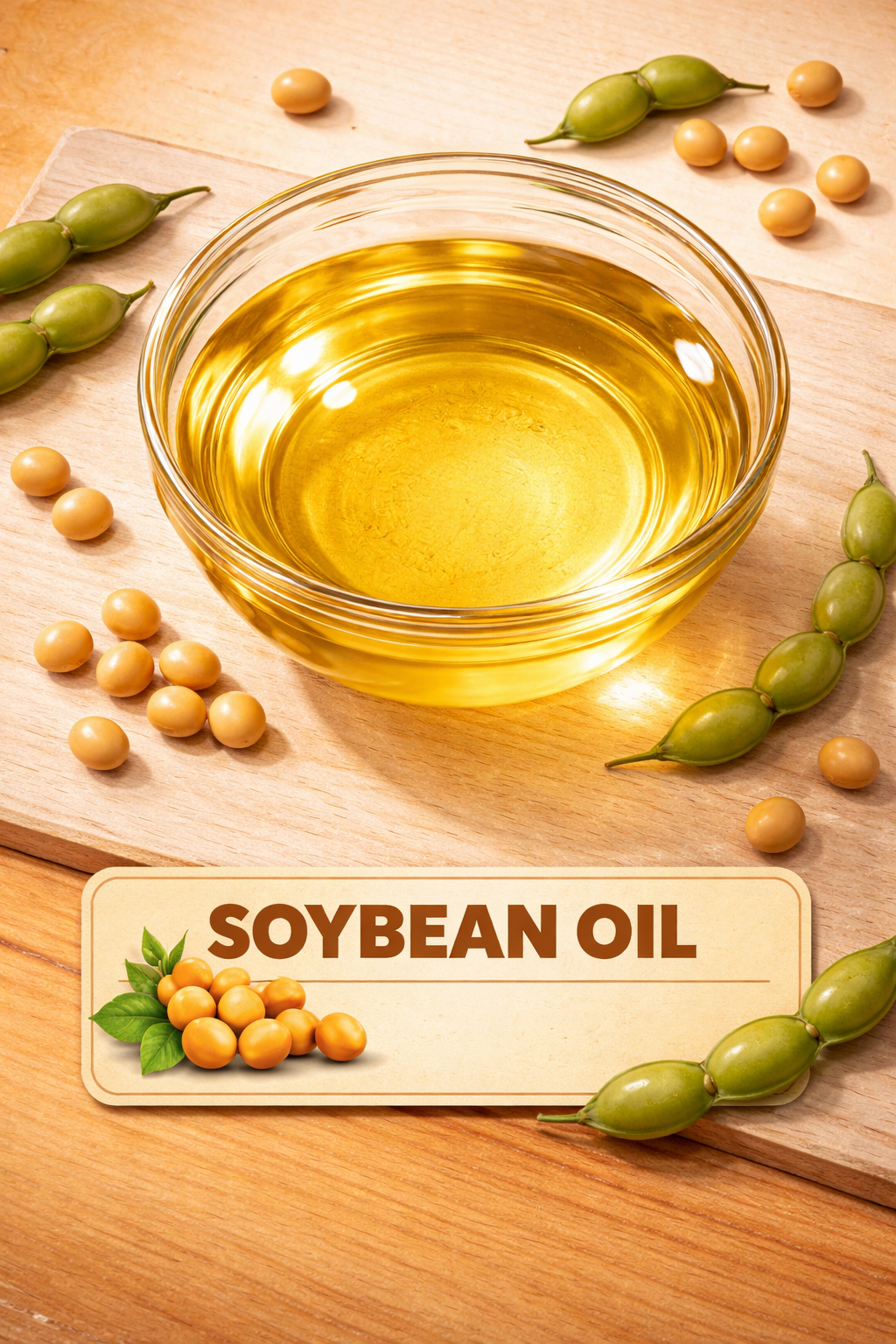
Soybean Oil
This is the workhorse of the chili crisp world. If you pick up a jar of Lao Gan Ma, the oil is soybean. Same with the majority of Chinese-produced chili crisps on grocery store shelves. Soybean oil is cheap to produce, completely neutral in flavor, and has a smoke point around 450°F — high enough to handle the frying temperatures required during production.
On the nutrition label, soybean oil is high in polyunsaturated fats, particularly omega-6 fatty acids. A tablespoon of soybean oil runs about 120 calories and 14 grams of total fat, with roughly 8 grams of polyunsaturated fat, 3 grams of monounsaturated fat, and 2 grams of saturated fat. It contains some vitamin E but is otherwise nutritionally unremarkable.
From a flavor standpoint, soybean oil is invisible. That’s both its strength and its limitation. It doesn’t compete with the chilies and aromatics, which is why traditional Chinese producers prefer it. But it also doesn’t contribute anything on its own. If the infusion step is weak — if the chilies weren’t steeped long enough, or the aromatics weren’t fried properly — soybean oil will taste like nothing. And you’ll notice.
When you see “vegetable oil” on a chili crisp label without further specification, it’s almost always soybean oil. In the U.S., the FDA requires manufacturers to specify the source oil, but imported products sometimes use the generic term. If you care about what’s in the jar, look for specifics.
Canola Oil (Rapeseed Oil)
Canola oil shows up frequently in North American and Canadian-produced chili crisps, and in some Chinese products as well. It’s a variety of rapeseed oil that’s been bred to contain low levels of erucic acid — the compound that made traditional rapeseed oil problematic for consumption.
Nutritionally, canola is one of the better commodity oils. A tablespoon delivers about 124 calories and 14 grams of fat, but the fat profile skews healthier than soybean: roughly 9 grams of monounsaturated fat, 4 grams of polyunsaturated fat (including some omega-3 fatty acids), and only about 1 gram of saturated fat. Among cheap, widely available oils, canola has one of the more favorable ratios of unsaturated to saturated fat.
In flavor, canola is nearly as neutral as soybean. Some people detect a faint grassy or slightly fishy note in lower-quality canola oil, particularly when heated repeatedly, but in a well-produced chili crisp this is almost never perceptible. The smoke point sits in the 400–450°F range, which is perfectly adequate for production.
For label-reading purposes, canola and soybean are functionally interchangeable in most chili crisps. The real question isn’t which of these two neutral oils is in the jar — it’s whether the producer did anything interesting with it during infusion.
Rapeseed Oil (Non-Canola)
Some imported chili crisps list “rapeseed oil” rather than canola. In Chinese-produced products, this typically refers to traditional pressed rapeseed oil, which has a stronger, more pungent flavor than refined canola. It can carry mustard-like, slightly bitter notes that add complexity to the chili crisp base. Some producers use this deliberately — it’s a flavor choice, not a cost-cutting measure. If you see “rapeseed oil” on a Chinese import, it’s worth paying attention to whether the oil itself contributes a noticeable flavor layer that you wouldn’t get from a neutral base.
Flavorful Oils: When the Base Does More
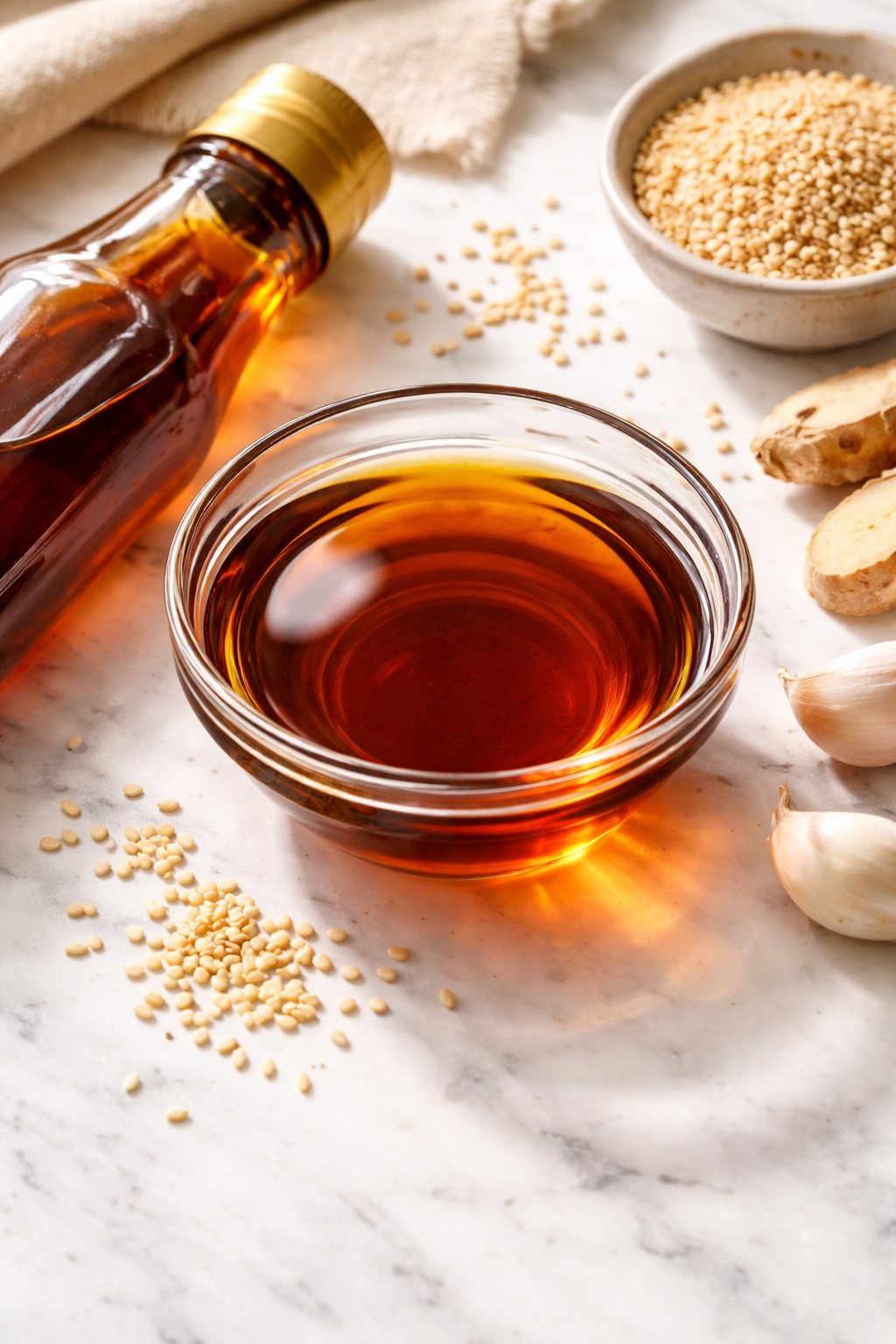
Sesame Oil (Toasted and Unrefined)
Sesame oil is where things get interesting. Unlike soybean and canola, sesame oil has a strong, identifiable flavor — nutty, warm, roasted — that actively shapes the finished product. In Chinese culinary tradition, toasted sesame oil (called xiangyou or xiao mo xiang you) has been used as a flavor enhancer in chili oils for centuries. It’s not a neutral carrier. It’s a co-star.
You’ll find sesame oil used in two ways in commercial chili crisps. Some products use it as the primary base oil — this gives the entire jar a pronounced sesame character. Others use it as a finishing oil, blending a small amount with a neutral base to add depth without overwhelming the chilies. Fly By Jing uses a blend approach; the sesame is detectable but doesn’t dominate.
Nutritionally, sesame oil differs meaningfully from the neutral commodity oils. A tablespoon contains about 120 calories and 14 grams of fat, with approximately 6 grams of monounsaturated fat and 6 grams of polyunsaturated fat. But what sets it apart is its antioxidant content — sesame oil contains compounds called sesamin and sesamol that have documented anti-inflammatory and antioxidant properties. The American Heart Association lists sesame oil among its recommended healthy cooking oils.
The smoke point varies depending on how it’s processed. Refined sesame oil handles about 410°F. Toasted sesame oil drops to around 320°F, which means it can’t handle the high-heat frying phase of production well on its own — another reason it’s often used as a blend component or finishing addition rather than the sole production oil.
If sesame oil is listed first on the ingredient label, you’re getting a sesame-forward product. If it’s listed third or fourth — after soybean or canola — it’s being used for flavor depth, not as the base. Both approaches are valid, but they produce very different products.
Extra-Virgin Olive Oil
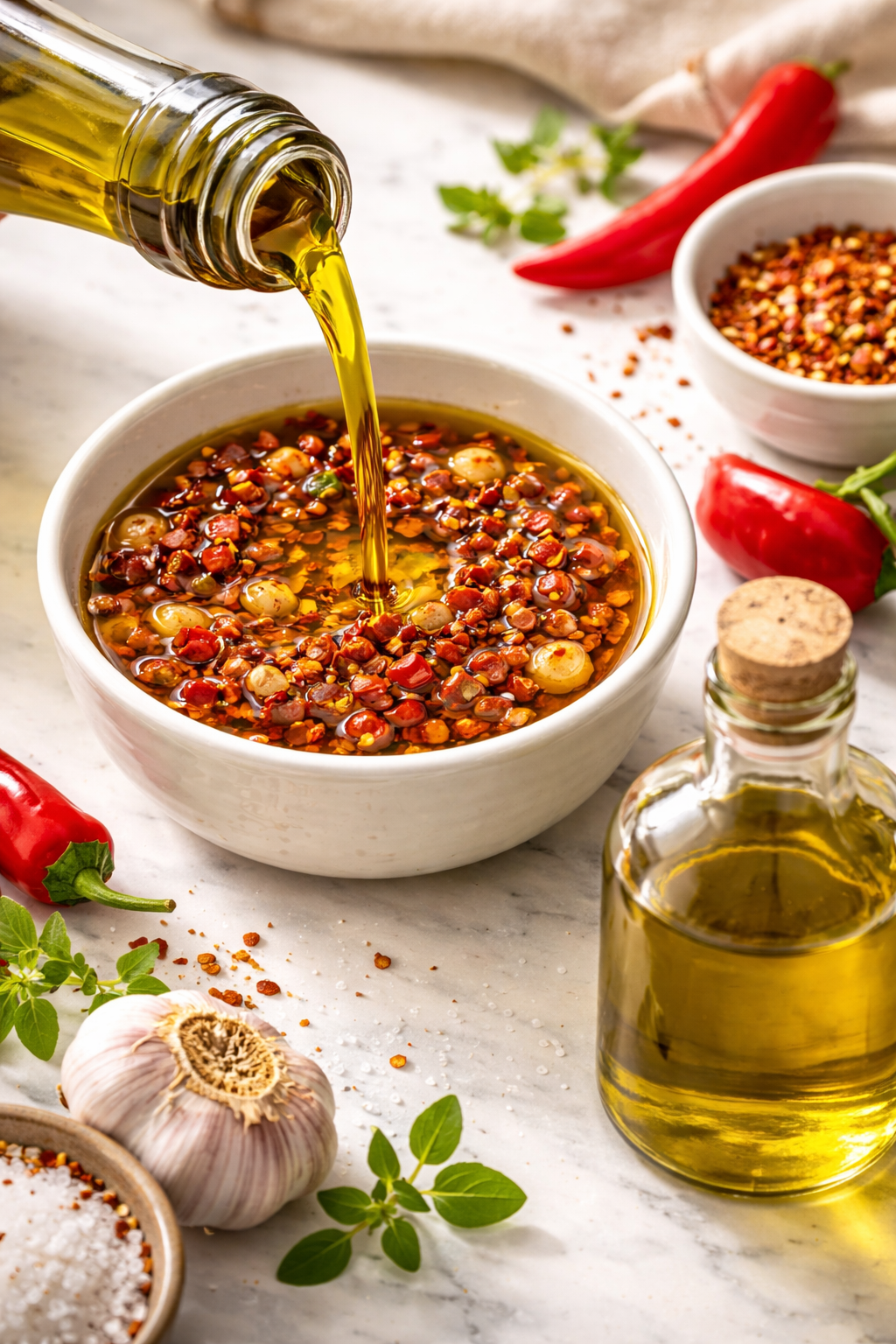
Olive oil is uncommon in traditional Chinese chili crisp but increasingly common in Calabrian, Italian-style, and fusion products. Brands like Calabrian chili crisp producers use extra-virgin olive oil as their base, and several American craft brands have followed suit.
The flavor impact is significant. Extra-virgin olive oil brings grassy, peppery, sometimes buttery notes that fundamentally change what the chili crisp tastes like. It’s not a neutral carrier — it’s a declared ingredient with its own agenda. In Calabrian-style products, the olive oil and the chili work together in a way that’s distinctly Mediterranean. On pizza, bruschetta, or pasta, this makes perfect sense. On steamed dumplings or congee, it might feel out of place.
Nutritionally, extra-virgin olive oil is widely considered one of the healthiest cooking fats. A tablespoon delivers about 120 calories and 14 grams of fat, with roughly 10 grams of monounsaturated fat (primarily oleic acid), 1.5 grams of polyunsaturated fat, and 2 grams of saturated fat. It’s rich in polyphenols — antioxidant compounds that have been linked to reduced inflammation and cardiovascular benefits in numerous studies.
The catch is the smoke point. Extra-virgin olive oil sits around 375–410°F, which is lower than the temperatures used in traditional chili crisp frying. This means olive oil-based products either use a different production method (lower-temperature infusion) or sacrifice some of the crispiness that comes from high-heat frying. Some producers address this by frying the crispy bits in a neutral oil first, then finishing and jarring in olive oil.
Peanut Oil
Peanut oil occupies an interesting middle ground — it’s not fully neutral, but it’s not aggressively flavored either. Refined peanut oil has a subtle nuttiness that complements the fried garlic and sesame seeds common in chili crisp. It’s widely used in Chinese cooking for deep-frying because of its high smoke point (about 450°F refined) and its ability to produce crispy results.
You won’t see peanut oil as the base in many commercial chili crisps, partly because of allergy concerns — peanut is a major allergen, and using it as the primary oil limits the product’s market. But in homemade chili crisp and in some smaller-batch products, peanut oil is a popular choice. It fries beautifully, carries flavor well, and adds a warmth that soybean oil doesn’t. Red Clay’s Southern Crisp is one example — a peanut oil-based chili crisp from South Carolina where the oil’s subtle nuttiness works alongside peanut chunks, fried garlic, and Fresno chilies for a distinctly Southern take on the category.
Nutritionally, peanut oil contains about 120 calories per tablespoon, with a fat profile that leans toward monounsaturated: roughly 6.5 grams monounsaturated, 4.5 grams polyunsaturated, and 2.5 grams saturated. It also contains vitamin E and phytosterols, which may support cholesterol management.
Less Common and Emerging Oils in Chili Crisp
The chili crisp market is evolving fast, and craft producers are experimenting with oils that would have seemed unusual even five years ago. Some of these are genuinely interesting. Others are marketing gimmicks. Here’s how to tell the difference.
Avocado Oil
Avocado oil has quietly become the prestige base oil in premium chili crisp. It has the highest smoke point of any plant oil — around 480–520°F refined — which means it handles the high-heat frying phase of production without breaking down. It’s rich in monounsaturated fats (about 10 grams per tablespoon) and oleic acid, the same heart-healthy compound found in olive oil. And it’s nearly neutral in flavor, which lets the chilies and aromatics lead.
The downside is cost. Avocado oil is significantly more expensive than soybean or canola, which is why you’ll mostly see it in premium, small-batch products rather than mass-market jars. If a $15 jar of chili crisp lists avocado oil as its base, the price starts to make more sense. It’s not just a markup — the ingredient costs more.
Nutritionally, avocado oil has one of the cleanest fat profiles of any cooking oil: high in monounsaturated fats, low in saturated fats, and containing some naturally occurring vitamin E. It’s one of the few oils that can be consumed raw without processing, which speaks to its inherent stability.
Grapeseed Oil
Grapeseed oil is showing up in newer, health-conscious chili crisp brands. It’s a byproduct of winemaking — the oil is extracted from grape seeds after pressing — and it has a light, clean flavor with a smoke point around 420°F. It’s high in vitamin E and polyunsaturated fats, though the high omega-6 content means it’s not universally celebrated by nutritionists.
In chili crisp, grapeseed oil behaves similarly to canola — neutral, clean, stays out of the way. The main selling point is perception: grapeseed sounds better on a label than soybean, and consumers associate it with higher quality. Whether the actual product tastes different is debatable. In my experience, the difference between grapeseed-based and canola-based chili crisps is negligible if the infusion is done well.
Sunflower Oil
Common in Eastern European and some Southeast Asian chili crisps, sunflower oil has a mild, slightly nutty flavor and a smoke point around 440–450°F. High-oleic sunflower oil — the variety bred for higher monounsaturated fat content — is nutritionally similar to olive oil without the strong flavor. It’s a solid middle-ground oil that doesn’t get much attention but does the job well.
On the nutrition label, standard sunflower oil is high in polyunsaturated fats (omega-6 heavy). High-oleic sunflower oil flips this, delivering mostly monounsaturated fats — about 10 grams per tablespoon — with very low saturated fat. If you spot “high-oleic sunflower oil” on a chili crisp label, that’s a producer who’s thinking about both flavor stability and fat profile.
Coconut Oil
Coconut oil-based chili crisps exist, but they’re rare and divisive. Refined coconut oil is nearly flavorless with a smoke point around 400°F, so it works technically. But unrefined (virgin) coconut oil carries a distinct coconut flavor that clashes with most chili crisp profiles. It’s also high in saturated fat — about 12 grams per tablespoon — which pushes the nutrition label in a direction that makes health-conscious consumers uncomfortable.
Where coconut oil does work is in Thai-inspired or Southeast Asian-style chili crisps where the coconut flavor complements the other ingredients — lemongrass, galangal, kaffir lime. In a Sichuan-style product, it would be bizarre.
Rice Bran Oil
This one’s a sleeper. Rice bran oil is widely used in Japanese and Southeast Asian cooking, and some Japanese-style chili crisps (taberu rayu) use it as a base. It has a high smoke point (around 450°F), a very mild flavor, and a nutritional profile that includes gamma-oryzanol — an antioxidant compound unique to rice bran that’s been studied for its cholesterol-lowering properties.
Rice bran oil produces exceptionally clean frying results, which is why it’s favored for tempura in Japan. In chili crisp, it creates a product with a lighter, less greasy feel than soybean oil. It’s an oil that most Western consumers haven’t encountered, but it’s worth knowing about if you see it on a label.
How Oil Affects the Nutrition Label
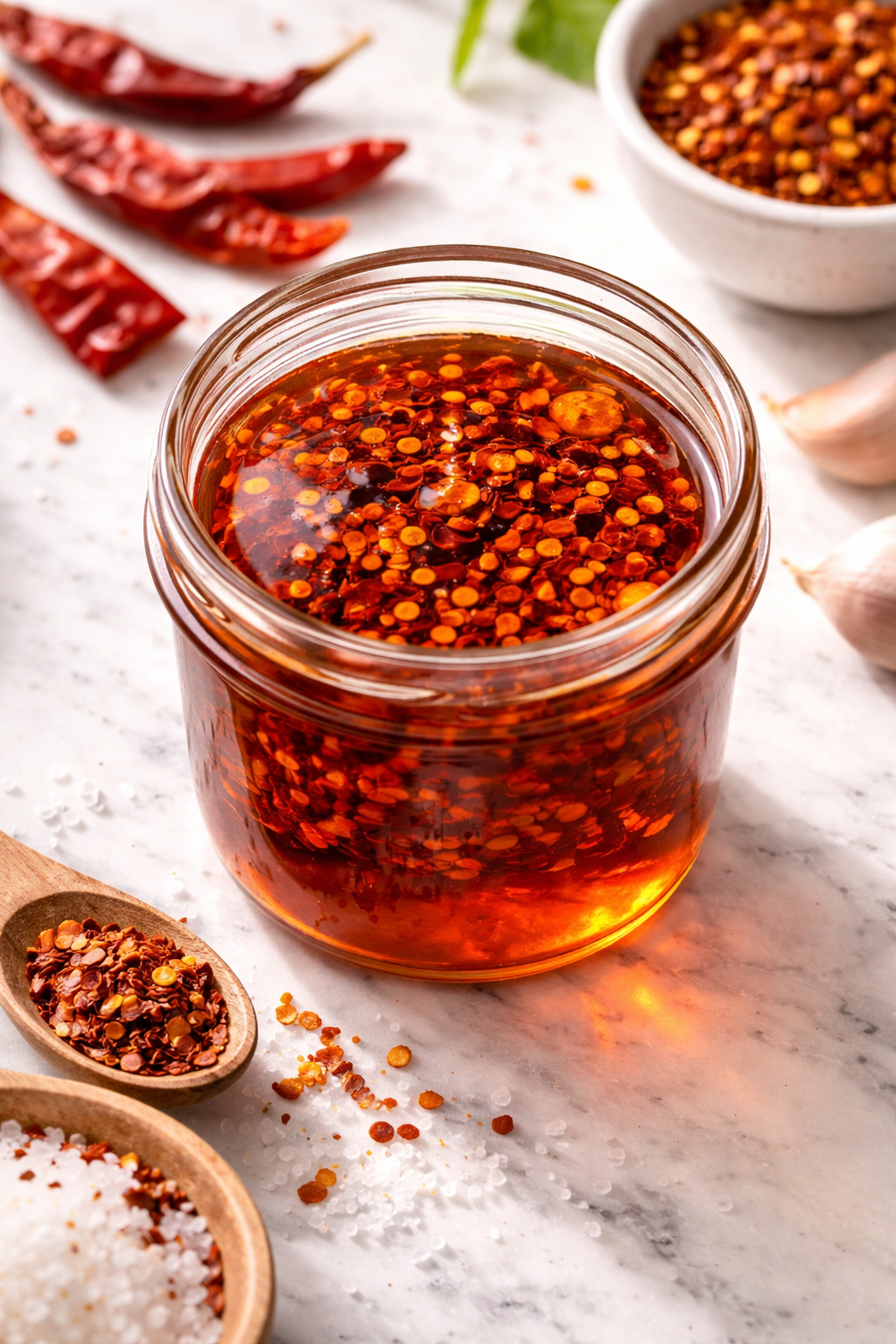
Since oil is the dominant ingredient in chili crisp, it drives the nutrition label almost entirely. Here’s what shifts depending on the oil type.
| Oil Type | Calories per Tbsp | Total Fat | Sat. Fat | Mono. Fat | Poly. Fat | Notable Compounds |
|---|---|---|---|---|---|---|
| Soybean | 120 | 14g | 2g | 3g | 8g | Vitamin E, high omega-6 |
| Canola | 124 | 14g | 1g | 9g | 4g | Some omega-3, vitamin E |
| Sesame (toasted) | 120 | 14g | 2g | 5.5g | 5.5g | Sesamin, sesamol (antioxidants) |
| Olive (extra-virgin) | 120 | 14g | 2g | 10g | 1.5g | Polyphenols, oleocanthal |
| Avocado | 124 | 14g | 2g | 10g | 2g | Oleic acid, vitamin E |
| Peanut | 120 | 14g | 2.5g | 6.5g | 4.5g | Phytosterols, vitamin E |
| Grapeseed | 120 | 14g | 1.5g | 2.5g | 10g | Vitamin E, high omega-6 |
| Coconut (refined) | 120 | 14g | 12g | 1g | 0.5g | Lauric acid (MCTs) |
| Rice Bran | 120 | 14g | 3g | 5g | 5g | Gamma-oryzanol, vitamin E |
| Sunflower (high-oleic) | 120 | 14g | 1g | 10g | 3g | Vitamin E |
A few things jump out from this table. All oils have essentially the same calorie count — that’s non-negotiable. Where they differ dramatically is in the type of fat. Olive, avocado, and high-oleic sunflower oils are dominated by monounsaturated fats, which are broadly associated with better cardiovascular outcomes. Soybean and grapeseed are heavy on polyunsaturated fats, particularly omega-6 fatty acids, which some nutritionists recommend limiting. Coconut oil is an outlier — almost entirely saturated fat.
In practical terms, a single serving of chili crisp (about 1 tablespoon, which is what most labels list) delivers a relatively small dose of any of these fats. The oil type matters more if you’re the kind of person who goes through a jar every week or two versus someone who uses a teaspoon occasionally. For heavy users, the difference between an olive oil-based product and a soybean-based one adds up over time.
Most chili crisp nutrition labels list the serving size as 1 tablespoon (about 15g). If you’re being honest with yourself, you probably use more than that. Two tablespoons — a more realistic serving for noodles or rice — means you’re doubling every number on that label. The oil type determines what those doubled numbers look like.
Oil-to-Solids Ratio: The Number That Tells You What You’re Buying
This is something I look at on every single jar before I open it. The oil-to-solids ratio — how much of the jar is liquid oil versus crispy bits and sediment — tells you more about a chili crisp than almost anything else on the label.
Here’s what different ratios typically mean:
| Oil-to-Solids Ratio | What You’re Getting | Typical Products |
|---|---|---|
| 80%+ oil | Closer to chili oil than chili crisp. Very few solids. | Budget products, some “chili oil” mislabeled as crisp |
| 65–75% oil | Standard. Good amount of oil with visible solids. | Lao Gan Ma, most mass-market brands |
| 50–65% oil | Chunky and condiment-forward. Lots of bits. | Fly By Jing, many craft/premium brands |
| Under 50% oil | Very dense. Almost a relish or paste texture. | Some salsa macha, thick-style products |
You can estimate the ratio before opening. Hold the jar up to a light source. The clear oil layer on top versus the settled solids on the bottom gives you a rough visual read. A jar where the oil goes three-quarters of the way up with a thin band of bits at the bottom is a very different product from one where the solids reach halfway or higher.
The ratio also affects how the nutrition label reads. More oil means more fat and calories per serving. More solids — garlic, chilies, peanuts, sesame seeds — means more protein, more fiber, more micronutrients from those whole ingredients. A high-solids product isn’t automatically better, but it is a different value proposition than an oil-dominant one.
How Oil Type Varies by Category
One of the things that makes evaluating chili-based condiments interesting is how different the oil story is across categories. If you’re reading labels across chili crisp, salsa macha, and chili oil, here’s what to expect.
In chili crisp, neutral oils dominate. Soybean, canola, and vegetable blends are the norm in Chinese-produced products. American craft brands are more likely to use sesame blends, avocado, or olive oil. The oil’s job in chili crisp is to carry the crispy bits and deliver the infused flavor — neutrality is traditionally preferred.
In salsa macha — Mexico’s oil-based chili condiment, originating in Veracruz — olive oil is more common than it would be in a Chinese chili crisp. Traditional salsa macha often uses a blend of neutral oil and a smaller amount of olive oil. Some modern producers have leaned into extra-virgin olive oil as a base, which gives the condiment a greener, grassier character. The oil in salsa macha is also cooking and blending with nuts (peanuts, pepitas, sesame) and dried Mexican chilies, which changes the extraction chemistry compared to Chinese chili crisp.
In chili oil — where the oil is the product — oil quality is the defining criterion. A great Chinese la you uses properly infused oil where the chilies, Sichuan peppercorns, and aromatics have genuinely steeped into the fat. Italian olio di peperoncino uses extra-virgin olive oil as both the base and the flavor. Korean gochugaru oil often features toasted sesame as a significant component. The regional varieties of chili oil each have their own oil tradition, and if you want to cook with chili oil, understanding the base oil’s smoke point matters even more.
Infused Oil vs. Oil That Just Carries Solids
This is a distinction that separates good chili crisp from great chili crisp, and most people never think about it.
In a well-made product, the oil itself is flavorful. It’s been heated with aromatics — star anise, cinnamon, Sichuan peppercorn, ginger, garlic — and those compounds have dissolved into the fat. When you drizzle just the oil (no bits) onto warm rice, it should taste like something. It should have color, aroma, and depth.
In a poorly made product, the oil is just a vehicle. It’s heated up, the bits are dumped in, and the jar is sealed. The oil tastes flat. All the flavor lives in the solid pieces, and the oil is just greasy, orange-tinted filler.
You can test this yourself: next time you open a jar of chili crisp, dip a clean spoon into the oil layer (avoid the bits) and taste it alone. If the oil has flavor — warmth, nuttiness, a hint of Sichuan buzz, roasted garlic — you’ve got a well-infused product. If it tastes like nothing with a vague chili tint, the producer rushed the infusion.
This matters for the label-reading skills covered elsewhere on this site. A short ingredient list with a quality oil that’s been properly infused will outperform a long ingredient list where the oil is an afterthought every single time. Redbloom’s Umami chili crisp is a good example — the infused avocado oil is excellent on its own, but the bits don’t hold up their end.
Smoke Points and Production Quality
Smoke point — the temperature at which an oil begins to break down and produce visible smoke — matters more during production than it does in your kitchen. But it has a direct impact on what ends up in the jar.
During chili crisp production, oil is heated to fry the crispy bits (garlic, shallots, chilies) and to extract flavor from aromatics. This typically happens at 250–375°F, depending on the method. Oils with smoke points well above this range — soybean at 450°F, avocado at 520°F, peanut at 450°F — handle this phase without degrading. Oils with lower smoke points — toasted sesame at 320°F, unrefined olive oil at 375°F — are more vulnerable to breaking down during production, which can introduce off-flavors.
This is why most producers use neutral, high-smoke-point oils for the frying step, then add flavorful oils like sesame or olive after the heat phase. It’s a smart approach: you get the crispy results from high-heat frying and the flavor complexity from the finishing oil. If a product uses toasted sesame oil as its sole production oil, the producer either kept temperatures very carefully controlled or the oil may have degraded somewhat during cooking.
What I Look For: Oil Quality Signals on a Label
After testing dozens of chili crisps, I’ve developed a shorthand for evaluating oil quality from the label alone — before I ever open the jar.
Good signals: A named oil (not generic “vegetable oil”). Sesame listed as a secondary or finishing oil. Olive oil in a Mediterranean-style product. Avocado oil in a premium product where the price justifies it. Two or more oils listed (often means a blend was chosen deliberately for flavor rather than cost alone).
Neutral signals: Soybean or canola as the sole oil. This is standard and not a red flag — it just means the oil isn’t a differentiator for this product. The chilies and bits need to do the heavy lifting.
Caution signals: “Vegetable oil” with no further specification on an imported product. Palm oil listed as the primary base (cheaper than soybean, can leave a waxy residue). Cottonseed oil appearing high on the list (common in very budget products, unremarkable flavor, and nutritionally less favorable than canola or soybean).
None of these signals are automatic deal-breakers. A soybean oil-based chili crisp with a great infusion and quality bits will outperform an avocado oil-based product with lazy production any day. But the oil tells you where the producer chose to invest — and where they chose to cut costs.