
This post contains affiliate links. I may earn a small commission if you buy through them — at no extra cost to you. My scores are never influenced by this.
TL;DR: GUIZ wins this one, and it’s not close. More solids, more crunch, more flavor complexity, more jar for the money. GUIZ Original earns EXCELLENT; Fly By Jing Original earns GOOD in this head-to-head. If you’re picking one original chili crisp to keep in your kitchen, GUIZ is the jar.
Two original chili crisps. Two completely different philosophies. GUIZ builds its jar around Guizhou chili peppers, peanuts, and a fermented base that includes broad bean paste and cooking wine. Fly By Jing builds its jar around three different oils, dried chili pepper, and fermented soybean with mushroom and seaweed powder in the background. Both are called “original.” Both are marketed to the same chili-crisp-curious American buyer. One of them delivers a significantly better product.
I reviewed GUIZ Original and Fly By Jing Original individually — this GUIZ vs Fly By Jing chili crisp comparison puts them side by side on every axis that matters: ingredients, settlement, flavor, heat, crunch, value, and which one I’d buy again. If you’re new to chili crisp, this is the comparison that tells you where to start.
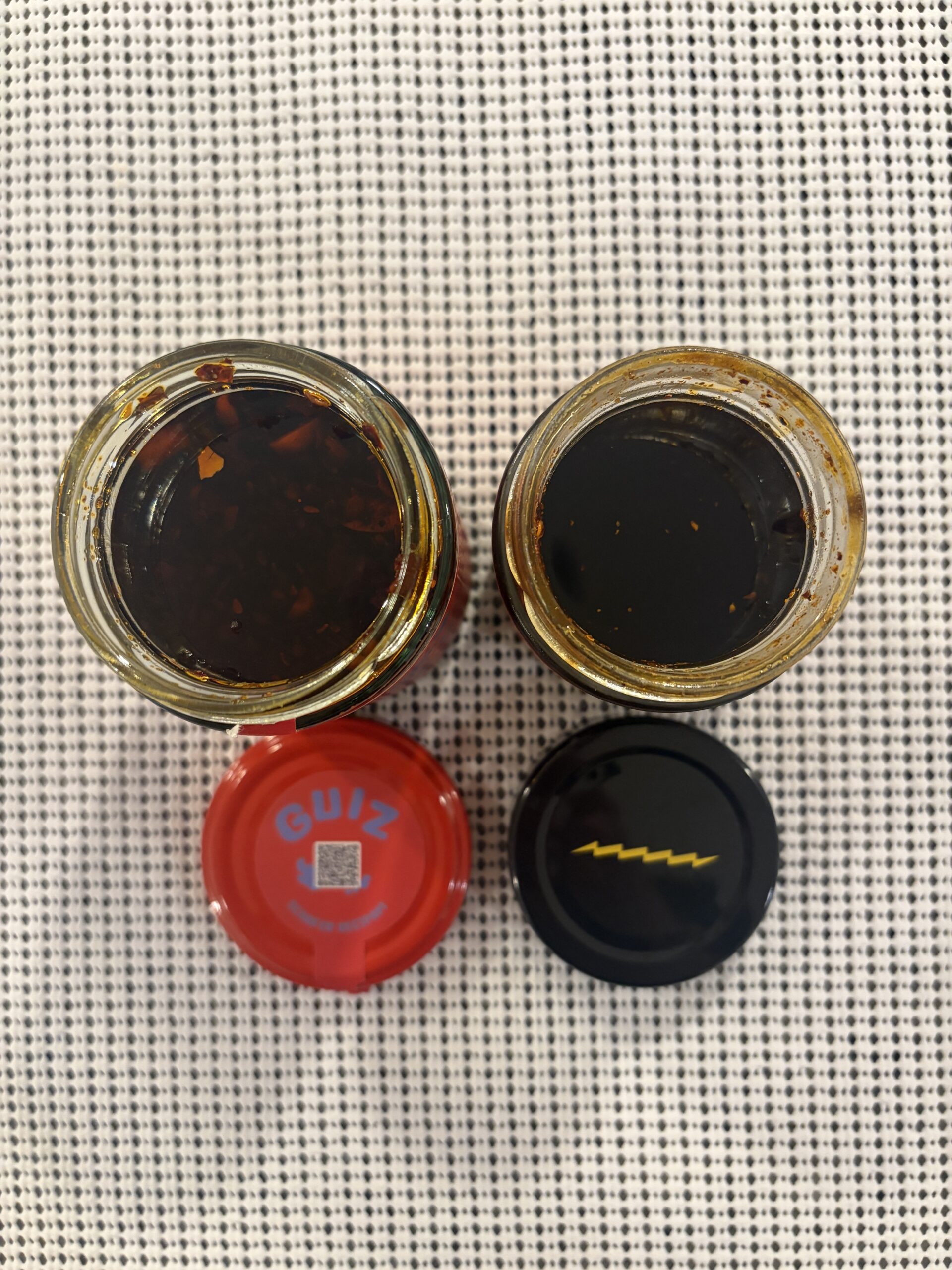 Fly By Jing chili crisp jars side by side — Flavor Index Lab” />
At a Glance
GUIZ vs Fly By Jing Chili Crisp Comparison Table
Tiers reflect in-context comparison performance. Individual review tiers may differ.
| GUIZ Original | Fly By Jing Original | |
|---|---|---|
| Category | Chili Crisp | Chili Crisp |
| Size | 8.11 oz | 6 oz |
| Price | $11.98 ($1.48/oz) | $11.98 ($2.00/oz) |
| Oil Type | Non-GMO soybean oil (1 oil) | Rapeseed + soybean + sesame (3 oils) |
| Key Ingredients | Guizhou chili, peanuts, broad bean paste, cooking wine | Dried chili, fermented soybean, mushroom powder, seaweed powder |
| Heat | 4/5 — Dual-track chili + Sichuan peppercorn | 3/5 — Peppercorn-forward, moderate burn |
| Crunch | Strong — peanuts, sesame, chili flakes | Minimal — small bits, mostly oil-softened |
| Settlement | ~90% solids | ~50-60% solids |
| Sugar | Yes (low, near end of list) | No |
| Refrigeration | No | Yes (after opening) |
| Tier | EXCELLENT | GOOD |
The Oil Question: One Oil vs. Three
The first thing that jumps off Fly By Jing’s ingredient list is the oil situation. The first two ingredients are rapeseed oil and non-GMO soybean oil. Then sesame oil shows up later. Three different oils making up the base of one chili crisp. GUIZ uses one: non-GMO soybean oil. That’s it.
Three oils isn’t automatically a problem — but it tells you where the product’s weight is going. When your first two ingredients are both oils, you’re building a product that is fundamentally an oil with things in it. GUIZ’s first ingredient is oil, but its second is Guizhou chili pepper and its third is peanuts. The weight of the jar is going to solids, not liquid. You can see this difference before you even open the lids.
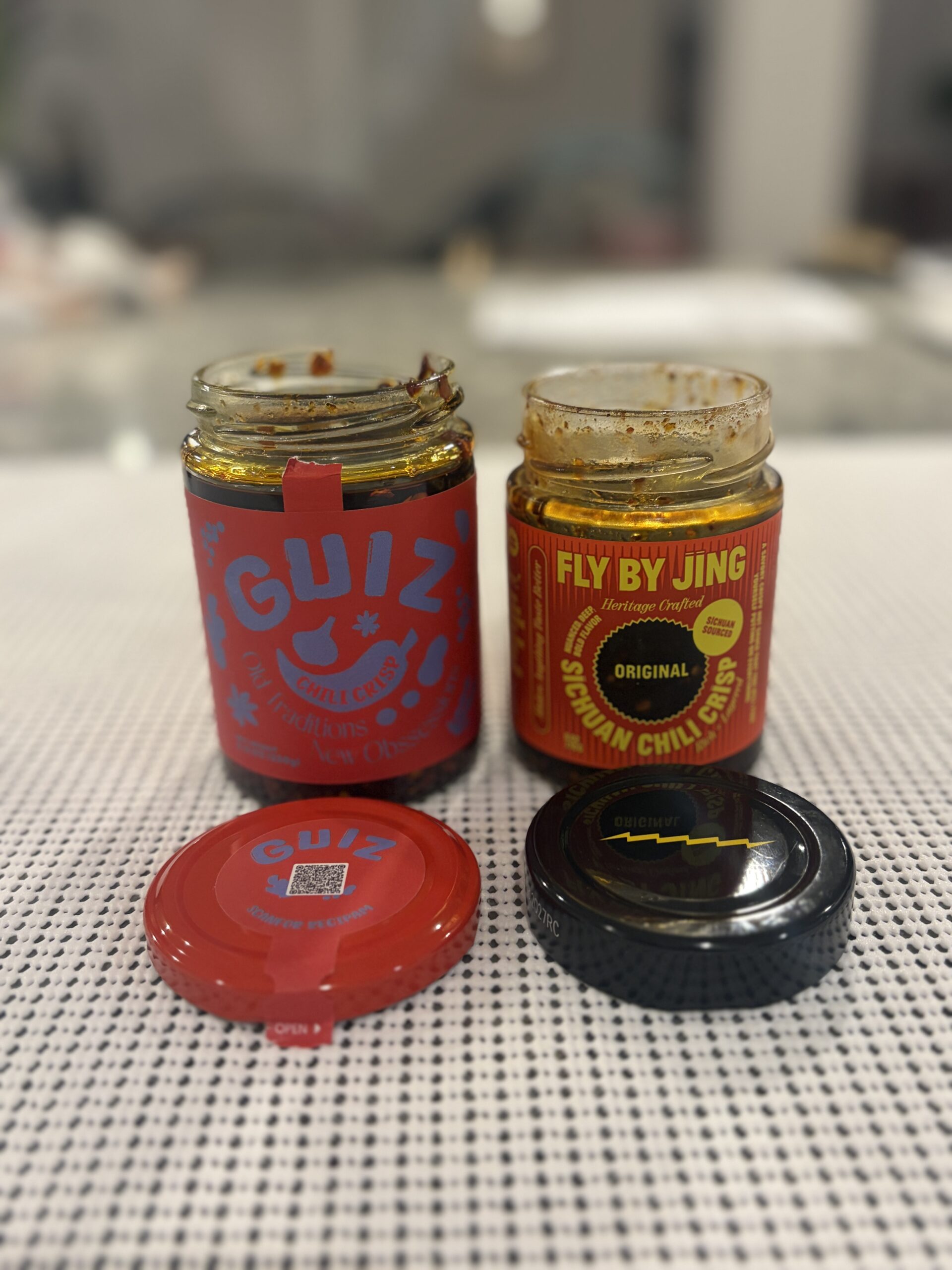
Fly By Jing’s triple-oil base does create a richer, darker oil character — the sesame especially adds a toasted depth you can taste on its own. But the trade-off is that you’re paying $2.00 per ounce for a jar where most of that weight is oil. GUIZ’s oil is simpler, cleaner, and it’s carrying garlic and ginger flavors from the infusion without needing three different fat sources to create complexity. The oil is doing a job, not performing a role.
Settlement & Density
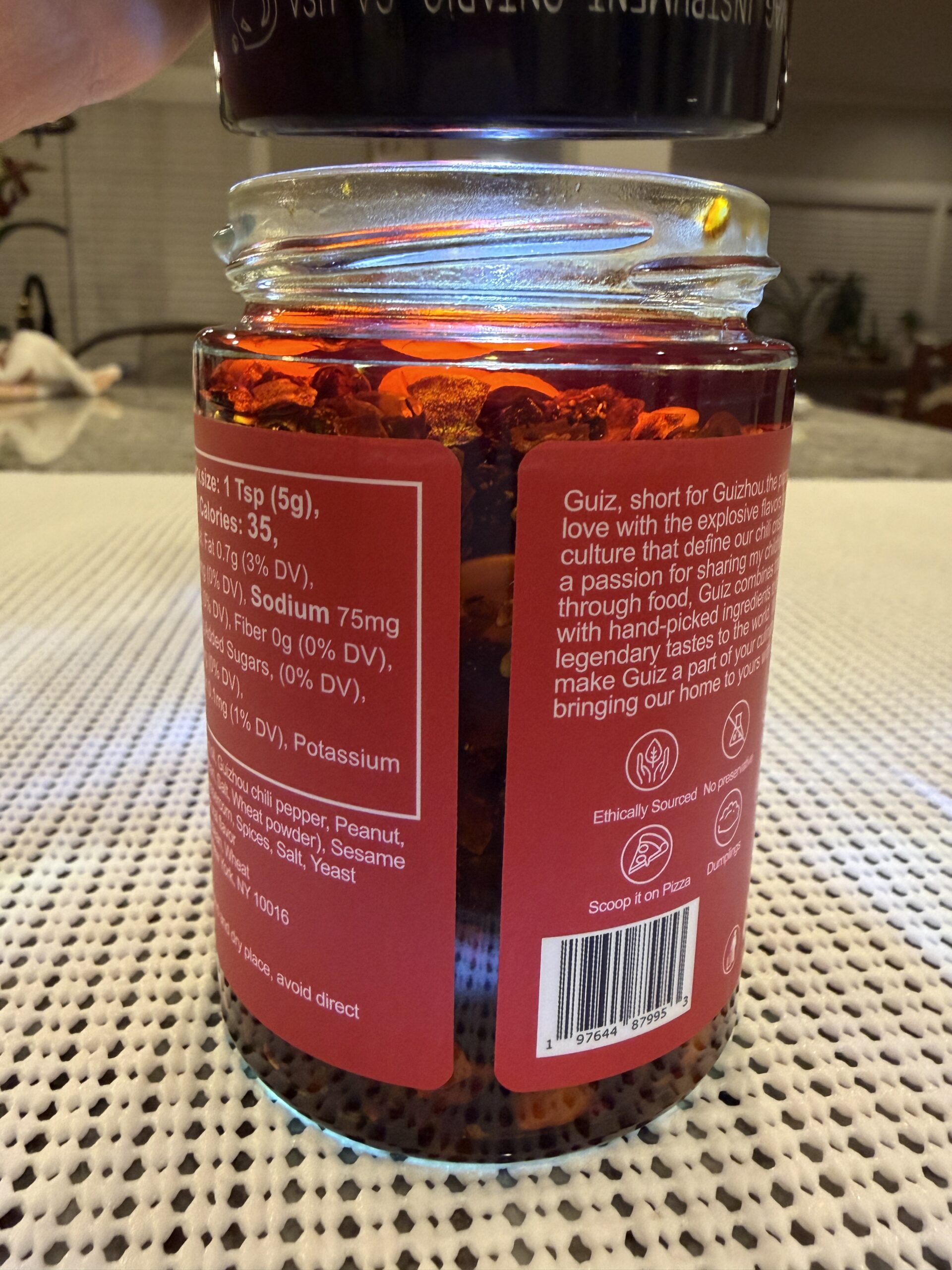
This is where the comparison stops being close. GUIZ settles at roughly 90% solids. Open the jar and you’re looking at peanuts, chili flakes, sesame seeds, and bits suspended in clear, orangish-red oil. You can see individual ingredients through the oil. The jar looks full because it is full.
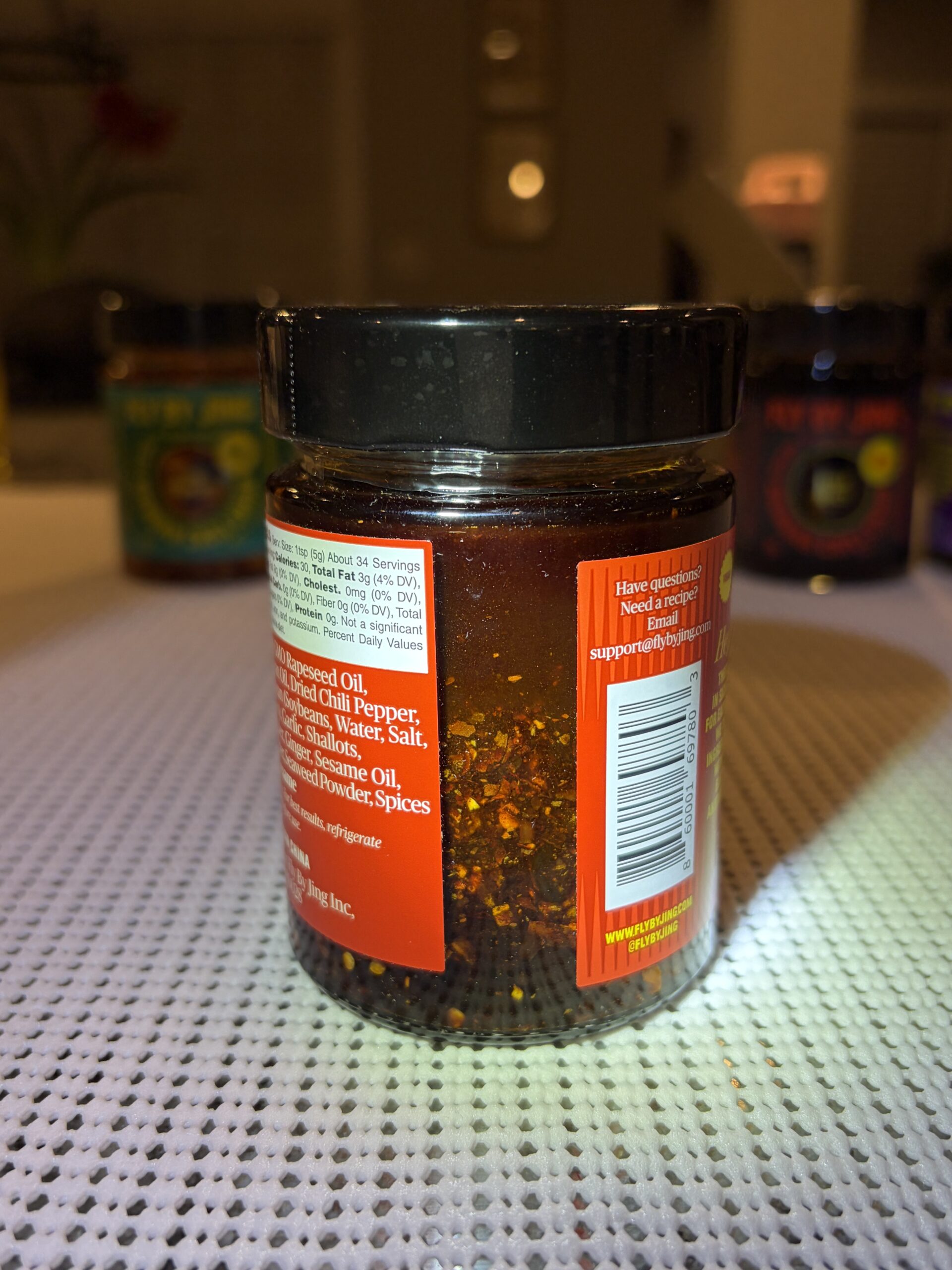
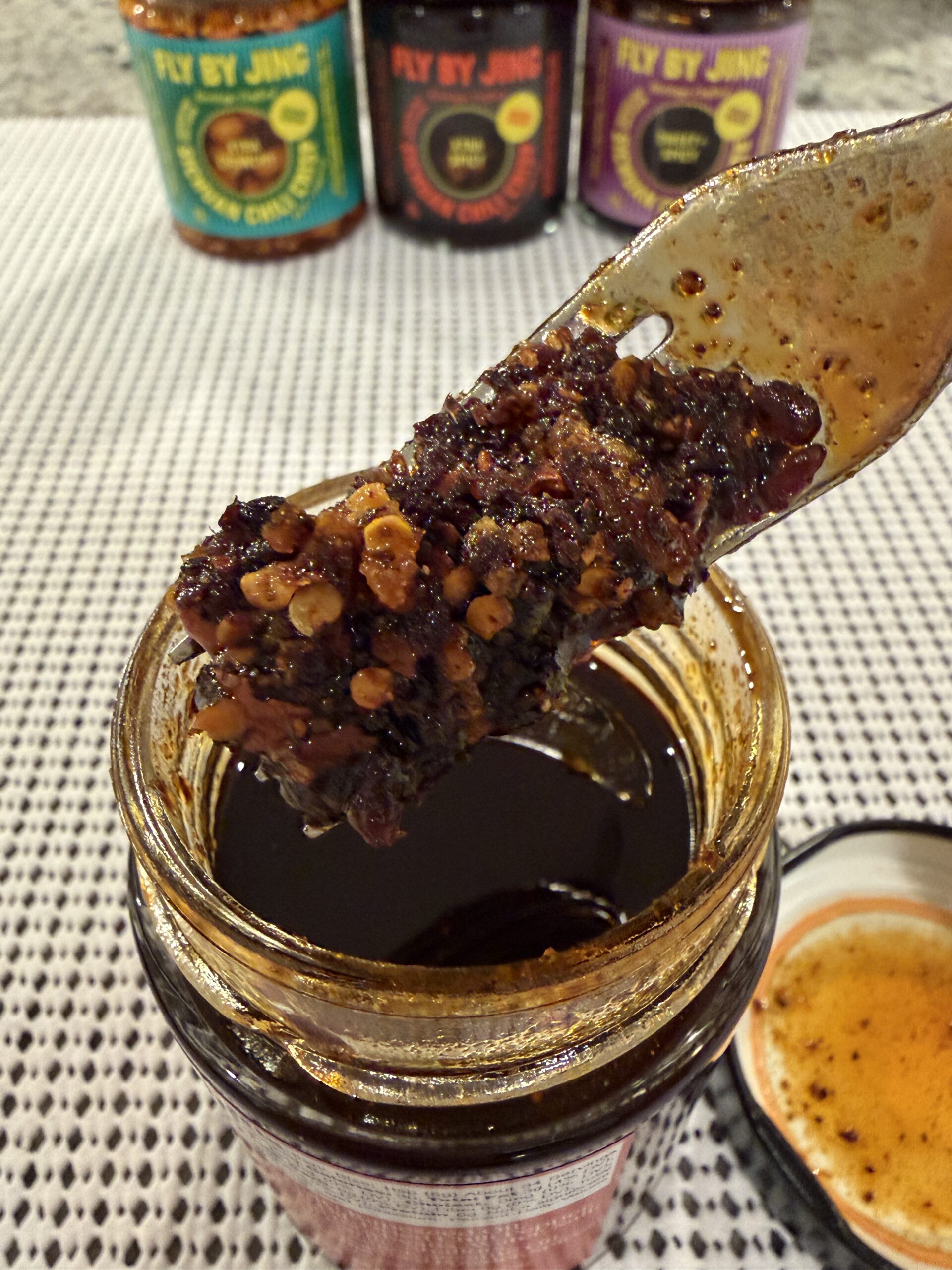
Fly By Jing settles at 50-60% solids on a good day. Looking down into the jar, you can’t see the bits — the dark oil from the sesame and rapeseed blend sits on top and obscures everything underneath. It’s not that there are zero solids. There are. But they’re small, and they’re low in the jar, and there aren’t nearly enough of them relative to the oil volume.
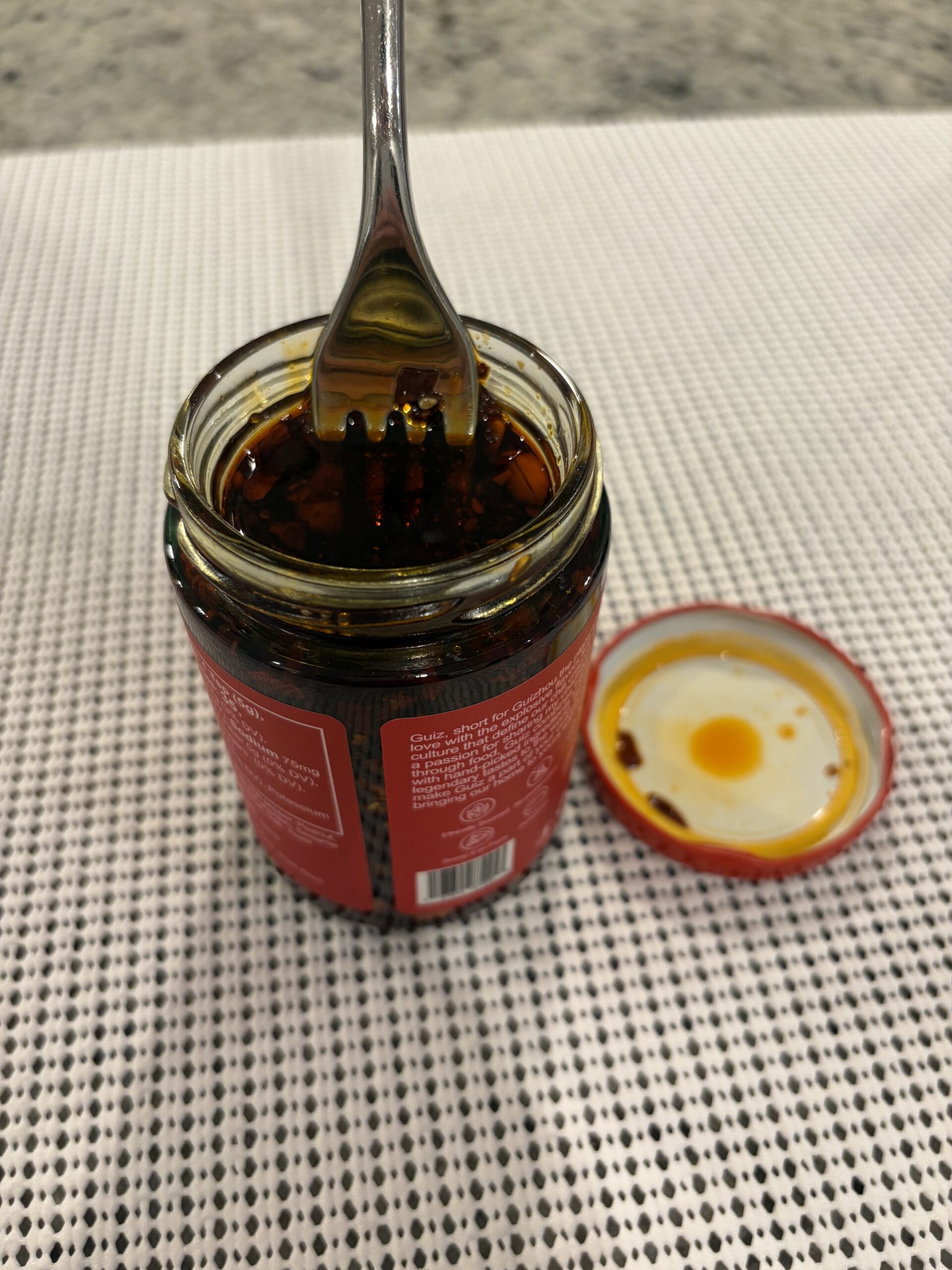
The fork test makes it even more obvious. In the GUIZ jar, the fork doesn’t sink before stirring — it sits on top of the packed solids. After stirring, the fork comes up loaded with distinct pieces: peanut chunks, chili flakes, sesame seeds clinging to the tines. In the Fly By Jing jar, the fork drops through the oil and reaches the bottom easily. What comes up on the fork is smaller, sparser, and coated in dark oil rather than surrounded by visible ingredients.
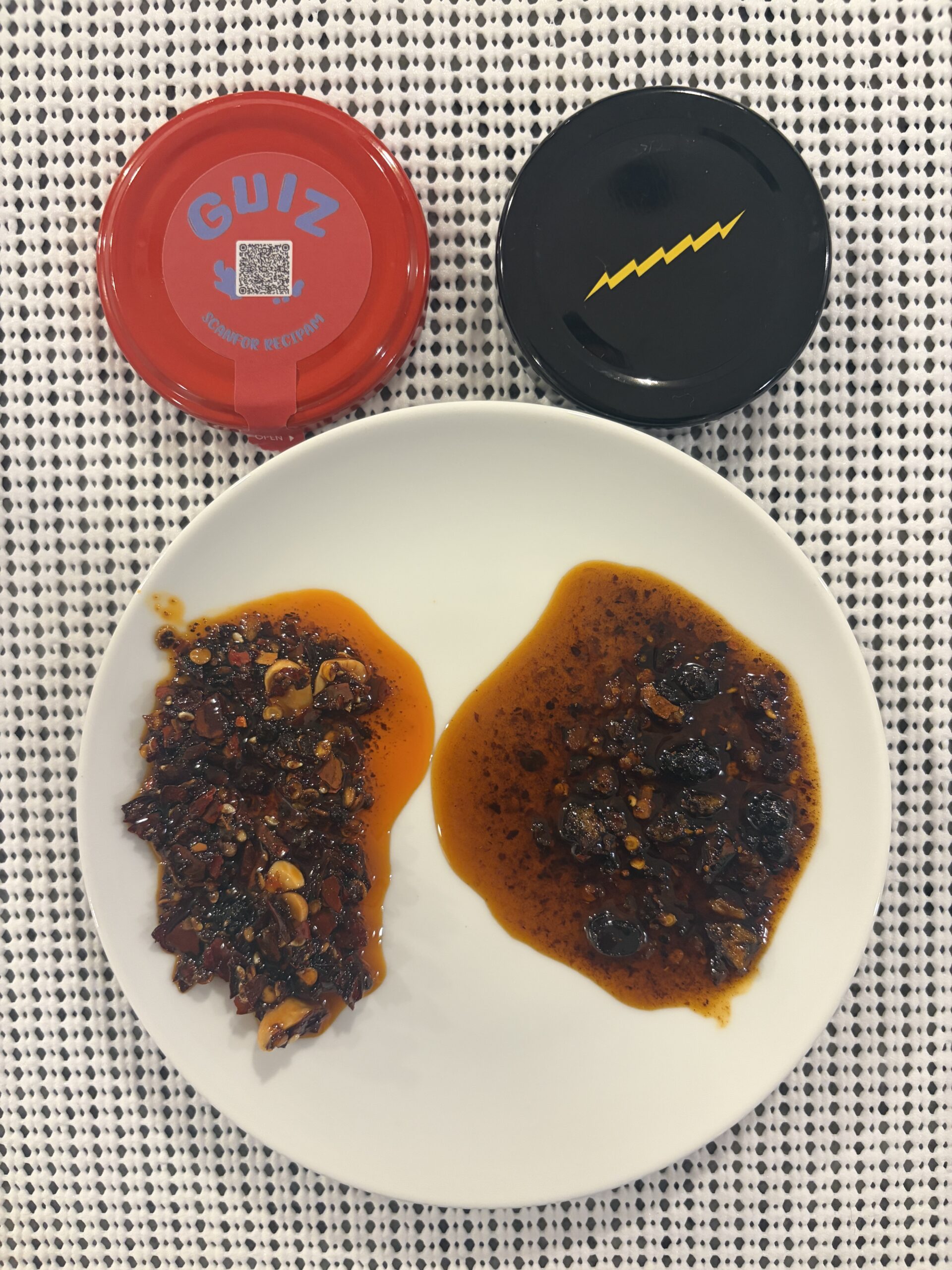
Settlement is the single most important visual indicator of what you’re paying for. At $2.00 per ounce, Fly By Jing is asking premium pricing for a jar that’s half oil. At $1.48 per ounce, GUIZ is charging less for a jar that’s almost entirely solids. The math doesn’t favor Fly By Jing on any reading.
Ingredients Side by Side
| Position | GUIZ Original | Fly By Jing Original |
|---|---|---|
| 1st | Non-GMO soybean oil | Rapeseed oil |
| 2nd | Guizhou chili pepper | Non-GMO soybean oil |
| 3rd | Peanuts | Dried chili pepper |
| 4th | Broad bean paste (doubanjiang) | Fermented soybean |
| 5th+ | Sesame seeds, ginger, garlic, Sichuan peppercorn, spices, salt, yeast extract, cooking wine, sugar, natural flavor | Sesame, ginger, garlic, mushroom powder, sesame oil, salt, Sichuan pepper, seaweed powder, spices |
The ingredient lists tell two different stories. GUIZ front-loads its solids: oil first, then immediately chili pepper and peanuts — the two ingredients that define the eating experience. By the third ingredient, you already know what GUIZ is about. Fly By Jing front-loads its oils: rapeseed and soybean oil hold the first two positions. Dried chili doesn’t show up until third. The jar’s identity is built on its oil base first, its solids second.
GUIZ also includes broad bean paste (doubanjiang) in the fourth position — a fermented ingredient that adds depth and funk without needing to rely on mushroom or seaweed powder. The cooking wine adds a sharpness that doesn’t exist in Fly By Jing’s profile at all. Fly By Jing leans on mushroom powder and seaweed powder for its umami layer, which works differently: it’s a quieter, more background savory presence rather than the forward fermented character that GUIZ delivers.
Neither jar lists MSG as an ingredient. Both are getting their savory depth from actual fermented and dried ingredients rather than from an MSG shortcut. That’s a point in both columns — and it separates both of them from Lao Gan Ma, which leans hard on MSG for its savory punch.
Flavor Profiles
GUIZ: Layered, Crunchy, and Forward
GUIZ hits you with a sequence. The oil carries garlic and ginger on first contact. Then the chili pepper arrives — not just heat, but actual chili flavor, the dried-roasted character of Guizhou peppers that smells as good as it tastes. Peanut crunch lands right behind it, and you’re chewing through something substantial while the Sichuan peppercorn starts its tingling work across your lips and tongue. The broad bean paste and cooking wine add a fermented funk underneath that you taste through the crunch. Every bite has a beginning, a middle, and a lingering end. Full review here.
Fly By Jing: Oil-Forward with Depth Underneath
Fly By Jing leads with oil — and that oil is doing real work, carrying sesame warmth and a light toasted quality. But after the oil impression, you hit saltiness and peppercorn funk almost simultaneously. The fermented soybean and mushroom powder create a quiet umami layer that sits beneath the salt and heat. The bits are small — you don’t get the crunch event that GUIZ delivers. You get a few bean chunks, some chili flake texture, but it’s mostly an oil-and-flavor experience rather than an oil-and-crunch one. The flavors are good. They’re just buried under oil and not distributed across enough solid material to give you a full bite. Full review here.
The Differentiator: Volume and Distribution
The main difference between these two jars isn’t a single flavor note — it’s how much flavor you get on every forkful and how that flavor is delivered. GUIZ gives you something across the entire bite as you’re chewing. The peanuts carry the crunch, the chili flakes carry the heat, the sesame seeds add nuttiness, and the oil ties it together. Fly By Jing gives you a quick shot of saltiness and peppercorn with some good flavors hiding deeper down, but you have to work through a lot of oil to find them. Tasting both side by side without food, GUIZ delivers noticeably more flavor per bite. That’s the gap.
Heat Comparison
Both jars use Sichuan peppercorn, but the heat experience is different. GUIZ runs a dual-track system: the Guizhou chili peppers bring a straight burn while the Sichuan peppercorn adds numbing and tingling on top. The two heat types layer on each other and create a fuller sensation — your mouth is working through burn and tingle simultaneously. I rate GUIZ a 4 out of 5 on heat. It sticks around for several minutes after you stop eating.
Fly By Jing’s heat is peppercorn-forward. The Sichuan pepper drives most of the heat experience, with the dried chili adding a background warmth that doesn’t hit as hard as GUIZ’s Guizhou pepper. It’s a 3 out of 5 — medium, comfortable, not intimidating. The heat builds and fades faster than GUIZ’s lingering burn. If you want to actually feel the spice, GUIZ is the jar. If you want just enough warmth to remind you the chili crisp is there, Fly By Jing gets the job done.
Which One for What
| Situation | Reach For |
|---|---|
| You want crunch on rice, noodles, or eggs | GUIZ — peanuts and sesame do the work |
| You want a smooth, oil-forward condiment for drizzling | Fly By Jing — the triple-oil base works best here |
| You want heat that lingers | GUIZ — dual-track chili + peppercorn |
| You want a milder option for cautious eaters | Fly By Jing — approachable medium heat |
| You want the most stuff in the jar for the price | GUIZ — 90% solids at $1.48/oz |
| You need something allergen-friendly (no nuts, no wheat) | Fly By Jing — free of top 9 allergens |
| Pizza, avocado toast, grain bowls | GUIZ — crunch adds to casual foods |
| Dumplings, noodle soup, congee | Either — both work, GUIZ adds texture, FBJ adds oil richness |
| You want to cook with the oil | Fly By Jing — more oil to work with, toasted sesame flavor |
Value & Verdict
Here’s the part that makes this comparison even more lopsided. Both jars sell for $11.98 on Amazon. But GUIZ gives you 8.11 ounces — that’s $1.48 per ounce. Fly By Jing gives you 6 ounces — $2.00 per ounce. You’re paying 35% more per ounce for a jar that has fewer solids, less crunch, and a lower settlement ratio. The solids-to-price math isn’t just unfavorable for Fly By Jing — it’s disqualifying at this price point.
Fly By Jing is a good chili crisp. The oil is interesting, the mushroom and seaweed powder create a savory background that’s unique in the market, and the brand has done more than anyone to bring Sichuan-style condiments to American kitchens. That matters. But when you put both originals side by side and evaluate them on what’s in the jar — not on the brand story, not on the marketing, not on the B Corp certification — GUIZ is the better product by a clear margin.
GUIZ Original on Amazon ($11.98) | Fly By Jing Original on Amazon ($11.98)
GUIZ Original: EXCELLENT — The more complete jar. More crunch, more flavor, more solids, better value. If you’re choosing one original chili crisp, this is it.
Fly By Jing Original: GOOD — A good product with a strong oil character and a unique savory profile. Worth trying, especially if you need something allergen-friendly or want to cook with the oil. But at this price, GUIZ gives you more of everything that makes chili crisp worth buying.
Frequently Asked Questions
Is GUIZ chili crisp better than Fly By Jing?
In a side-by-side comparison, GUIZ Original outperforms Fly By Jing Original on crunch, flavor complexity, settlement (90% solids vs. 50-60%), and value per ounce ($1.48 vs. $2.00). Fly By Jing has a richer oil character and is allergen-friendly (no peanuts or wheat). For most buyers looking for a classic chili crisp experience, GUIZ is the better jar.
Why is Fly By Jing so expensive compared to GUIZ?
Both jars sell for $11.98 on Amazon, but Fly By Jing contains 6 oz ($2.00/oz) while GUIZ contains 8.11 oz ($1.48/oz). That’s a 35% price premium per ounce for Fly By Jing. The smaller jar size and lower solids-to-oil ratio mean you’re getting less product and fewer crunchy bits for a higher per-ounce cost.
Which chili crisp has more crunch — GUIZ or Fly By Jing?
GUIZ Original has significantly more crunch. Peanuts, sesame seeds, and chili flakes fill roughly 90% of the jar. Fly By Jing’s bits are smaller, sparser, and often oil-softened. If crunch is what you’re after, GUIZ is the clear choice.
Is Fly By Jing chili crisp worth buying?
Yes, with caveats. Fly By Jing Original is a good chili crisp with a unique oil character (three oils including sesame) and a savory profile from mushroom and seaweed powder. It’s also free of the top 9 allergens, which matters for some buyers. But at $2.00 per ounce with a lower solids ratio, it’s a harder value proposition than GUIZ at $1.48 per ounce.
Do GUIZ and Fly By Jing use MSG?
Neither jar lists MSG as an ingredient. GUIZ gets its savory depth from broad bean paste (doubanjiang), cooking wine, and yeast extract. Fly By Jing uses fermented soybean, mushroom powder, and seaweed powder. Both achieve umami through fermented and dried ingredients rather than added MSG.
Does Fly By Jing chili crisp need to be refrigerated?
Yes — Fly By Jing requires refrigeration after opening. GUIZ does not require refrigeration and has a 12-month shelf life stored in a cool, dry place. This is a practical advantage for GUIZ if fridge space is limited or if you use chili crisp at room temperature.
Which original chili crisp should I buy first — GUIZ or Fly By Jing?
Start with GUIZ Original. It delivers more crunch, more flavor complexity, better settlement, and a lower price per ounce. It’s the more complete chili crisp experience. If you’ve already tried GUIZ and want something with a different oil character or need an allergen-friendly option, Fly By Jing Original is worth trying as a second jar.