
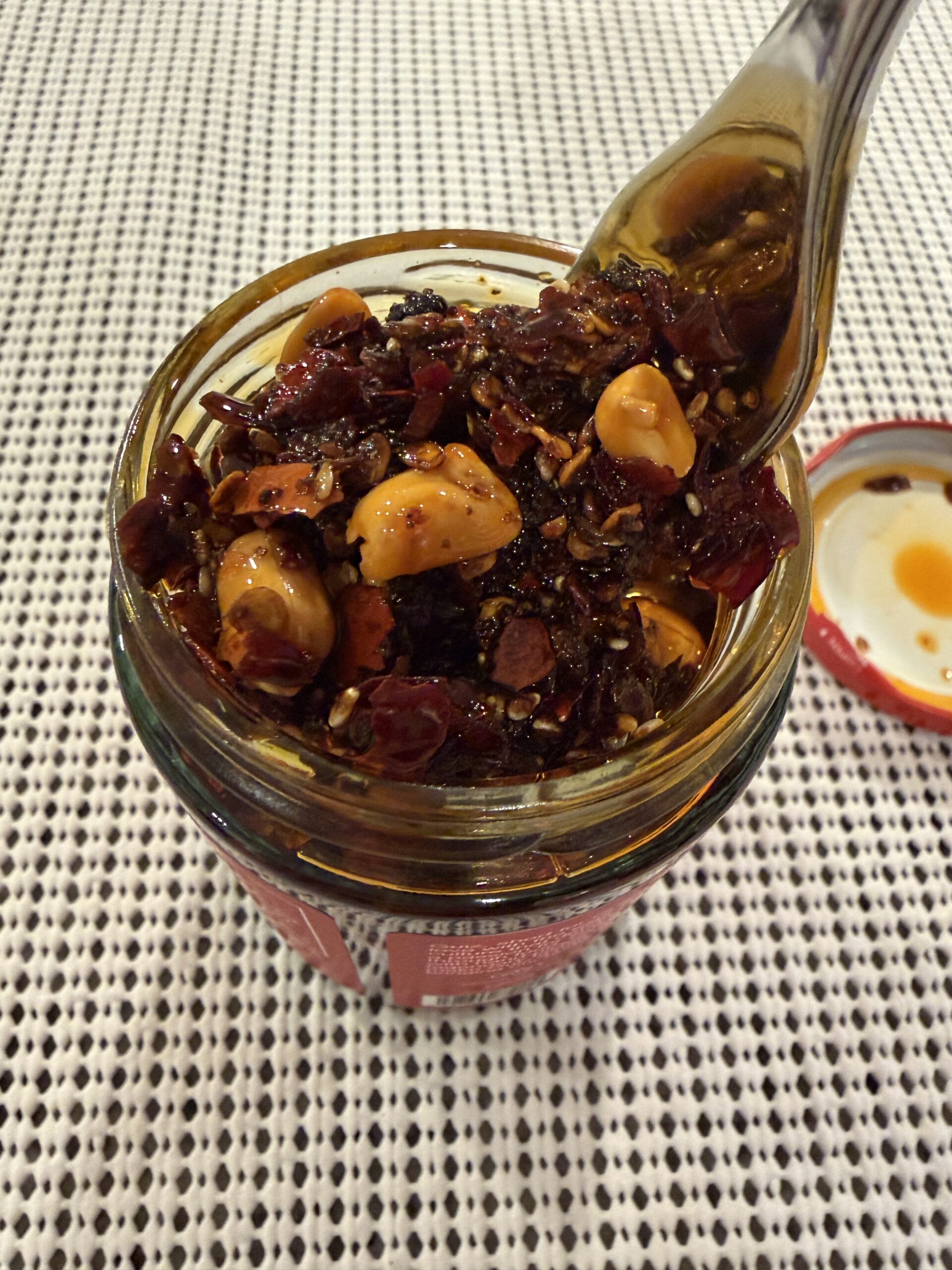
If you’ve ever wondered what are the bits in chili crisp — and whether they actually matter — I can answer both at once. I was excited about a jar labeled “fried garlic chili crisp.” Garlic listed high, good oil, visible bits through the glass. Everything pointed to a keeper. Then I tasted it: overwhelmingly, almost unbearably, burnt garlic. One-dimensional. Acrid. A different jar, marketed as “extra crunchy,” turned out to be packed to the brim with fried soybeans. Every spoonful was the same bland crunch.
Two jars. Two different failures. Same lesson: the bits define the entire chili crisp experience, and looking good through the glass doesn’t mean they’ll deliver on a spoon.
The word “crisp” in chili crisp refers to one thing — the solid, crunchy pieces suspended in the oil. Those bits separate this condiment from flavored oil. They’re what makes chili crisp a distinct category from chili oil, and they’re the first thing I evaluate when I open a new jar. The size of the pieces, the variety of ingredients I can identify, the way they’re distributed through the jar — all of that tells me more about what I’m about to eat than the label ever will.
This guide breaks down what are the bits in chili crisp, explains why some ingredients signal quality while others signal cost-cutting, and gives you a practical framework for evaluating crunch before and after you open a jar.
What Are the Bits in Chili Crisp, Exactly?
The bits are deep-fried solid ingredients that have been cooked in oil until their internal moisture evaporates and the structure turns brittle. That’s the mechanical process behind every crispy bit in every jar — frying drives out water and replaces it with oil, creating a rigid, crunchy texture that holds up in a fat-based medium.
The specific ingredients vary by brand, region, and price point, but they fall into consistent categories: aromatics (garlic, shallot, onion), chili pieces (flakes, rings, whole dried), seeds and nuts (sesame, peanut), legumes (soybeans), and fermented elements (black beans, preserved mustard). The combination and proportion define the character of the product.
When you look at a chili crisp ingredient list, the bits are usually everything that isn’t oil, salt, sugar, or MSG. If the first ingredient is oil and the second is soybeans, you’re looking at a product where the crunch is designed around cost. If the first ingredient is oil and the next three are garlic, chili, and shallot, someone made real decisions about what the crunch should taste like.
The Quality Bits: What Good Crunch Looks Like
Fried Garlic
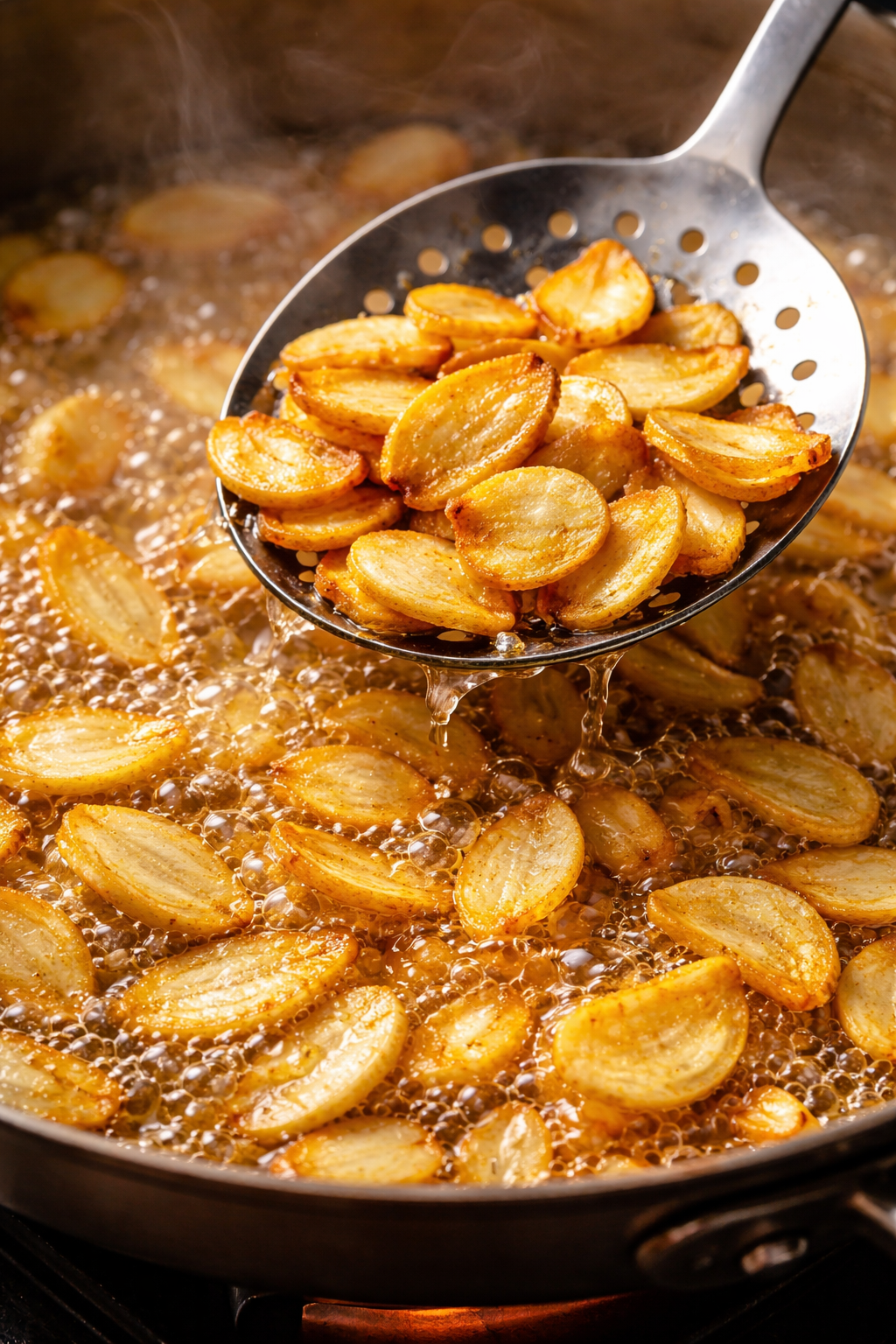
Fried garlic is the workhorse of chili crisp texture. When done well, garlic is sliced or minced, fried at a controlled temperature until golden and brittle, then held in oil as the medium. Good fried garlic has a sweet, toasty, savory depth that functions as the flavor backbone for everything else in the jar.
The keyword is “golden.” Garlic goes from raw to golden to brown to burnt in a narrow window. Golden fried garlic is sweet and nutty. Brown fried garlic turns bitter. Burnt fried garlic is acrid — and that acrid note doesn’t hide behind other flavors. It dominates. That’s what happened with my “fried garlic chili crisp” jar. The garlic looked fine. The ingredient list read well. But somewhere in production, the frying crossed the line, and every spoonful tasted like a single overwhelming note of charred allium with nowhere for your palate to go.
What makes this tricky is that you can’t detect it from the outside. The jar I opened looked exactly like what I’d want a garlic-forward chili crisp to look like. The problem only revealed itself on tasting. Compare that to a Japanese garlic chili crisp I tried later — garlic listed first, same visual profile — but the flavor was balanced with umami and a light sesame note that gave the garlic room to work without taking over.
When garlic is listed high on a chili crisp ingredient list, that’s a good sign. It means the manufacturer is investing in a flavorful aromatic as a primary solid. But garlic quality depends entirely on execution, which is something a label can’t tell you and a review can.
Fried Shallot
Shallot is garlic’s more delicate counterpart. Fried shallot brings a sweeter, more layered onion flavor with a lighter crunch — more flaky than snappy. Thai and Southeast Asian-influenced chili crisps lean on fried shallot, and it’s one of the ingredients that separates mid-range products from premium ones.
Shallots cost more than garlic and require more processing. They’re typically sliced into thin rings before frying, and they burn faster, so the timing has to be precise. When shallot appears on a label, it signals the manufacturer is spending more per jar on ingredients. That doesn’t guarantee a better product, but it does mean the crunch profile will be more nuanced than a garlic-and-soybean jar can deliver.
Chili Flakes and Pieces
The chili component serves double duty — it contributes texture and heat simultaneously. Dried chili flakes, rings, or small pieces are fried alongside the other solids and become part of the crunchy matrix.
Size matters here. Larger rings and flakes hold more of their original chili flavor and create textural contrast against smaller bits like minced garlic. Very fine chili powder mostly dissolves into the oil, contributing color and heat without crunch. The best chili crisps use a deliberate mix — visible rings or flakes for texture, with finer particles through the oil for consistent heat.
Chili type affects bit quality too. Erjingtiao and chaotianjiao — the most common dried chilies in Sichuan-style chili crisp — produce flakes that are moderately crispy with real chili flavor. Some Western brands use generic “red pepper flakes” that fry up brittle and one-dimensional. You can often see this through the jar: quality chili pieces tend to be deeper red and more varied in size, while generic flakes look uniform and bright red.
Sesame Seeds
Sesame seeds are a supporting player, but a steady one. They add a nutty, toasty element and a fine crunch that fills the gaps between larger pieces. White sesame is more common in Sichuan-style products; black sesame appears in some Japanese and Korean-influenced versions.
The useful thing about sesame seeds is that they don’t absorb oil the way porous ingredients do. They maintain their crunch for the life of the jar. But they can’t carry the texture alone — if sesame seeds are the primary crunchy element, the product is leaning on a minor ingredient to do a major ingredient’s job.
Peanuts
Peanuts bring a dense, substantial crunch unlike any fried aromatic. Where garlic and shallot are crispy-brittle, peanuts are crunchy-dense. They hold up in oil, they don’t dissolve on contact with warm food, and they add a protein-forward richness that rounds out the overall experience.
Peanuts are common in Sichuan-style chili crisps and in salsa macha, where they’re often a primary ingredient. The trade-off is allergen concern — their presence limits the product’s audience. Brands that include peanuts tend to use them sparingly, a few pieces per spoonful, rather than loading the jar.
Fermented Black Beans (Douchi)
fermented black beans in chili crisps are the most underrated bit in chili crisp. Douchi — fermented and salted black soybeans — add a funky, deeply savory, umami-heavy element that nothing else in the jar replicates. They’re chewy rather than crunchy, which provides a textural contrast against the crispy bits.
You’ll find douchi primarily in traditional Sichuan-style products. The flavor contribution is significant — douchi bridges the gap between the oil’s heat and the bits’ crunch, adding a fermented depth that makes the product taste more complex than its ingredient count suggests. When “fermented black beans” or “douchi” appears on a label, the product is drawing from a traditional Sichuan pantry rather than assembling generic ingredients.
The Filler Problem: When “Crunchy” Means Cheap
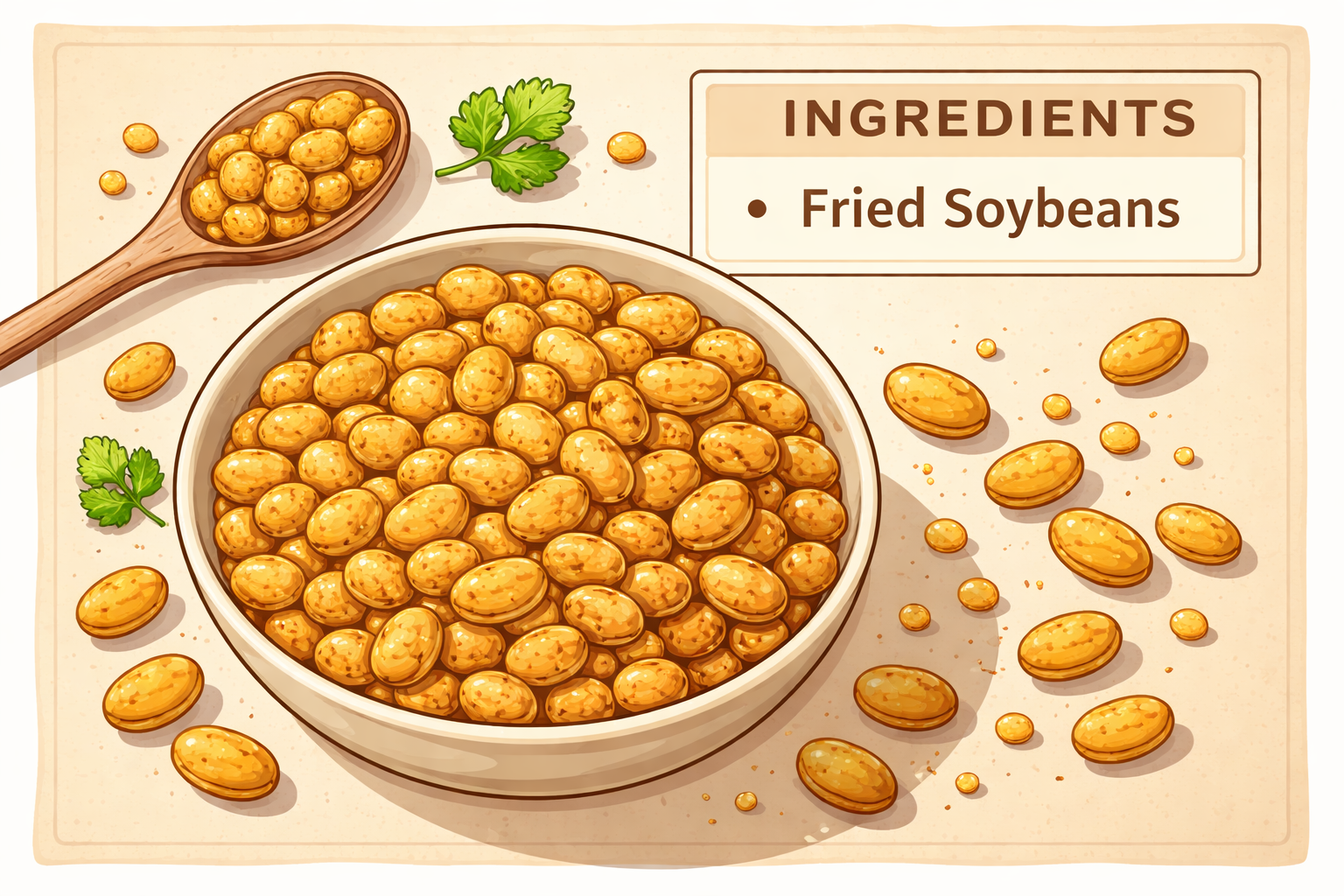
Soybeans are the elephant in the chili crisp jar.
Here’s the nuance: soybeans can work. In small amounts — listed fifth or sixth on the ingredient list — fried soybeans add a mild, nutty crunch that fills out the texture without dominating. They’re a legitimate supporting ingredient playing a supporting role.
The problem starts when soybeans show up in the first three or four ingredients. At that point, they’re not supporting the crunch. They are the crunch. And fried soybeans, as a primary bit, have problems that make them a poor substitute for quality aromatics.
They’re bland. Fried soybeans have a mild, slightly nutty flavor that never develops or evolves. Compare that to fried garlic, which has a sweet-savory depth, or fried shallot, with layered sweetness and caramelization. Soybeans taste like fried soybeans. There’s nothing else to say about them.
They dissolve. This is the critical one. Fried soybeans absorb moisture fast. The second they touch warm rice, a wet dumpling, or anything with steam, they go from crunchy to mealy in seconds. The crunch the label promised evaporates on contact. Garlic and shallot bits hold their texture significantly longer because their fried cellular structure is more rigid and less porous than a legume’s.
They’re cheap. Soybeans are one of the least expensive food crops on the planet. Using them as the primary solid ingredient fills a jar with visible “bits” at a fraction of the cost of garlic or shallot. A jar that’s 60% fried soybeans by solid volume costs meaningfully less to produce than one that’s 60% fried garlic. That cost difference either shows up as a lower retail price or a higher margin.
That “extra crunchy” jar I mentioned at the top was a textbook case. The ingredient list started with soybean oil, then soybeans, then chili, then garlic. The crunch was real on first bite, but it was uniform and one-note. Every spoonful delivered the same texture, the same mild flavor, the same quick dissolve. No contrast, no complexity, nothing that made me want another spoonful.
If soybeans appear before garlic on the ingredient list, the crunch is filler-forward. That doesn’t make the product terrible — plenty of people enjoy soybean-heavy chili crisps at their price point — but it’s worth knowing what you’re buying before you expect garlic-forward crunch from a soybean-forward jar.
Particle Size and Distribution: The Variables Nobody Talks About
Two jars can have identical ingredient lists and completely different eating experiences. The difference is in how the bits are cut, sized, and distributed.
Particle size controls two things: how long the crunch lasts, and how much flavor each piece delivers. Larger pieces — visible garlic chips, chili rings you can pick out with a fork, chunky shallot slices — hold their crunch longer because they have more internal structure resisting oil saturation. They also deliver more concentrated flavor per bite because there’s enough mass to actually taste the ingredient on its own.
Smaller particles — minced garlic, tiny chili flakes, crushed sesame — integrate more evenly into each spoonful but absorb oil faster and contribute less individual character. They create a more uniform texture, which some people prefer, but they compress the flavor range. Every bite tastes the same.
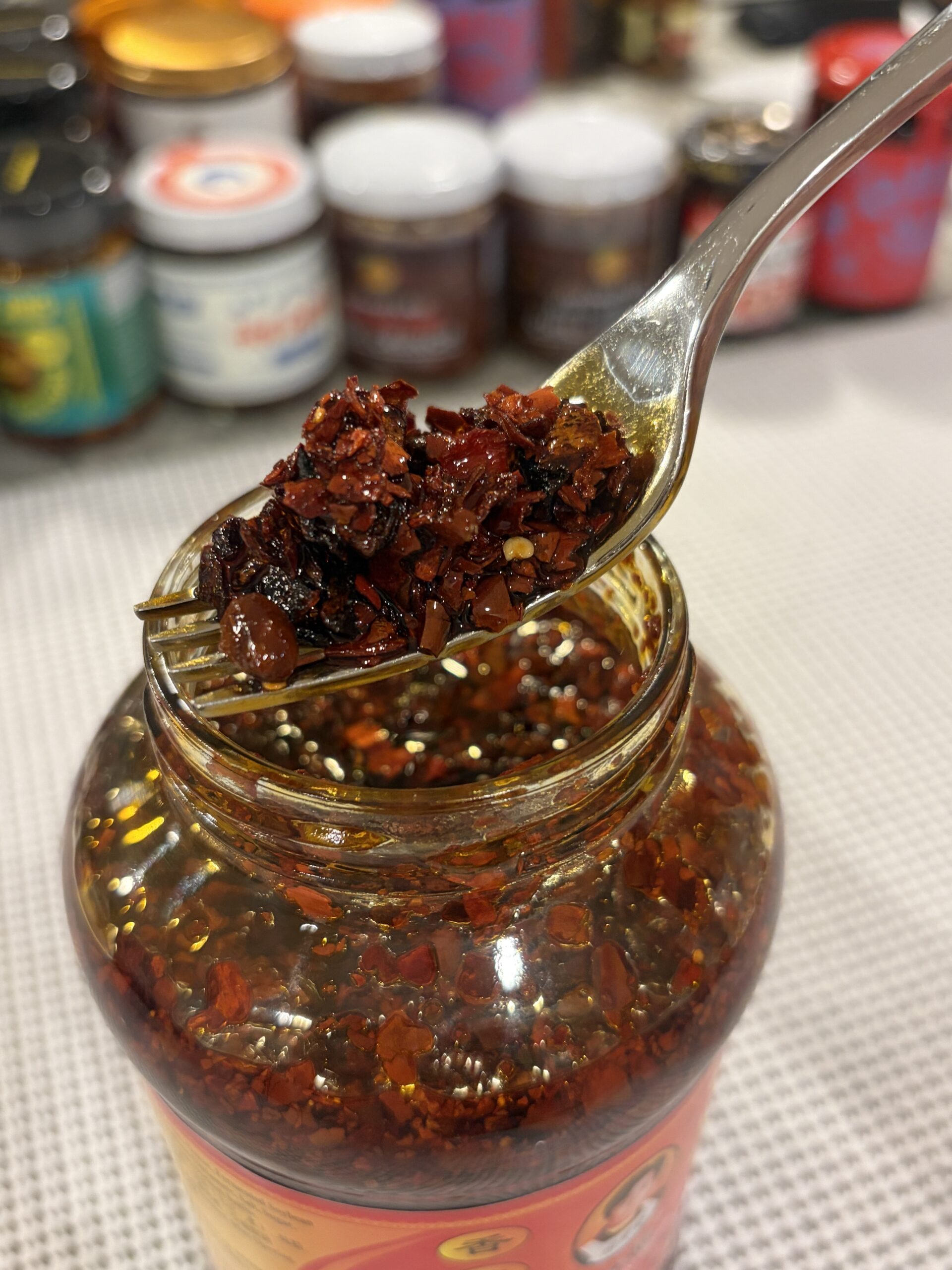
The best chili crisps use a deliberate mix of sizes. Larger pieces function as crunch anchors and flavor hits. Smaller particles fill the spaces for consistency. This mix doesn’t happen by accident in well-made products — the processing is designed to produce a specific size distribution that keeps each spoonful interesting.
Distribution through the jar matters too. Bits that settle to the bottom while oil floats on top is just physics — that’s normal. A good chili crisp should be easy to stir back together, and the bits should distribute relatively evenly when you do. Heavy settling with bits cemented to the bottom suggests either over-packing of solids or particle sizes so uniform that they compact into a dense layer. Neither is ideal.
Oil Saturation: Why Crunch Dies in the Jar
Every crispy bit in chili crisp is fighting a slow battle against the oil it sits in. Oil saturation is the process by which oil gradually re-infiltrates the fried bits, replacing the air pockets that make them crunchy with fat that makes them soft. It happens in every jar. The question is how fast.
Small, uniform particles saturate faster because they have more surface area relative to their volume. A tiny minced garlic piece might lose its crunch in weeks. A larger garlic chip can hold for months. This is one reason particle size variety matters — the larger pieces serve as a crunch reserve for when the smaller particles have already softened.
Temperature accelerates saturation. A jar stored in a cool pantry will hold its crunch longer than one sitting next to a stove or in a warm cabinet. Heat makes oil more fluid and more penetrative, which speeds up the process.
The type of oil matters too. Lighter, thinner oils like refined soybean or canola penetrate fried bits faster than heavier oils. Sesame oil, which is thicker, tends to saturate more slowly — one of the reasons sesame-forward chili crisps sometimes hold their crunch better over time.
There’s not much you can do once saturation has happened. But you can manage it: use a dry utensil every time, keep the jar sealed, store it somewhere cool, and don’t let an open jar sit around for six months expecting the crunch to survive.
How to Evaluate Bits Before You Buy
You can learn a lot about a jar’s crunch quality before you ever open it. Here’s what to look for, working from the outside in.
The ingredient list is your best tool. If garlic, shallot, or chili appear in the first three or four ingredients after oil, the product is investing in quality bits. If soybeans appear that high, the crunch is built around cost. If the list starts with oil, then sugar, then soybeans — keep moving.
Look through the glass. Most chili crisp jars are transparent or have transparent sections. Look at the settled bits: Are you seeing varied sizes and colors (garlic chips, chili flakes, seeds mixed together), or is it a uniform brown mass? Variety in what you can see usually means variety in what you’ll taste.
Check the oil-to-solids ratio. Let the jar sit on a shelf for a minute. Where does the oil layer end and the solids start? A good general-purpose chili crisp sits around 50/50 to 60/40 oil-to-solids when settled. If the oil layer takes up more than half the jar, the product is closer to a chili oil with bits than a chili crisp.
Notice the marketing language. “Extra crunchy” or “loaded with bits” on a front label doesn’t tell you what the bits are. The ingredient list on the back does. Marketing language creates expectations; the ingredient list documents reality. Read the back.
Quality signals: Garlic, shallot, or chili listed high. Multiple types of visible bits. Varied particle sizes through the glass. Fermented black beans present.
Filler signals: Soybeans in the first three ingredients. Uniform appearance through the glass. “Extra crunchy” on the label with no specific ingredients named. Oil layer exceeding half the jar volume.
The Crunch Quality Spectrum
Here’s how I think about bit quality across the chili crisp category, from the ingredients that contribute the most to the ones that contribute the least:
| Bit Ingredient | Crunch Character | Flavor Contribution | Longevity in Oil |
|---|---|---|---|
| Fried garlic | Crispy-brittle, snappy | Sweet, toasty, savory backbone | Good — holds weeks to months |
| Fried shallot | Flaky, delicate | Sweet, layered onion depth | Moderate — softens faster than garlic |
| Chili flakes/rings | Dry-crisp, variable by size | Heat + chili flavor simultaneously | Good — low moisture resists oil |
| Peanuts | Dense, crunchy-hard | Rich, nutty, protein-forward | Excellent — holds months |
| Sesame seeds | Fine, toasty crunch | Nutty, mild | Excellent — minimal oil absorption |
| Fermented black beans | Chewy (not crunchy) | Funky, deep umami, fermented depth | N/A — texture is inherently soft |
| Soybeans | Mealy, dissolves on contact | Mild, neutral, minimal | Poor — absorbs moisture fast |
The best jars combine three or more ingredients from the top of this list. The most forgettable jars lean on the bottom.
What makes chili crisp crunchy?
The crunch in chili crisp comes from deep-fried solid ingredients — most commonly garlic, shallots, chili flakes, and sesame seeds. Frying drives out moisture and creates a rigid, brittle structure. The quality of the crunch depends on how well the bits were fried, how large they are, and whether the oil has re-saturated them during storage.
Why is my chili crisp not crunchy?
The most common reason is oil saturation. Crispy bits absorb oil over time, especially if the jar has been stored in warm conditions or sitting for months. Smaller, more uniform particles absorb oil faster than larger, varied pieces. If your bits are soft and greasy instead of crisp, the product may have been over-processed, stored too long, or manufactured with bits too small to hold their texture.
Are the soybeans in chili crisp good?
It depends on their role. Soybeans in small quantities can add a mild, nutty crunch. But when soybeans appear in the first three or four ingredients, they’re usually there to bulk up the solids volume cheaply. Fried soybeans dissolve quickly on contact with moisture and contribute minimal flavor compared to fried garlic or shallots. Check the ingredient list — if soybeans appear before garlic, the crunch is mostly filler.
What is the ideal oil-to-solids ratio in chili crisp?
There’s no single perfect ratio — it depends on what you want the product to do. A good general-purpose chili crisp sits around 50/50 to 60/40 oil-to-solids. More oil works better as a drizzle or cooking ingredient. More solids works better as a topping or condiment. The key is that the ratio should match the product’s purpose, and the solids should be quality ingredients, not cheap filler.
How do you keep chili crisp bits crispy?
Store the jar in a cool, dry place and always use a clean, dry utensil. Moisture is the enemy — a wet spoon accelerates softening. Some people store chili crisp upside down periodically to redistribute the oil, but the simplest approach is to use the jar within a few months of opening and keep it sealed between uses.
What are the crunchy bits in Lao Gan Ma?
Lao Gan Ma’s Spicy Chili Crisp contains fried soybeans, chili flakes, and small amounts of peanut. Soybeans are the dominant solid ingredient, giving the product its characteristic dense, packed texture. Compared to brands that lead with fried garlic or shallot, Lao Gan Ma’s texture is heavier on legume-based crunch.
What is the difference between chili crisp and crunchy chili oil?
The difference is in the solids ratio. Chili crisp is defined by its crispy solid ingredients — the bits are the point, and the oil is the medium. Crunchy chili oil is primarily an oil product with some solids added for texture. If you hold a spoonful and most of what you see is oil with a few flakes in it, that’s chili oil with crunch. If the spoon is loaded with visible pieces, that’s chili crisp.