
Here’s the actual story.
Before the Jar: Chili Crisp’s Deep Roots
What those earlier versions didn’t have was the emphasis on fried solids — the crispy garlic, shallots, and textural bits that define what we now call chili crisp. Those elements evolved over time as the format moved from a simple infused oil into something closer to what you pull off a shelf today. The “crisp” part is the newer innovation. The chili-in-oil part is ancient.
It’s also worth noting where this format comes from geographically. Guizhou province — not Sichuan — is the spiritual and commercial birthplace of modern chili crisp. Guizhou cuisine has historically been even more chile-forward than Sichuan’s, without the same reliance on numbing Sichuan peppercorn. The Guizhou kitchen is built around dried chilies as a primary flavor, which is exactly why the condiment that eventually became chili crisp for the rest of the world came out of Guizhou, not Chengdu.
1997: The Woman Who Bottled It
Tao Huabi was running a small restaurant in Guiyang, the capital of Guizhou, in the early 1990s. The chili sauce she put on the tables was the thing people kept asking about. Customers wanted to take it home. So in 1997, she stopped just making it for the restaurant and started making it for everyone.
The brand she built was called Lao Gan Ma — which translates to “Old Godmother.” Not grandmother. The “godmother” framing matters: it’s authoritative, a little maternal, but with the implication of someone who has power and knows how to use it. The brand name ended up being a perfect description of what happened next.
Within a few years, Lao Gan Ma was everywhere in China. Not everywhere like a trendy condiment — everywhere like a staple. College students relied on it to make institutional food edible. Migrant workers brought it to job sites. It became associated with the comfort of home cooking for people who were far from home. By the time the brand reached its current scale, it was bottling approximately 1.3 million units per day.
That number isn’t a typo. 1.3 million jars. Every day.
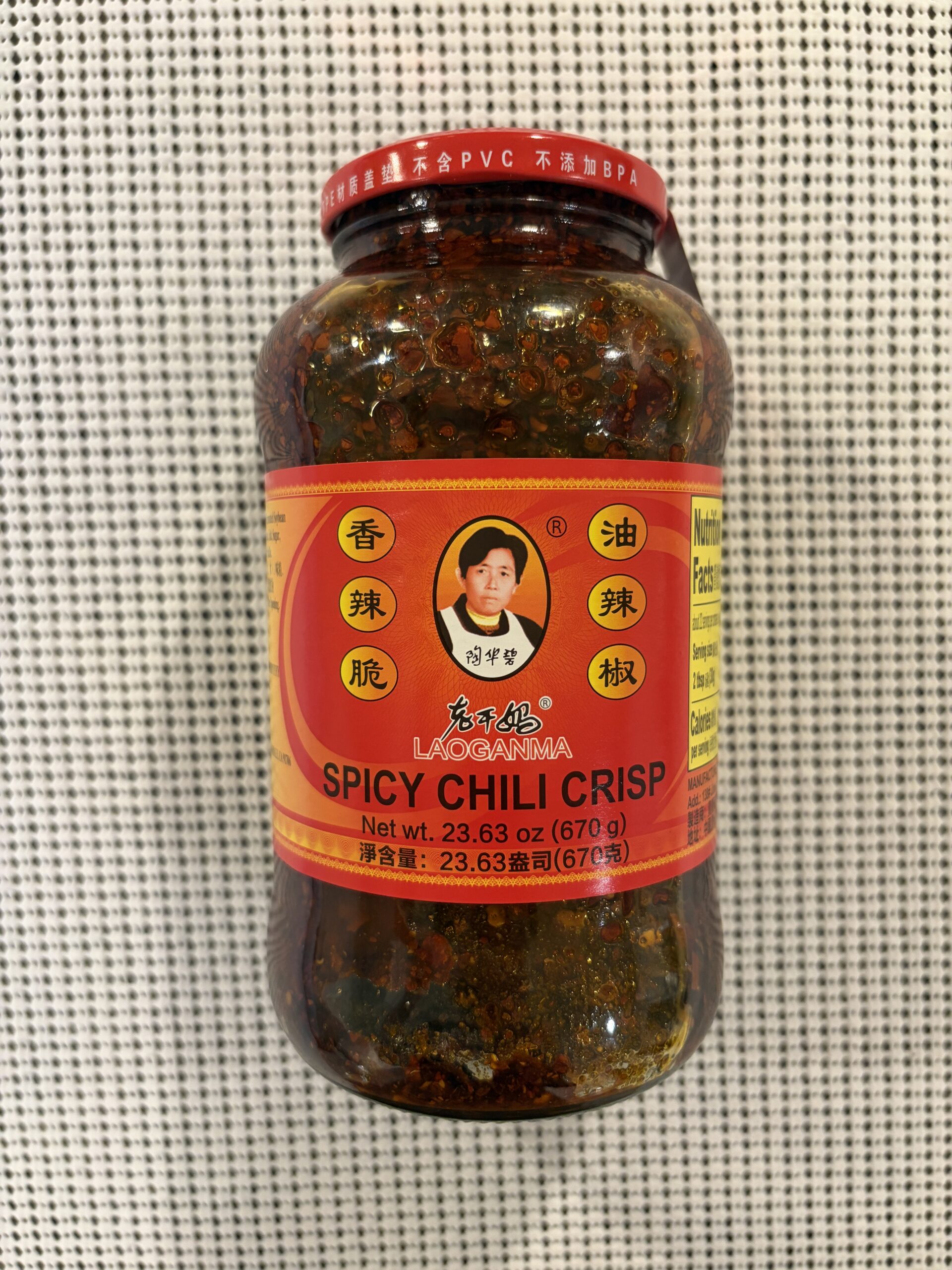
Lao Gan Ma’s Spicy Chili Crisp — the one in the iconic jar with Tao Huabi’s face on the label — became the reference product that everything else in the category gets compared to. It’s the benchmark because it arrived first and did it right. Whether it’s still the best option depends on what you’re looking for, but there’s no understanding the category without understanding what Lao Gan Ma established. If you want to know what’s actually in that jar, I’ve built a label-reading guide that breaks it down ingredient by ingredient.
The Category Spreads: Japan, Korea, Italy
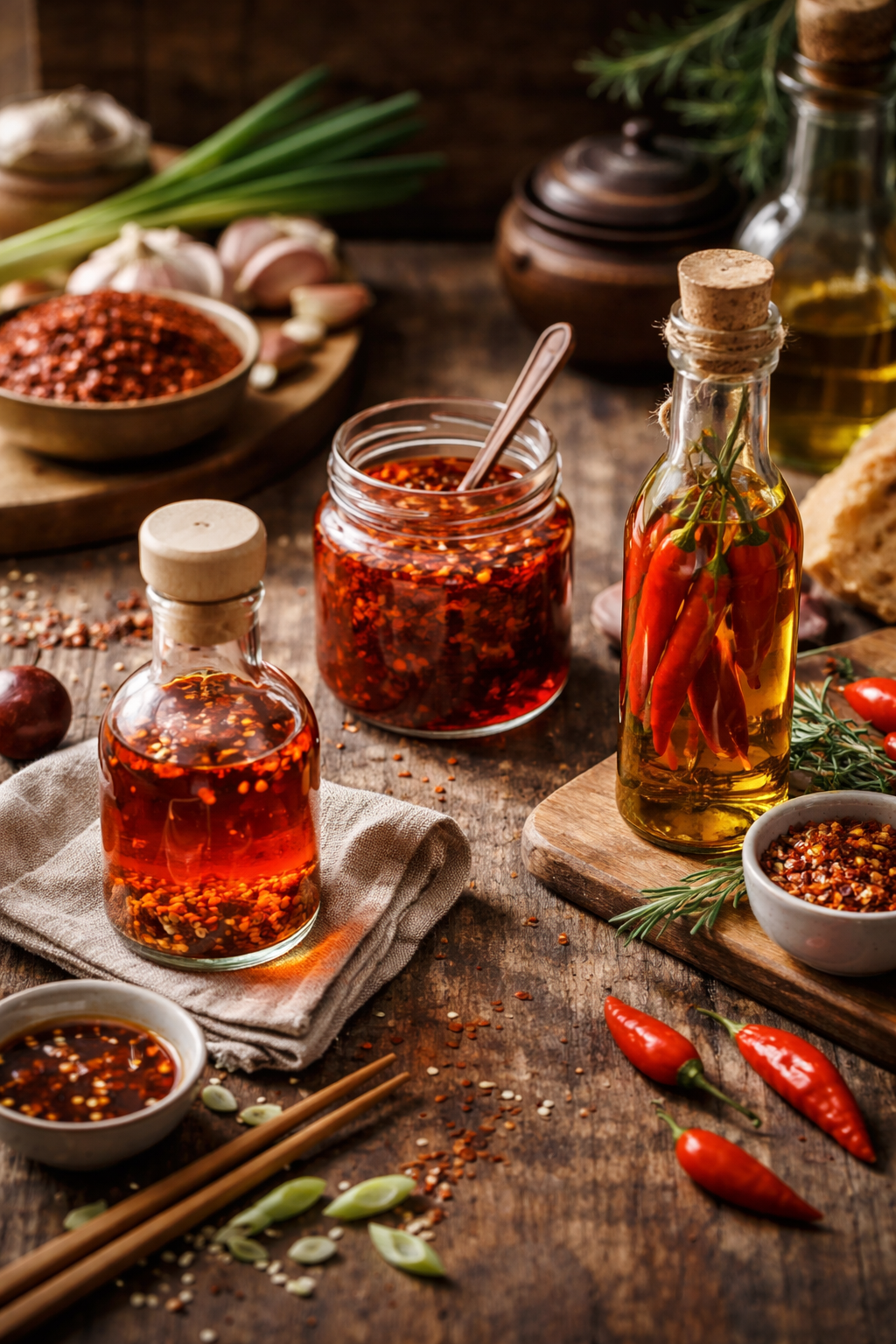
Chili crisp as a category didn’t stay in China. The oil-plus-fried-solids structure works across ingredient traditions because the logic behind it — concentrated flavor in a spoonable condiment — is universal.
Japan: Taberu Rayu (2009)
Japan’s version is called taberu rayu — literally “eating chili oil,” as opposed to the traditional rayu that you’d cook with or drizzle over ramen. The distinction matters: traditional rayu is mostly oil, pourable, used as a seasoning. Taberu rayu has enough solids that you spoon it, not pour it. It’s chili crisp in all but name.
The Japanese iteration dates to around 2009, when S&B Foods launched a taberu rayu that became a grocery store phenomenon. It was lighter than Chinese-style chili crisp — milder heat, more umami-forward, often with sesame and sometimes bonito or other dashi elements. The flavor profile was calibrated for Japanese palates, which trend toward subtler heat and more savory depth than straight capsaicin intensity.
That 2009 launch essentially created a new subcategory. Within a year or two, Japanese supermarkets had entire shelf sections dedicated to taberu rayu variants. The format had been adapted rather than just imported, and the adaptation worked.
Korea, Italy, and Beyond
Korean chili crisp typically uses gochugaru — the coarse, fruity Korean chili flakes that give gochujang and kimchi their characteristic warmth — in place of Sichuan-style dried chilies. The heat profile shifts from the numbing-tingly mala sensation of Sichuan peppercorn to something brighter and sweeter. You’d recognize it as chili crisp in texture and format, but the flavor is distinctly different.
Calabrian chili crisp, the Italian variation, swaps the base entirely: olive oil instead of soybean or canola, and Calabrian chilies (a Southern Italian pepper with a fruity, moderately spicy character) instead of Chinese dried chilies. The result is something that tastes like Italian pantry ingredients in chili crisp form. It’s genuinely different from Sichuan-style, not just a variation on it.
Each regional adaptation proves the same point: the format is durable. The oil-plus-fried-solids structure works across ingredient traditions because the logic behind it — concentrated flavor in a spoonable condiment — is universal. That same logic is why salsa macha, Mexico’s own oil-based chili condiment, shares so much structural DNA with chili crisp — even though it developed independently in Veracruz.
How Chili Crisp Became a Thing in America
Chili crisp was available in the US well before it was a trend. Anyone shopping at an Asian grocery store could find Lao Gan Ma for years — the brand was exporting globally long before American food media noticed. What changed in the late 2010s wasn’t the product’s availability. It was the audience.
A few things happened in sequence:
The premium brands arrived. Fly By Jing launched its Sichuan Chili Crisp in 2019, positioning it explicitly as a premium, chef-quality product. The founder, Jing Gao, brought a direct-to-consumer approach and a story that translated well to food media: a Chinese-American woman reclaiming the flavors of Chengdu for a Western audience at a price point ($18–22 per jar) that signaled quality rather than just utility. That launch put chili crisp in front of a lot of food writers who’d never had reason to cover it before.
The pandemic happened. In 2020 and 2021, people who were suddenly cooking all their own meals started reaching for condiments that could make simple food interesting. A bowl of rice that normally would’ve been fine was now a daily reality, and chili crisp turns a bowl of plain rice into something you actually want to eat. Search volume for “chili crisp” roughly doubled between 2019 and 2021. The trend and the timing were a near-perfect match.
Every major food outlet covered it. The New York Times, Bon Appétit, The Washington Post, National Geographic — between 2020 and 2023, there was a steady stream of features framing chili crisp as the condiment everyone needed to know about. That coverage brought in the readers who wouldn’t have found it through Asian grocery stores or food-enthusiast circles.
The Momofuku Moment (2024)
In early 2024, Momofuku — the restaurant group founded by David Chang — attempted to trademark the phrase “chili crunch,” which is what they called their version of the product. The backlash was significant and fast. The Asian food community pointed out, correctly, that “chili crunch” is a generic descriptor for a category of condiments, not a proprietary term. Trademarking it would have given one company legal standing to challenge anyone using the phrase.
Chang dropped the trademark attempt. But the episode crystallized something: chili crisp had crossed from food-world phenomenon into something mainstream enough that there was money to fight over. When you’re arguing about trademark rights to a condiment name, the category has officially arrived.
Where the Category Stands Now
The history of chili crisp saw it go from one woman’s restaurant table sauce in Guizhou to a global condiment category in about 25 years. That’s fast. Faster than most food trends, and with more staying power — because it’s not really a trend. The format works. It’s versatile, concentrated, interesting, and it makes food better. Those aren’t the properties of something that fades.
The current market looks something like this: a small number of mass-market brands at low price points (Lao Gan Ma, Trader Joe’s, S&B), all typically built on neutral base oils and familiar seasonings, a larger number of premium DTC and specialty brands targeting food enthusiasts (Fly By Jing, Momofuku, Brightland, and dozens of others), and an increasingly crowded middle ground as major food companies launch their own versions.
The quality range across all of this is enormous. Some of the premium-priced products are genuinely better than the mass-market options. Some aren’t. Some of the grocery-store brands punch well above their price. The category’s success has also brought in products that use the chili crisp name or aesthetic without delivering the texture and ingredient quality the format requires.
Which is exactly the problem I started this site to address.
A Quick History of Chili Crisp Timeline
- 1790 Chili-in-oil recipe appears in Tiao Ding Ji, a Qing Dynasty Chinese cookbook. The concept of seasoned oil as a condiment is already well established in Chinese cooking.
- 1997Tao Huabi founds Lao Gan Ma in Guiyang, Guizhou province. Begins commercial production of Spicy Chili Crisp. The format — fried aromatics suspended in seasoned oil — gets standardized and scaled.
- 2000sLao Gan Ma becomes ubiquitous across China and begins significant global export. Available in Asian grocery stores worldwide, largely below Western food media’s radar.
- 2009S&B Foods launches taberu rayu in Japan, creating a distinct Japanese subcategory — lighter, more umami-forward, calibrated for Japanese palates. Becomes a grocery phenomenon within a year.
- 2019Fly By Jing launches Sichuan Chili Crisp, positioning chili crisp as a premium, chef-quality product for Western food audiences. First major US-born premium brand in the category.
- 2020–21Pandemic cooking drives a surge in condiment interest. Search volume for “chili crisp” roughly doubles. Major food media runs waves of coverage. Chili crisp crosses into mainstream US food culture.
- 2024Momofuku attempts to trademark “chili crunch.” Backlash from Asian food community leads to the attempt being dropped. The episode confirms chili crisp’s mainstream commercial status.