
There are two ways to make chili crisp. Both produce something recognizable as chili crisp. But they’re different techniques, they carry different histories, and they yield different results in the jar. Understanding how chili crisp is made — and which method was used — is one of the faster ways to calibrate expectations before you open a new bottle.
Most people don’t think about how chili crisp is made. They read the ingredient list, check the heat level, maybe look at the oil-to-solids ratio. That’s all good. But method matters too, and it’s almost never on the label.
The Core Method: Frying Aromatics in Oil
Every chili crisp starts the same way: aromatics — typically garlic, shallots, dried chilies, and whatever else defines that jar — get cooked in oil. The oil is the medium and the carrier. The aromatics are the payload. What makes the methods different is how the cooking happens.
The goal in both cases is the same: drive off moisture, develop flavor through the Maillard reaction, and infuse the oil with the aromatic compounds from every ingredient. What changes is the temperature curve, the timing, and the degree of control the maker has over the result.
Pour-Over: The Traditional Method
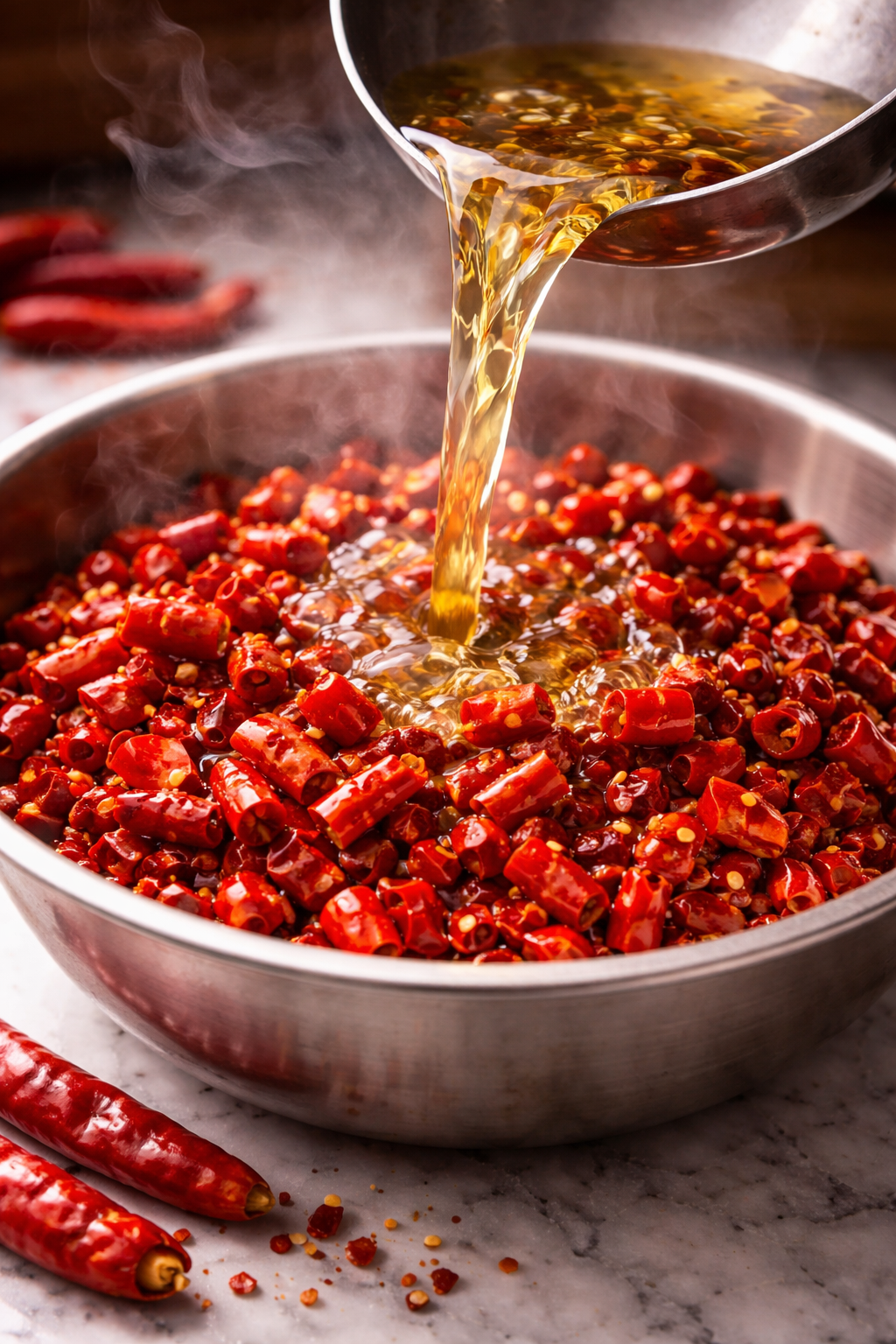
Pour-over — called you po (油泼) in Chinese cooking, roughly “oil splash” — is the technique with the longer history. The dry aromatics are packed into a vessel, often with spices and dried chilies layered in. Very hot oil is then poured directly over them. The high temperature flash-fries the ingredients in seconds.
It’s fast and dramatic. The sizzle is loud. The aromatics cook almost instantly. That high-heat exposure develops toasty, slightly charred edges on the garlic and shallot that you simply don’t get from a slower cook. The oil picks up a sharper, more aggressive aromatic quality — pronounced, a little smoky, with more defined individual flavors in the solids.
Oil temperature for pour-over is typically 375–425°F (190–220°C). Too cool and the aromatics don’t fry — they steep. Too hot and garlic burns before it crisps, turning the oil bitter. The window is narrow. This is why pour-over requires more attention than simmer, and why rushed versions can go wrong fast.
Pour-over is the method most associated with home production in China and with traditional chili crisp before the category went mainstream globally. It’s also the method most artisan and small-batch producers use today, partly because of the authentic heritage signal it carries, partly because it’s genuinely well-suited to small volumes where a maker can monitor temperature closely.
Simmer Method: Lower Heat, Longer Time
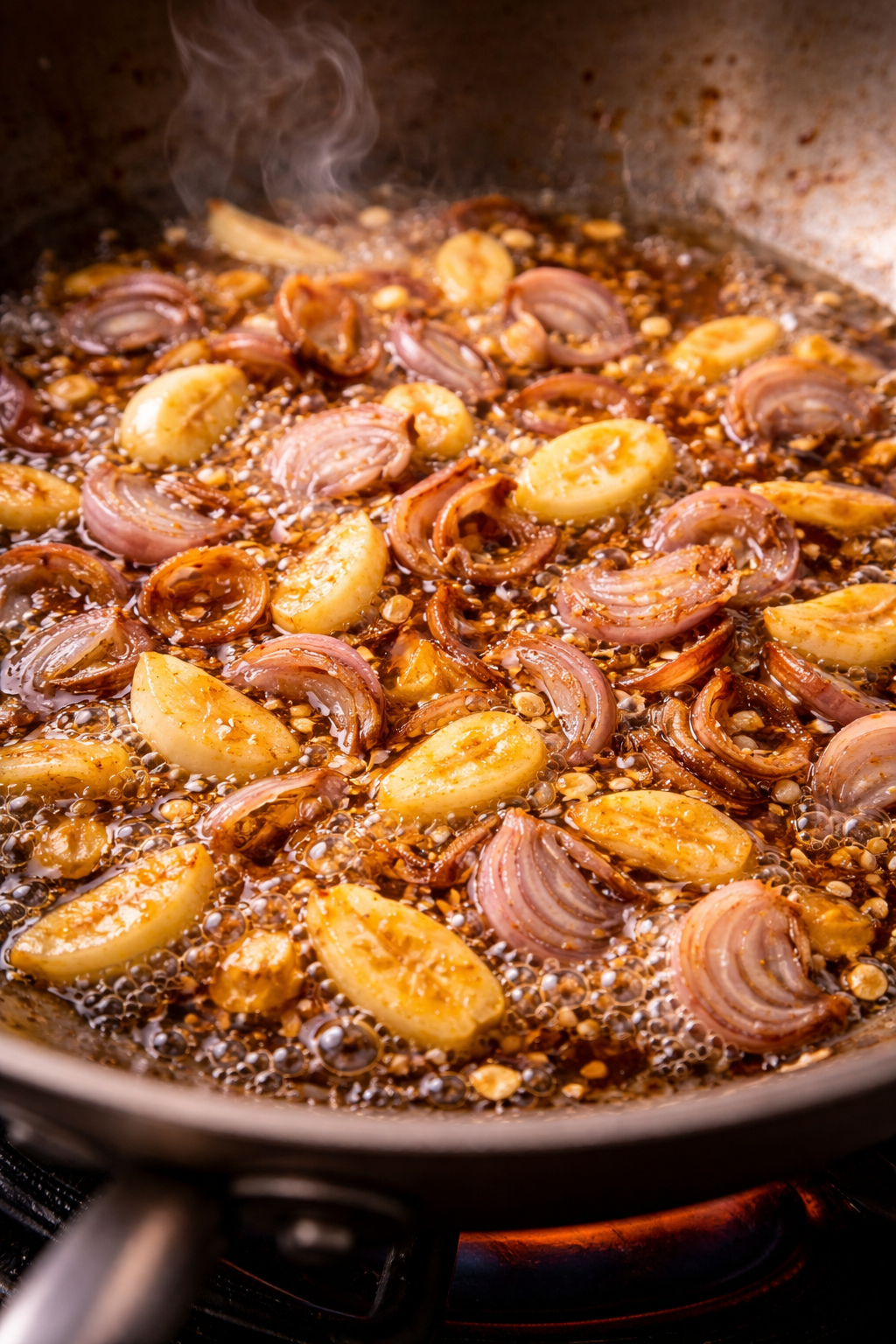
The simmer method takes a different approach. Aromatics are added to cold or warm oil and the temperature is raised slowly, with the ingredients cooking together in the oil at lower heat — typically 225–300°F (107–149°C) — over a longer period. The result is more gradual flavor extraction.
The flavor profile from simmer method tends to be rounder and more integrated. Nothing has the high-heat char edges you get from a flash fry. The garlic is softer and more mellow; the oil is richer and fuller but less sharp. It’s a gentler technique, and the product it produces tends to have a gentler character to match.
Simmer method is more common in commercial production, primarily because it’s easier to scale. You can run a large batch at controlled temperature without the precision timing demands of pour-over. It’s also more forgiving — a few degrees of variance at lower temperatures matters less than at the high end of pour-over range.
Which Method Is “Better”?
Neither. They produce different things. Better is the wrong question.
Pour-over delivers sharper, more aromatic, more texturally distinct solids. The individual components — garlic, chili, shallot — tend to hold their character. It’s the method for people who want defined flavor, more presence, more edge.
Simmer delivers a more unified product where the components meld together. If you want something that integrates smoothly into food rather than sitting on top of it, simmer-method products often do that better.
| Factor | Pour-Over | Simmer |
|---|---|---|
| Temperature | 375–425°F — high heat, short time | 225–300°F — moderate heat, longer time |
| Flavor character | Sharper, more distinct, slightly smoky | Rounder, more integrated, mellow |
| Texture of solids | Crisper edges, defined char | Softer, more uniform |
| Heritage | Traditional — the original Chinese technique | More common in commercial production |
| Scale | Better for small-batch and home production | More practical at commercial volume |
| Margin for error | Lower — timing and temperature critical | Higher — more forgiving across temperature range |
What “Traditional Method” Claims Actually Mean
Some labels will say “traditional method” or “crafted using traditional techniques.” This is marketing language with no regulatory definition attached. It implies pour-over or small-batch production, but there’s no standard that enforces the claim.
What it usually signals: the brand wants to differentiate from mass production, probably because their price point is higher. Whether the claim reflects actual production practice is hard to verify. A few brands genuinely do use traditional pour-over at small scale and the product tastes like it. Others use the label on products that taste like they came off an industrial line.
The ingredient list is still more reliable than production claims. If the solids list is garlic, shallot, dried chili, and sesame — and those things taste like what they’re supposed to taste like — that’s a better quality signal than the word “traditional” on the front label.
Small-Batch vs. Commercial: What You Can Actually Taste
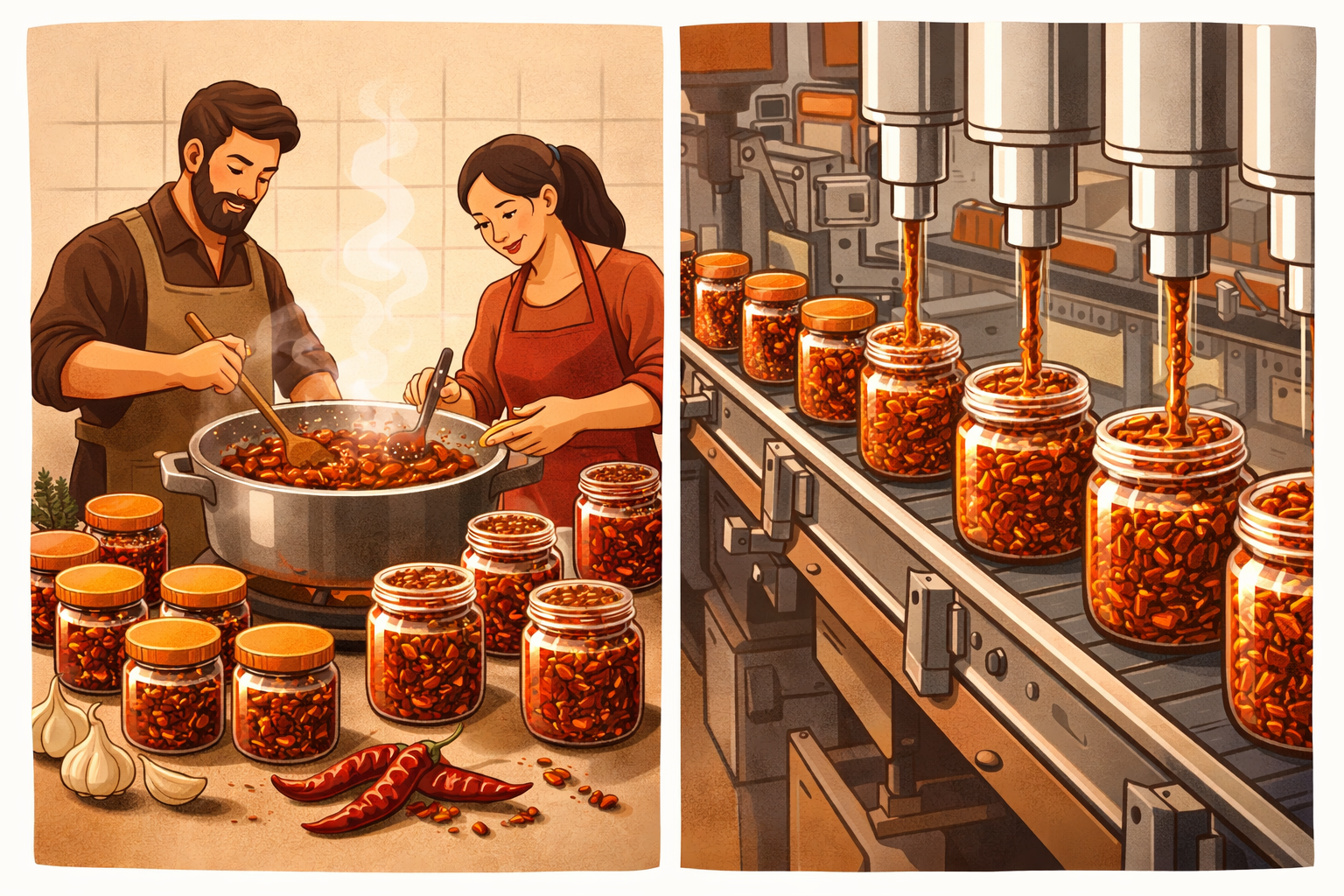
The difference is real. I’ve had small-batch pour-over chili crisp where the garlic is still distinct — you can taste it as garlic, not just as “fried thing” — and the oil has a layered quality that shifts as it warms. I’ve also had commercial products where everything has been homogenized into a single undifferentiated flavor note.
That’s not universally true in either direction. Some commercial producers do excellent work at scale. Some small-batch products are inconsistent batch to batch, which is its own problem. But on average, the gap between carefully made small-batch and high-volume commercial is noticeable, and it mostly comes down to temperature control and ingredient quality — both of which are harder to maintain as volume increases.
Commercial chili crisp is formulated for a shelf life of 18–24 months. That requires preservatives and often a slightly different texture profile than fresh-made product. Homemade chili crisp without added preservatives: good for 1–3 months refrigerated. Small-batch artisan products without preservatives: check the label for best-by date and refrigerate after opening.
Why This Matters When You’re Evaluating a Jar
Method isn’t something I score directly at FIL — a jar earns its tier based on what’s in it and how it performs, not how it was made. But knowing the method gives you a framework for interpreting what you taste.
Sharp garlic with defined edges and some char? Probably pour-over, or at least high-heat production. Mellow, integrated, smooth? Simmer, or lower heat. Completely uniform solids that all taste the same regardless of what they’re supposed to be? That’s usually commercial production optimized for consistency over character.
The method is the context. The jar is the evidence. Read them together and you’ll understand the product a lot faster than tasting blind.
How is chili crisp made?
Chili crisp is made by frying aromatics — garlic, shallots, dried chilies, and other ingredients — in oil until crispy, then combining the solids with seasoned oil. The two main methods are pour-over (hot oil poured directly over the aromatics) and simmer (aromatics cooked together with the oil at lower heat for a longer time).
What is the difference between pour-over and simmer method chili crisp?
Pour-over involves heating oil to a high temperature and pouring it directly over dried chilies and aromatics, which flash-fries them and creates a more pronounced, toasty flavor. Simmer method cooks aromatics gently in oil at lower heat over a longer period, extracting flavor more gradually. Pour-over tends to produce sharper, more aromatic flavor; simmer tends to produce a rounder, more integrated result.
Which method is more traditional?
The pour-over method (called ‘you po’ in Chinese cooking — oil splash) is the traditional technique. It’s been used in Chinese home cooking for centuries and remains the most common method in artisan and small-batch production. Many home cooks still make chili crisp this way.
How is chili crisp made in a factory?
At commercial scale, producers typically use large vats to fry aromatics in temperature-controlled oil, then blend in dry-roasted or dehydrated ingredients, pre-mixed seasonings, and preservatives. Temperature control is more consistent than home production, but at high volume, brands often use faster simmer cycles and standardized ingredient blends — which is why some commercial products taste more uniform.
Why does homemade chili crisp taste different from store-bought?
Fresh aromatics, no preservatives, and the cook’s ability to adjust temperature in real time all contribute. The biggest difference is usually freshness — homemade garlic and shallots haven’t been sitting in oil for 18 months. Commercial products are shelf-stable, which requires preservatives and often a slightly different texture as a result.
What does ‘traditional method’ mean on a chili crisp label?
Usually not much. ‘Traditional method’ is marketing language without a regulated definition. It typically implies pour-over or small-batch production, but there’s no standard that enforces it. The label is claiming heritage, not a specific process. Read the ingredient list instead — it tells you more about quality than any production claim.
How long does chili crisp last?
Commercially produced chili crisp typically has a shelf life of 18–24 months unopened. Once opened, most manufacturers recommend refrigerating and consuming within 6 months. The oil acts as a natural preservative, but fresh aromatics degrade over time. Homemade chili crisp without preservatives: 1–3 months refrigerated.