
There are at least five distinct types of chili oil in regular production around the world right now — and they are not the same product. Same basic concept: oil, chilies, heat. Everything else is negotiable. The base oil changes. The chili variety changes. The aromatics, the viscosity, the flavor direction, what you’re supposed to put it on — all of it changes depending on where the recipe comes from.
The types of chili oil that matter most for anyone building a condiment shelf are Chinese la you, Korean gochugaru oil, Italian olio di peperoncino, Thai nam prik, and Japanese rayu. Each one represents a distinct culinary tradition with its own logic. Knowing which type you’re looking at before you buy it is the single most useful piece of information you can have when staring down a shelf of bottles with red-tinted oil inside.
This is that guide. No recipes, no ranking — just a clean breakdown of what makes each type different and what it’s actually for.
Why the Different Types of Chili Oil Aren’t Interchangeable
This is worth saying plainly: the regional tradition behind a chili oil determines its flavor in ways that go beyond just heat level. It’s not a minor variation. Chinese la you built around soybean oil, facing-heaven chilies, and Sichuan peppercorn tastes completely different from an Italian olio di peperoncino built on olive oil and Calabrian chili. Different base oils. Different chili heat characters. Different aromatic profiles. Different use cases.
Using the wrong type for a dish won’t always ruin it, but it will change it. And if you’re buying without knowing which type you have, you’re guessing at the outcome.
The chili oil market has blurred these lines considerably — and that’s before you get into how chili oil differs from chili crisp, which is a separate question worth understanding first. What Is Chili Oil? covers that distinction if you need the foundation before diving into styles. Bottles labeled “chili oil” in the U.S. might be Chinese-style, Japanese-inspired, Korean-influenced, or a fusion with no clear origin. The label won’t always tell you which type you’re holding. The ingredient list usually will — if you know what to look for.
| Type | Base Oil | Primary Chili | Key Character |
|---|---|---|---|
| Chinese la you | Soybean or rapeseed | Facing-heaven, erjingtiao | Mala heat, aromatic depth |
| Korean gochugaru oil | Sesame or neutral blend | Gochugaru (Korean red pepper) | Sweet-spicy, toasted sesame |
| Italian olio di peperoncino | Olive oil | Calabrian or peperoncino | Fruity, grassy, moderate heat |
| Thai nam prik | Neutral (often vegetable) | Roasted dried chilies, dried bird’s eye | Savory-funky, tamarind, umami |
| Japanese rayu | Sesame (light) | Chinese-style dried chili | Light, sesame-forward, delicate heat |
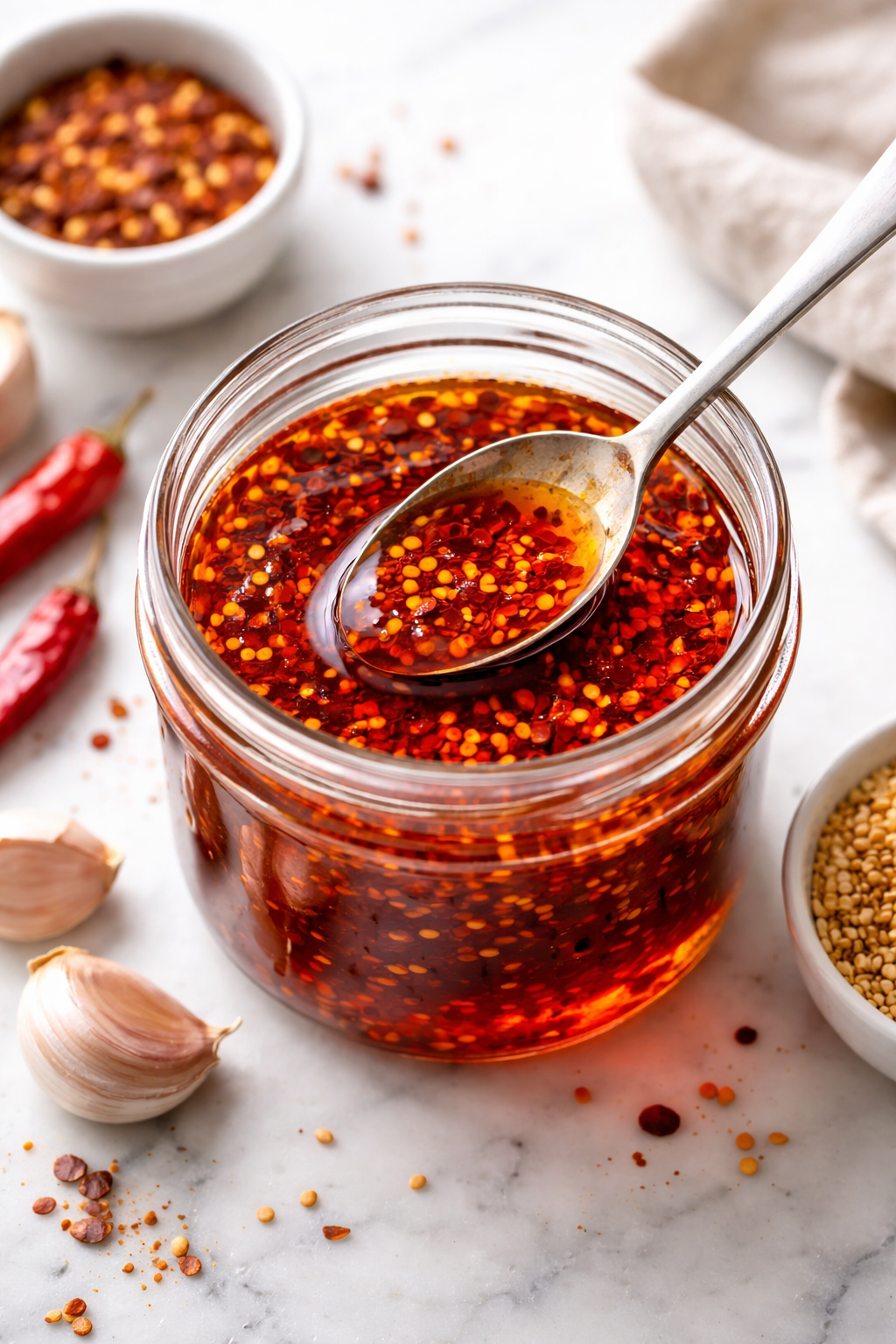
Chinese Chili Oil: La You, the Original Format
Chinese chili oil — la you (辣油) — is where this whole category starts. Every other type of chili oil in the world either traces its roots back to it or developed in conscious dialogue with it. Understanding la you is understanding what chili oil is fundamentally supposed to be.
The base is almost always a neutral oil — soybean is most common, rapeseed (caiziyou) is the Sichuan preference. Neutral oil matters here because it’s not supposed to compete with the chilies and aromatics. The oil is the carrier. The flavor comes from what you infuse into it: dried chilies, garlic, ginger, star anise, cassia bark, and — in the Sichuan version specifically — Sichuan peppercorn.
That Sichuan peppercorn is what creates the mala (麻辣) profile that makes Chinese chili oil distinctive. Ma means numbing. La means spicy. Together they produce a sensation that other types of chili oil don’t replicate — the heat sits on top of a low-frequency tingle that extends the experience rather than just burning and fading. A Sichuan-style chili oil without peppercorn is missing its defining characteristic. The heat types guide breaks down how mala heat works versus front burn versus slow build across all chili condiments.
The Sichuan version — hong you (红油), or “red oil” — is the most widely exported format and the one that most people in North America encounter first. It’s the template Lao Gan Ma works from. It’s what Chinese restaurant tables in the U.S. typically carry. And it’s the reference point that most of the American chili crisp market is consciously riffing on. The history of chili crisp traces how this format evolved from condiment to category.
Chinese chili oil without Sichuan peppercorn exists too — it’s common outside Sichuan province — but it’s noticeably different. Cleaner heat, less layered. What you get depends on which region’s tradition the recipe comes from.
What la you is for: Dumplings, noodles, cold dishes, rice, stir-fry marinades, drizzling over anything that needs heat and depth. It’s the most versatile of the five types of chili oil — the one most suitable as an all-purpose option for everyday use. It also has the most developed cooking application, because the neutral oil base won’t clash with other ingredients the way olive oil or sesame oil can at high heat.
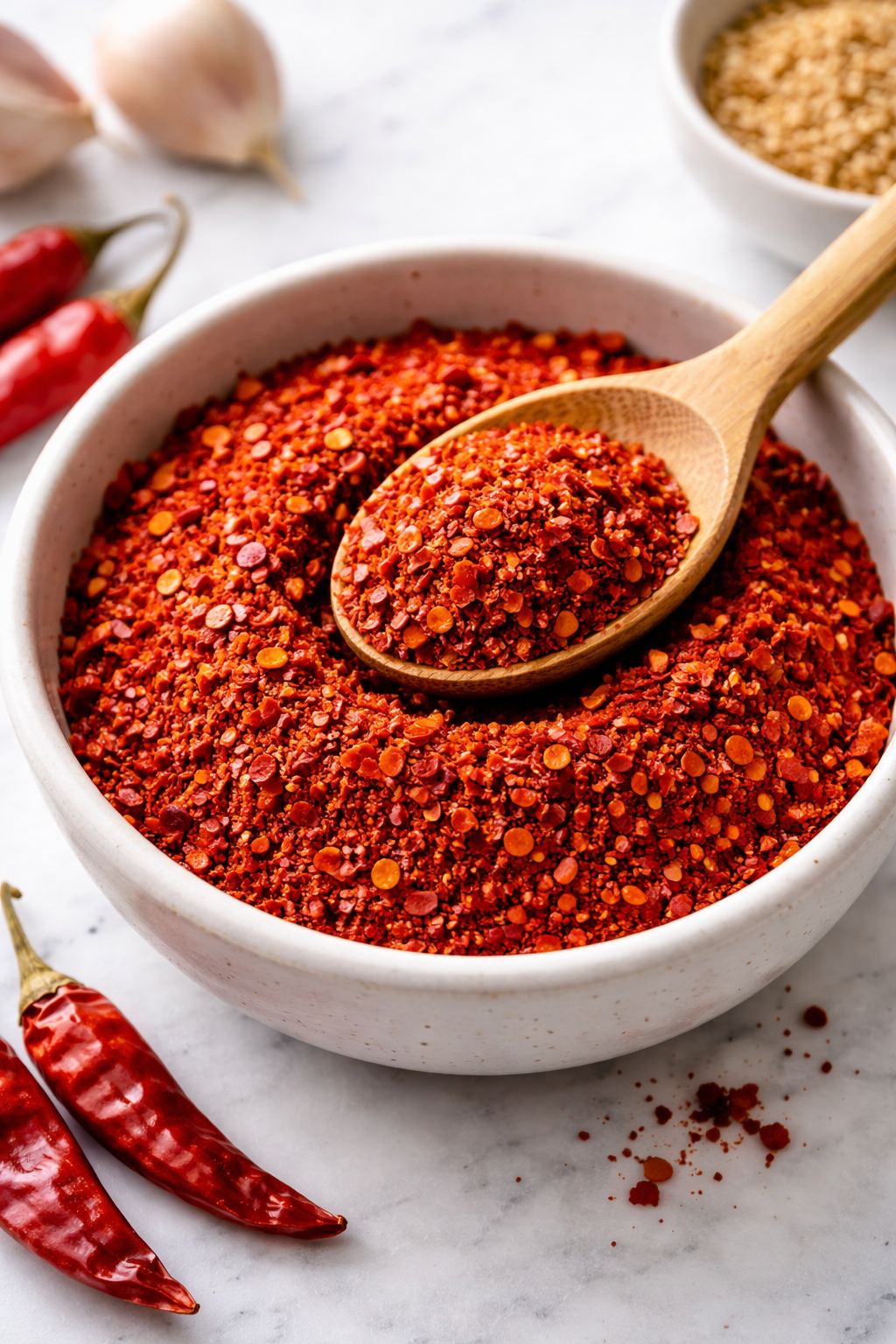
Korean Chili Oil: Gochugaru Oil and the Sesame Dimension
Korean chili oil is built around gochugaru — the coarsely ground Korean red pepper that shows up in kimchi, gochujang, and most Korean cooking that involves heat. What gochugaru brings to a chili oil is distinct: a mild-to-medium heat with a natural sweetness and a slight fruitiness that Chinese dried chilies don’t have. It’s not sharp or aggressive. It settles.
The oil base in Korean chili oil is typically sesame — toasted sesame oil, or a blend of neutral oil with sesame oil added. That sesame note is prominent in a way it isn’t in la you, where aromatics like garlic and Sichuan peppercorn dominate. In Korean chili oil, sesame and gochugaru are co-leads. The flavor reads warm and rounded rather than sharp and complex.
Korean chili oil doesn’t have a single dominant commercial format the way la you does. It shows up as a finishing drizzle in bibimbap and japchae, as a dressing component in cold noodle dishes, and as a table condiment alongside dumplings (mandu). Some Korean chili oils include dried garlic, toasted sesame seeds, or green onion. The variations are real but the gochugaru-sesame combination is consistent enough to identify the category.
In the U.S. market, Korean chili oil is underrepresented relative to Chinese-style. The chili crisp boom has brought more Korean-influenced products to shelves — several use gochugaru as their primary chili — but a straight Korean chili oil without the crispy solids of a chili crisp is harder to find commercially. You’re more likely to encounter it at a Korean restaurant or make it at home. The commercial gap is a real one.
What gochugaru oil is for: Korean dishes specifically — bibimbap, cold noodles, japchae, mandu, any rice bowl that wants warmth without aggression. It’s gentler than Chinese chili oil and plays better with sesame-forward and grain-based dishes. Less useful as a cooking oil; better as a finisher.
Italian Chili Oil: Olio di Peperoncino and the Olive Oil Question
Italian chili oil — olio di peperoncino — is where the base oil stops being neutral and starts being an active ingredient. Olive oil has a flavor. A pronounced one. Fruity, grassy, sometimes peppery on its own before you add a single chili. When you infuse dried peperoncino or Calabrian chili into olive oil, you’re building a condiment where the oil and the chili are genuinely equal contributors.
That changes what the product is useful for. Olio di peperoncino is a finishing oil first. It belongs on pizza, on pasta, on bruschetta, on grilled vegetables — anywhere the olive oil character will read as a feature rather than a conflict. Trying to use it for high-heat cooking the way you’d use la you doesn’t work; olive oil has a lower smoke point and a flavor that breaks down poorly under sustained heat. The cooking with chili oil guide covers the smoke point breakdown by base oil type.
The chili varieties used in Italian chili oil matter a lot. The peperoncino rosso di Calabria — a small, intensely red dried chili from Calabria in southern Italy — is the most prized. Calabrian chili has moderate heat with a rich, fruity quality that high-heat dried chilies don’t have. It’s the same chili that makes Calabrian chili paste a differentiated product from standard crushed red pepper, and it translates that difference into Italian chili oil form cleanly.
A simpler version — just generic dried peperoncino in olive oil — is what most Italian households keep on the table. It’s mild, approachable, and frankly closer to infused olive oil than to what most people think of as chili oil. The heat is incidental. The olive oil flavor is the point.
Calabrian chili oil is different — the heat is real and the chili flavor is distinctive. If you see “Calabrian chili” on the label, you’re in different territory than standard olio di peperoncino.
What olio di peperoncino is for: Pizza (the Italian restaurant standard), pasta finishing, bread dipping, grilled vegetables, bruschetta, any application where olive oil is already the right fat. It doesn’t belong in Asian-inspired dishes — the olive oil character will fight rather than support. But in its correct context, it’s the only type of chili oil that makes sense.
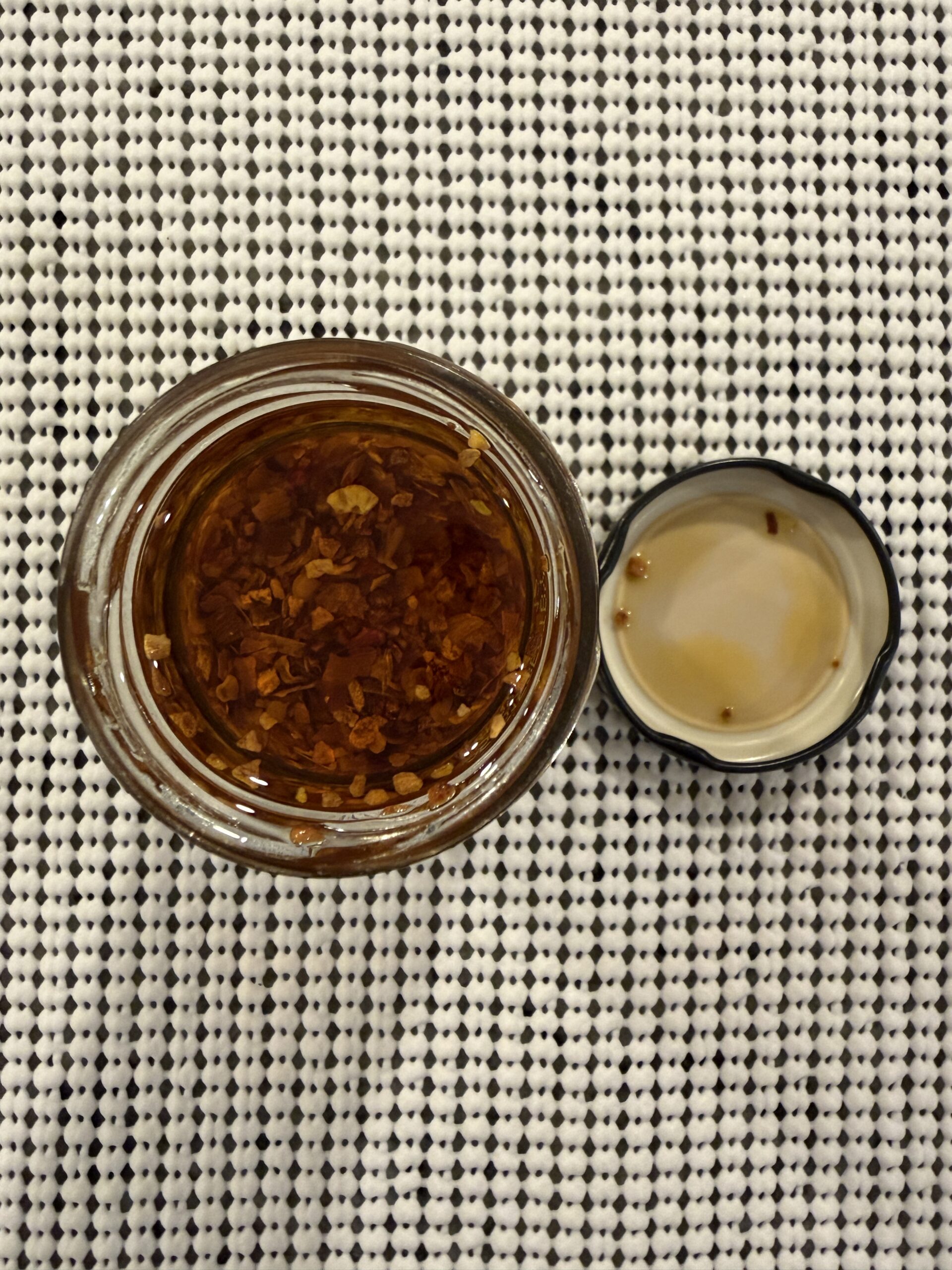
Thai Chili Oil: Nam Prik and the Funky Tradition
Thai chili oil is where the category gets genuinely different from everything else on this list. The other four types are fundamentally heat plus oil with aromatics. Thai nam prik adds fermentation, shrimp paste, tamarind, and fish sauce into the picture — which pushes it from chili oil into something more complex and, for some palates, more challenging.
Nam prik (น้ำพริก) is Thailand’s broad category of chili-based condiment sauces and pastes — the name literally means “chili water.” Not all of them are oil-based. The varieties that function closest to what we’d call chili oil are nam prik pao (roasted chili paste) and nam jim jaew (a dipping sauce with ground toasted rice, tamarind, and fish sauce). Both involve chilies. Both are used as condiments. Neither is purely oil.
Nam prik pao — the roasted chili paste version — is probably the most relevant comparison to the other types of chili oil on this list. It’s made by roasting dried chilies, shrimp paste, shallots, and garlic, then blending them with oil into a thick, deeply savory paste. The flavor is smoky, tangy, salty, and funky in a way that’s immediately identifiable as Thai cooking. It shows up in tom yum, pad thai, and many other Thai dishes as a background flavor base.
The key difference between Thai chili oil and the others: Thai nam prik is rarely used as a pure finishing drizzle the way la you or rayu is. It functions more as a seasoning paste, a soup base ingredient, or a dip. The line between chili oil and chili condiment is blurrier here than anywhere else in this guide.
For buyers looking at a shelf, Thai-style chili oils in the Western market are harder to find in pure form. Most of what gets labeled “Thai chili oil” stateside is a simplified version — dried Thai chilies in neutral oil, which captures the heat but misses the fermented complexity. The full nam prik experience is better found at a Thai restaurant or specialty grocery than in the average supermarket condiment aisle.
What Thai chili oil is for: Thai cooking specifically — tom yum, fried rice, noodles, dipping sauces, marinades. The funky-savory profile from shrimp paste and fish sauce doesn’t translate cleanly into non-Thai applications. It’s the most cuisine-specific of the five types, and also the one where a simplified Western version loses the most in translation.
Japanese Rayu: The Bridge Between Chili Oil and Chili Crisp
Japanese rayu (ラー油) is the type that connects chili oil to chili crisp — and understanding that connection explains a lot about why the chili crisp market in the U.S. looks the way it does today.
Traditional rayu is a light, sesame-forward chili oil with minimal solids. It’s Japan’s adaptation of Chinese la you, adjusted for Japanese flavor preferences — which meant pulling back on the Sichuan peppercorn, softening the heat, and letting sesame oil take a more prominent role. The result is a delicate, aromatic condiment used as a table drizzle for gyoza, ramen, and rice. It’s closer to a finishing oil than a flavor bomb.
That changed in 2009 when S&B Foods introduced taberu rayu — literally “eating chili oil.” The innovation was adding fried garlic, fried onion, and other crispy solids to the rayu format, turning a drizzle into something you could actually eat as a topping. Taberu rayu became one of S&B’s best-selling products almost immediately and launched a domestic Japanese chili crisp boom that preceded the American one by several years.
The influence of taberu rayu on the Western chili crisp market is real and underreported. Many of the American brands that launched during the 2019–2022 chili crisp explosion were aware of the Japanese format. The structure — infused oil, crispy aromatics, sesame notes, relative restraint on heat — shows up clearly in Japanese-influenced chili crisps on the market today.
For practical purposes: if a label says “rayu” and the oil is light in color with a strong sesame note and minimal solids, you’re looking at traditional rayu — a finishing drizzle, not a topping. If the jar has visible crispy bits and the label says “taberu rayu” or “eating chili oil,” you’re in chili crisp territory rather than pure chili oil territory.
What rayu is for: Gyoza dipping, ramen finishing, rice bowls, anything that benefits from a light sesame-chili note without aggressive heat. Rayu is the most restrained of the five types of chili oil. It’s calibrated for cuisines where subtlety matters. Don’t use it expecting the punch of la you — use it when you want heat that whispers rather than announces.
How Regional Style Affects What You Should Buy
The five types of chili oil described above are not ranked here, and FIL’s review scoring system doesn’t penalize any type for being what it is. A Korean gochugaru oil isn’t supposed to taste like la you. An Italian olio di peperoncino isn’t supposed to taste like rayu. Each is scored on whether it delivers what its type promises — execution within the tradition, not adherence to some universal standard.
What regional style does affect is which types of chili oil belong in your kitchen. A few honest guidelines:
- If you cook a wide variety of Asian dishes — Chinese la you is the most versatile. It works as both a condiment and a cooking ingredient, and it’s the easiest type to use across cuisines without flavor conflict.
- If your cooking is predominantly Korean — a gochugaru-based oil will serve you better than la you. The sweet-spicy-sesame profile integrates into Korean dishes in ways a Sichuan-style oil doesn’t.
- If you eat a lot of Italian food at home — olio di peperoncino is the right tool. Keep it off Asian dishes and use it where olive oil belongs.
- If you primarily want a finishing drizzle for Japanese food — rayu is the answer. Keep expectations calibrated — it’s subtle by design.
- If you cook Thai food regularly — sourcing an actual Thai-style nam prik pao is worth the effort. The simplified Western versions leave a lot out.
Most condiment shelves benefit from at least two types of chili oil. Chinese la you plus one other covers most situations. If you’re choosing a second, pick based on what you actually cook most — not what looks most interesting on the shelf.
The question of which oils actually survive high heat — and which of these five types can go in a pan vs. which are finishing-only — is covered in detail in the practical guide to cooking with chili oil, including smoke point comparisons by base oil and specific stir fry technique.
And if you’re curious about how the salsa macha tradition fits in — Mexico’s oil-based chili condiment built on nuts, dried chilies, and vinegar — that’s a parallel category worth understanding alongside chili oil. Different tradition, different ingredients, but the same fundamental question: what can oil and chilies do together?
Reading Labels When the Type Isn’t Labeled
Most bottles in the U.S. won’t say “Chinese chili oil” or “Korean chili oil” on the front. They’ll say “chili oil” and leave you to figure it out. The ingredient list is usually enough to identify the type:
- Soybean oil or rapeseed oil + Sichuan peppercorn → Chinese la you
- Sesame oil or sesame oil blend + gochugaru → Korean-style
- Olive oil + Calabrian chili or peperoncino → Italian olio di peperoncino
- Light sesame oil + few or no visible solids → Japanese rayu
- Shrimp paste, fish sauce, or tamarind anywhere on the list → Thai-influenced
Fusion products exist and are increasingly common — Korean-Italian, Japanese-influenced American, Sichuan-meets-sesame. These don’t map cleanly to a single type. When that’s the case, the base oil and the primary chili are still the two most informative ingredients. They tell you where the flavor is going to land even if the origin is mixed. The label-reading guide for chili crisp covers the same ingredient-first approach that applies here.
Price is also a signal. Olive oil costs more than soybean oil, so olio di peperoncino almost always carries a higher price point than comparable Chinese chili oils at the same volume. If you’re seeing a high price on a chili oil with an unclear label, check for olive oil on the ingredient list first.
What are the main types of chili oil?
The five main types of chili oil are Chinese la you (Sichuan-style, neutral oil with dried chilies and aromatics), Korean gochugaru oil (sweet-spicy, often sesame-based), Italian olio di peperoncino (olive oil with Calabrian or peperoncino chilies), Thai nam prik (savory-funky with shrimp paste and tamarind), and Japanese rayu (lighter, sesame-forward, often used as a table condiment). Each is a distinct product with different base oils, chili types, and use cases.
What is Chinese chili oil called?
Chinese chili oil is called la you (辣油), which translates literally as ‘spicy oil.’ The Sichuan version is sometimes called hong you (红油), or ‘red oil,’ and typically features dried facing-heaven chilies, Sichuan peppercorn, and a neutral base oil like soybean or rapeseed. It’s the foundational format — most of the jarred chili oils and chili crisps sold globally trace their lineage directly back to la you.
What is Korean chili oil?
Korean chili oil is typically made with gochugaru (Korean red pepper flakes) infused into a toasted sesame oil or neutral oil base. It’s noticeably different from Chinese la you — the heat is gentler, the flavor has a natural sweetness from gochugaru, and sesame is often a primary note rather than a background one. It shows up frequently as a finishing drizzle on bibimbap, japchae, and cold noodles.
What is Italian chili oil called?
Italian chili oil is called olio di peperoncino — literally ‘pepper oil.’ It’s made by infusing olive oil with dried peperoncino chilies, sometimes with Calabrian chili as the base. The olive oil base gives it a fruity, grassy character you don’t get from neutral-oil versions. It’s the standard condiment for finishing pizza, pasta, and bruschetta across southern Italy.
Is Japanese rayu the same as chili crisp?
Not exactly, but rayu is the bridge between chili oil and chili crisp. Traditional Japanese rayu is a light sesame-forward chili oil with very few solids — closer to Chinese la you than to chili crisp. What changed things was taberu rayu (‘eating chili oil’), introduced by S&B Foods in 2009, which added fried garlic, onion, and other crispy solids. Taberu rayu is the Japanese chili crisp and the category inspiration for many Western brands selling chili crisp today.
What is Thai nam prik?
Nam prik is Thailand’s broad category of chili-based condiments and pastes, and not all versions are oil-based. The varieties that function like chili oil — nam prik pao (roasted chili paste) and nam jim jaew — typically include shrimp paste, tamarind, fish sauce, galangal, and roasted chilies. The flavor profile is savory and funky in a way that Chinese or Italian chili oil is not. If you’ve eaten Thai food, you’ve probably encountered nam prik pao in a curry base or soup without knowing it.
Does the style of chili oil affect how FIL scores it?
No. FIL scores execution within a style, not adherence to tradition. A Korean gochugaru oil isn’t graded against a Chinese la you — it’s graded on whether it delivers what Korean chili oil is supposed to deliver: clean heat, sesame depth, usable viscosity. Regional style is a buying guide, not a judgment call. Knowing the type tells you what you’re getting. Whether it’s good at being that thing is what the review score reflects.