
This post contains affiliate links. I may earn a small commission if you buy through them — at no extra cost to you. My scores are never influenced by this.
TL;DR: Mr. Bing sells their Mild and Spicy chili crisps as a two-pack — so the real question isn’t which to buy, it’s whether the pack is worth it. Short answer: they’re the same product at different heat levels. The Mild lets more flavor through. The Spicy adds burn with no chili character. Neither stands out alone, but mixed together in a 2:1 Mild-to-Spicy ratio, you get a more complete jar. Check the two-pack price on Amazon.
Two Jars, One Question — Are These Actually Different Products?
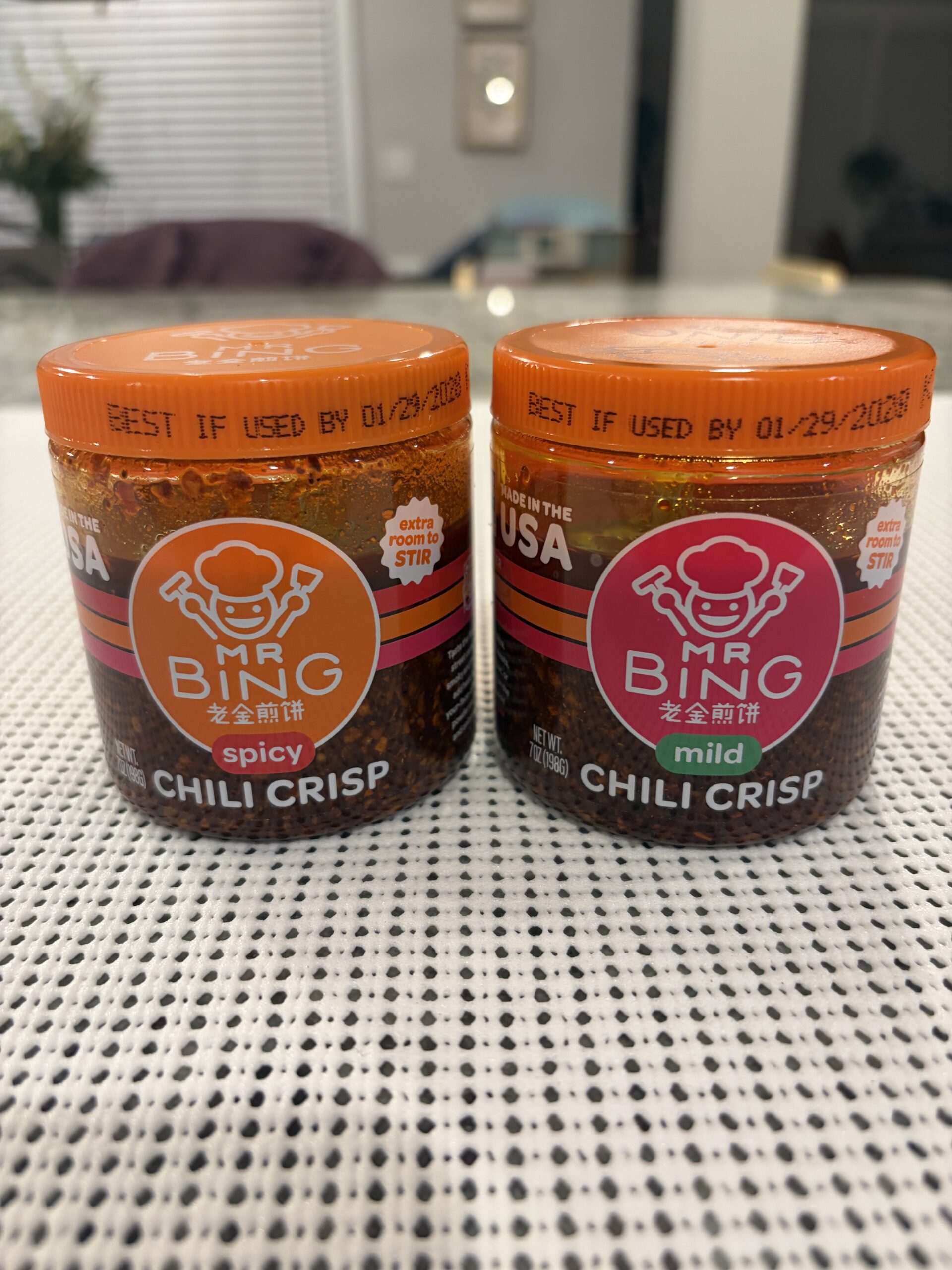
Mr. Bing sells a chili crisp Mild and a Spicy. You can buy them individually at $9.99 each or as a two-pack for $18.99. I tested both side by side for this Mr. Bing chili crisp spicy vs mild comparison. The core question: are these two different products with different strengths, or the same product with a heat dial turned up?
I already covered each one in full — the Mild review and the Spicy review break down the individual jars. This post is about what happens when you put them next to each other.
Comparison Table
Tiers reflect in-context comparison performance. Individual review tiers may differ.
| Element | Mild | Spicy |
|---|---|---|
| Category | Chili Crisp | Chili Crisp |
| Oil | Canola (passive) | Canola (passive) |
| Heat | 1/5 — whisper | 3/5 — true medium |
| Crunch | Very crunchy, uniform, fine | Identical |
| Sugar | Yes (turbinado) | Yes (turbinado) |
| Chili Peppers | Guajillo, gochugaru (specified) | Not specified on label |
| Spices | Not specified on label | White pepper, Sichuan peppercorn |
| Price | $9.99 / ~6 oz actual | $9.99 / ~6 oz actual |
| Per oz | $1.67 | $1.67 |
| Tier | AVERAGE | AVERAGE |
What These Two Jars Share
Almost everything. Same oil, same base ingredients, same finely ground texture, same jar fill level (about 80% — branded as “Extra Room to Stir”), same wet-sand sediment, same cloudy oil after stirring. Open them side by side and you cannot tell them apart visually. Same dark brown oil color, same amount of finely ground bits, same powdery substance suspended in the oil. Swap the lids and you’d never know.
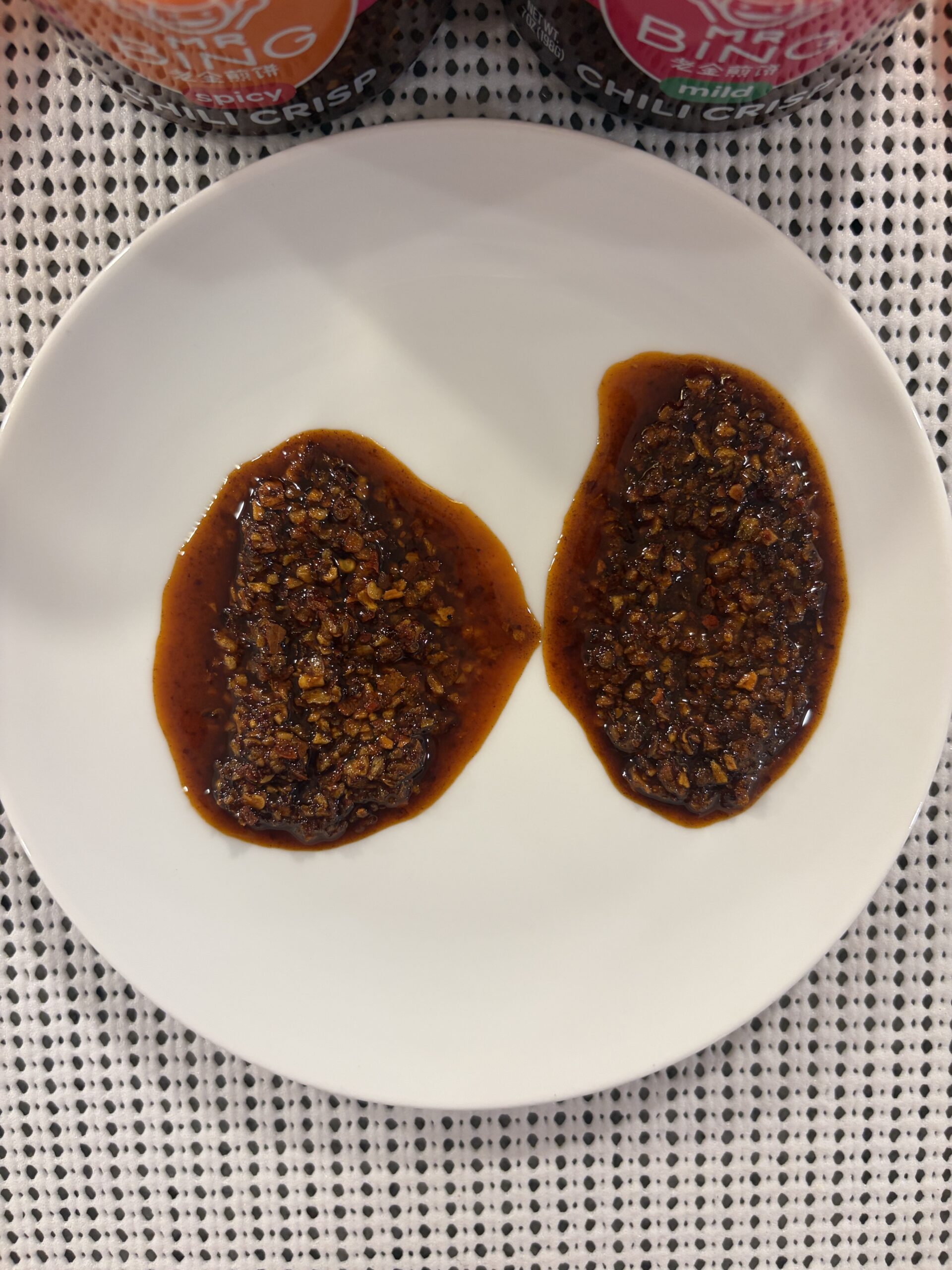
The shared DNA runs deeper than appearance. Both use non-GMO expeller-pressed canola oil as the base — a clean but passive oil that doesn’t contribute flavor independently. Both have turbinado sugar creating that dense, packed sediment. Both have mushroom powder as the main umami driver. Both use rice bran (purpose unclear — possibly crunch structure, possibly filler). Both have the same everything bagel seasoning crunch — dried onion and garlic ground to a very fine, very uniform consistency.
The oil alone tastes the same in both: mostly salty, slight spice, minimal flavor contribution. Both are split-jar products — the bits do the work, the oil is just a vehicle.
Aroma — Same Umami, No Preview of the Heat Gap
Open both jars side by side and the first thing you notice is how similar they smell. Both lead with mushroom umami — that slightly bonito-adjacent note from the mushroom powder. Both have dried garlic and onion underneath. Neither gives you any preview of the heat difference that’s coming.
The Spicy reads slightly more mushroom-forward to my nose, while the Mild has a faintly sweeter dried-onion quality. But these are marginal differences you’d only catch with both jars open simultaneously. Close your eyes and you couldn’t reliably tell which jar you’re smelling. Neither aroma evolves after stirring — what you get when you crack the lid is what you get five minutes later. Compare that to a jar of Lao Gan Ma, where stirring releases toasted chili depth the sealed jar doesn’t hint at. The aroma test confirms what the visual test already told you: these are the same product with different amounts of chili pepper. Everything else is shared.
The Label Shell Game
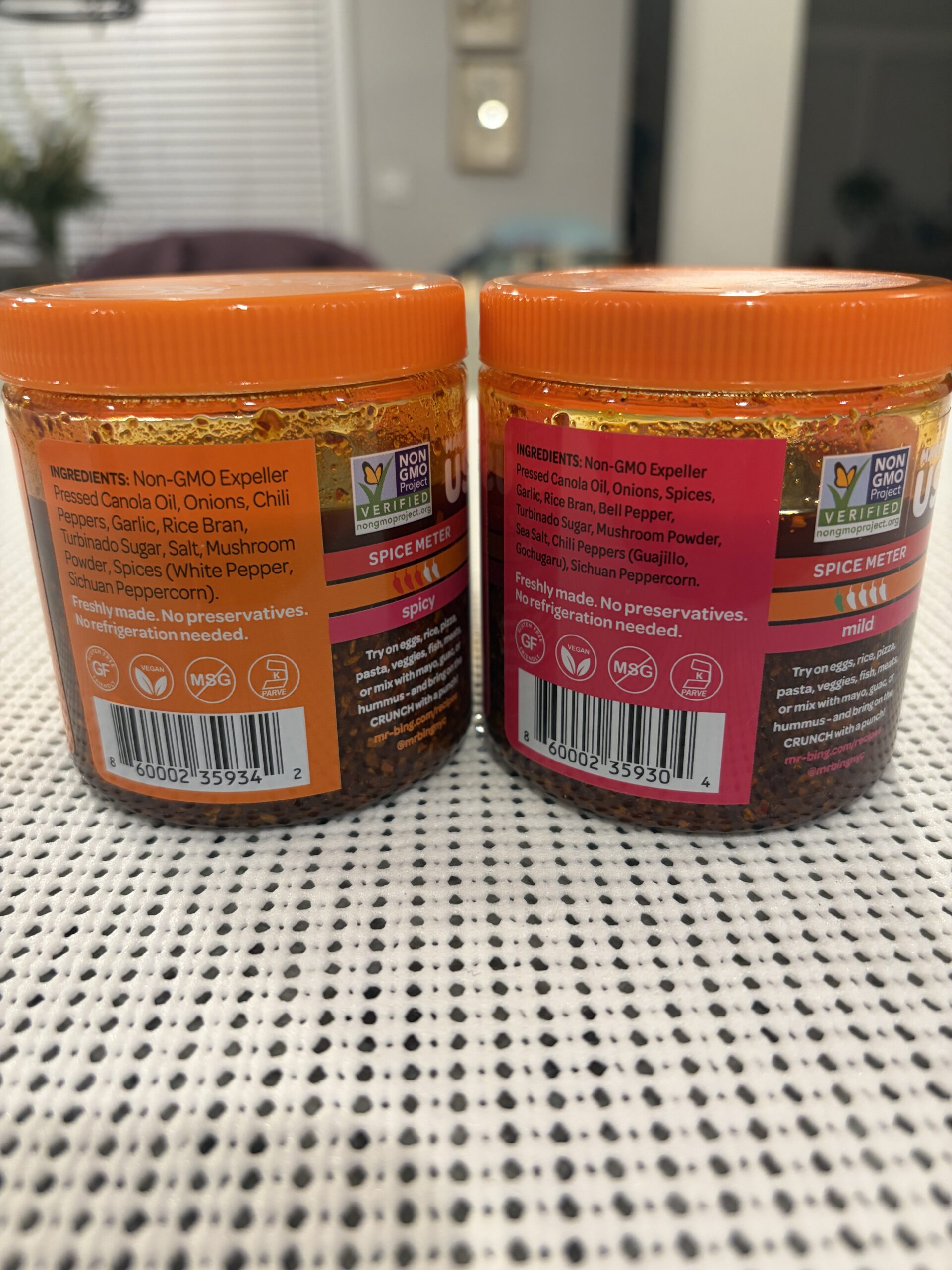
Same ingredients, different order, different things hidden. This is the most interesting detail about the Mr. Bing lineup, and you’d miss it if you only bought one jar.
The Mild label specifies the chili pepper varieties — guajillo and gochugaru — but lists “spices” with no parenthetical. The Spicy label specifies the spices — white pepper and Sichuan peppercorn — but lists “chili peppers” with no variety. Each label reveals what the other hides. Whether this is deliberate proprietary protection or just inconsistent labeling, the result is the same: you need both jars to get the full picture of what’s actually in this product.
The other key difference: on the Spicy jar, chili peppers jump to third position in the ingredient list — right after onions. On the Mild, they’re near the bottom. That’s a real difference in proportion, not just a heat additive. The Spicy genuinely has more chili material in the jar. Everything else is in the same relative order.
Mr. Bing Chili Crisp Spicy vs Mild — The Heat Changes Everything
The Spicy Experience
Spice hits first — immediate heat on contact, no warmup. Then a big hit of sweetness and saltiness right behind it. By the time any subtle flavors might arrive — mushroom, dried garlic, whatever the chili peppers are supposed to bring — your palate is already overwhelmed by three competing sensations. Heat, sweet, salt. That’s the entire sequence. Any nuance is lost behind the wall.
The Mild Experience
No big spice hit up front, which lets other flavors emerge first. The saltiness is dialed back compared to the Spicy. Initial sweetness from dried onions, dried garlic, mushroom umami — these come through before anything else. It’s more muted overall, but a nicer progression. Heat shows up after everything else fades — lingers on the tongue as a whisper. You barely notice it was there when everything else was in your mouth.
Which Tastes Better?
The Mild tastes a bit better. Not because it’s a better product in absolute terms, but because the reduced heat lets more flavor come through. The Spicy’s only real differentiator is heat, and that heat has no chili character — it’s anonymous burn that could come from any pepper prepared any way. Neither delivers on the “four smoky and fruity peppers” label promise. You won’t taste smokiness. You won’t taste fruitiness. The Sichuan peppercorn should contribute a fruity, tingly quality when prepared correctly — it doesn’t show up in either jar.
Texture — Identical, for Better and Worse
Same crunch in both. Super crunchy, very fine, completely uniform. Like chewing directly on dried garlic and dried onions — everything bagel seasoning in wet form. Both could have benefited from more variety in bit size. Neither has anything chunky, nothing that pops, nothing that surprises on the fifth forkful that wasn’t there on the first.
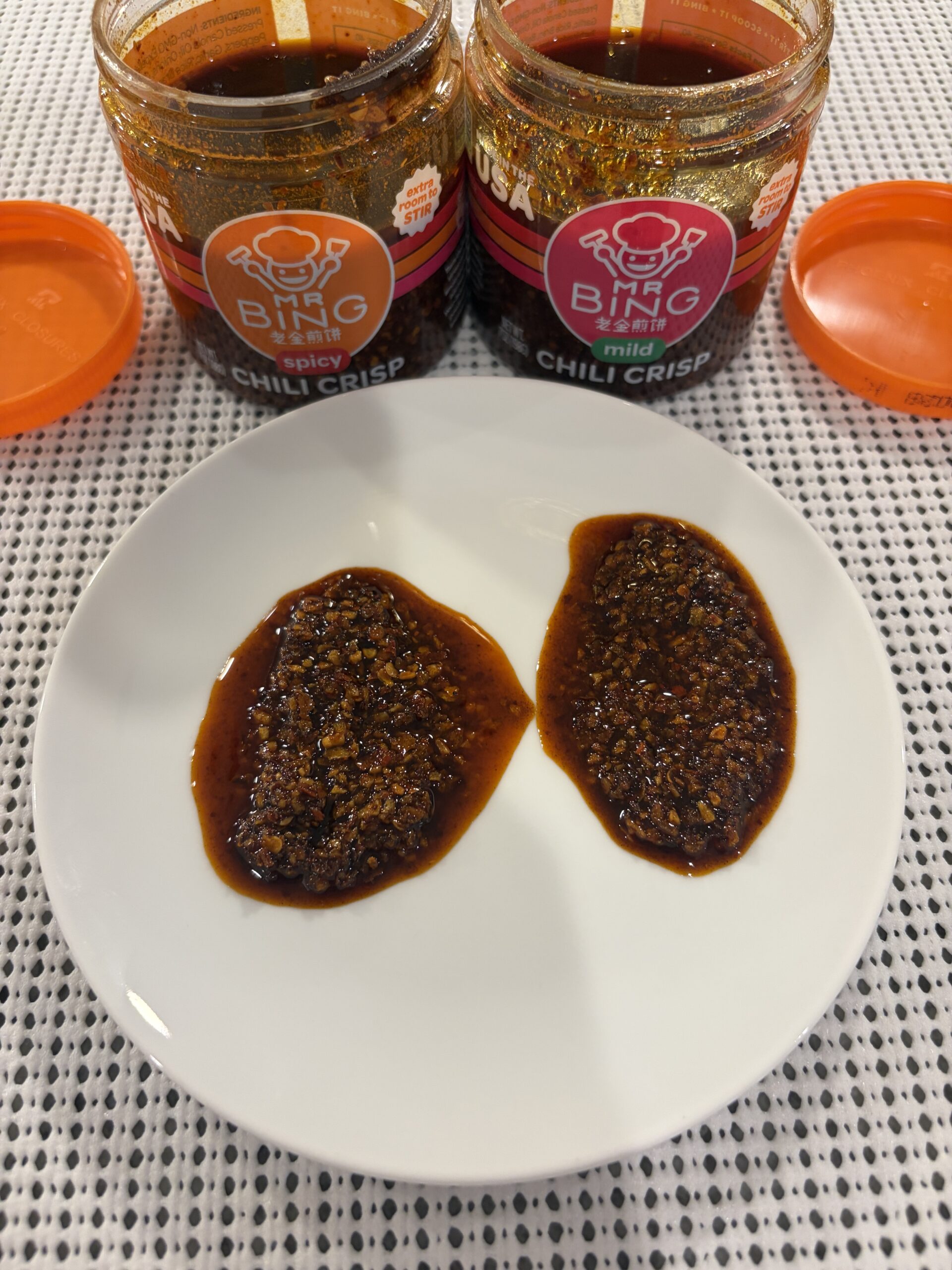
The fine bits have one advantage: they’d spread nicely through dips and across noodles or dumplings. That functional quality holds for both jars equally.
“Extra Room to Stir” — Clever or Convenient?
Both jars are about 80% full with a branded headspace — “Extra Room to Stir.” At least they know you need to stir it. But the counterpoint: if the jar had more product and less sugar-heavy sediment that packs down like wet sand, you wouldn’t need the extra room. The dense settlement is a consequence of the formulation — turbinado sugar sinks and compacts. The headspace is a feature born from a problem. Both jars label 7 oz but deliver closer to 6 oz of actual product. At $9.99 each, that shifts your real per-ounce cost from $1.43 to about $1.67.
Which One for What
If you want flavor: The Mild. Reduced heat lets mushroom umami, dried garlic, and dried onion emerge. It’s still not complex, but there’s more to taste.
If you want heat: The Spicy. It’s a true medium — comfortable for most, not intimidating. Just know that the heat doesn’t bring any chili character with it.
If you want the best version of Mr. Bing: Mix them. Two scoops Mild, one scoop Spicy. The Mild provides better flavor balance. The Spicy adds the heat the Mild lacks. Together, they’re closer to what a single well-formulated jar would be.
If you want something better: Lao Gan Ma Spicy Chili Crisp delivers more flavor complexity at roughly half the per-ounce price. The Momofuku Original is the closest parallel in approach and price — same USA-made, fine-grain, sweet-salty formula — and also rated AVERAGE.
Specific Food Pairings
Dumplings: The Mild. You want to taste the dumpling filling, and the Mild adds crunch without burying pork-and-ginger notes underneath salt and heat. The fine bits spread across each piece evenly — no clumps.
Noodles: Either works, but the Spicy has an edge. Noodles can absorb the heat, and the fine uniform bits distribute across a bowl better than chunkier crisps would. Toss with sesame oil and soy sauce first, then top with Mr. Bing.
Eggs: The Mild, but barely. The salt-and-sugar combination in both variants runs heavy for eggs. If you’re putting chili crisp on eggs regularly, reach for Lao Gan Ma instead — it won’t flatten the egg’s own flavor.
Mixed into guac or hummus: The Mild. Its fine bits blend into dips seamlessly, and the mushroom powder umami works well with avocado. The Spicy would make any shared dip uncomfortably hot for most people at the table.
Pizza: The 2:1 mix. Pizza already has salt and fat working for it — the crunch adds texture and the controlled heat from the mix doesn’t fight the cheese and sauce. Sprinkle it on after the first bite to see how it plays with your specific pie.
Is the Two-Pack Worth It?
The two-pack runs $18.99 on Amazon — versus $9.99 per jar individually. That’s a dollar off. Not a screaming deal, but if you’re going to try Mr. Bing, the two-pack is the right move. You want both variants anyway (the mixing ratio is the best use case), and buying them separately makes even less sense at full price.
The real value question is whether Mr. Bing is worth $18.99 at all when you could get a large jar of Lao Gan Ma for under $5 and a jar of something else with the remaining $14. At the AVERAGE tier, Mr. Bing is competing with products that cost less and deliver more.
The Verdict
Mr. Bing’s Mild and Spicy are the same product at different heat levels — same crunch, same oil, same limitations. The Mild has better flavor progression. The Spicy adds heat that carries no chili character. Neither justifies a $10 jar on its own. Mix them 2:1 Mild-to-Spicy and you get closer to what a single good jar should be — but that means spending $20 to build one decent condiment from two average ones. The crunch is legitimate, the ingredient list is clean, and the mushroom powder is a nice idea that never gets room to breathe. For $18.99, you’re paying a premium for a mixing project. Check the two-pack price on Amazon.
Frequently Asked Questions
What’s the difference between Mr. Bing spicy and mild chili crisp?
The main difference is heat level — the Spicy rates 3/5 and the Mild rates 1/5 on Mr. Bing’s own scale. Visually and texturally they’re identical. The Spicy has more chili peppers (higher on the ingredient list) and specifies white pepper and Sichuan peppercorn. The Mild specifies the chili varieties (guajillo, gochugaru) but hides the spices.
Is the Mr. Bing two-pack worth buying?
The two-pack is $18.99 versus $9.99 each individually — a dollar savings. If you’re going to try Mr. Bing, the two-pack makes sense because the best use case is mixing both jars together. But at the AVERAGE tier, there are better chili crisps available at lower per-ounce prices.
Which Mr. Bing chili crisp should I start with?
The Mild. It has better flavor balance because the reduced heat lets mushroom umami, dried garlic, and onion come through. The Spicy’s heat overpowers the other flavors without adding chili character.
Can you mix Mr. Bing spicy and mild together?
Yes — that’s actually the recommended approach. A 2:1 ratio of Mild to Spicy gives you the Mild’s cleaner flavor progression with enough heat to make it interesting. It’s the closest you’ll get to what a single well-formulated jar would taste like.
How spicy is Mr. Bing spicy chili crisp?
It’s a true medium — Mr. Bing rates it 3 out of 5, which is accurate. Comfortable for most people with moderate spice tolerance. The heat lingers but isn’t overwhelming.
Are Mr. Bing chili crisps vegan and gluten-free?
Yes. Both Mild and Spicy are Vegan, Gluten-Free, Non-GMO, No MSG, No Preservatives, and K Parve (kosher pareve). Made in the USA with non-GMO expeller-pressed canola oil.
How does Mr. Bing compare to Lao Gan Ma?
Very different products. Lao Gan Ma has large visible chunks, clear oil, and identifiable chili flavor at roughly half the per-ounce price. Mr. Bing has fine uniform bits, cloudy oil, and heat without chili character. LGM is rated GOOD; both Mr. Bing variants are AVERAGE.