
This post contains affiliate links. I may earn a small commission if you buy through them — at no extra cost to you. My scores are never influenced by this.
NPG Sichuan Chili Oil Review — What You’re Getting
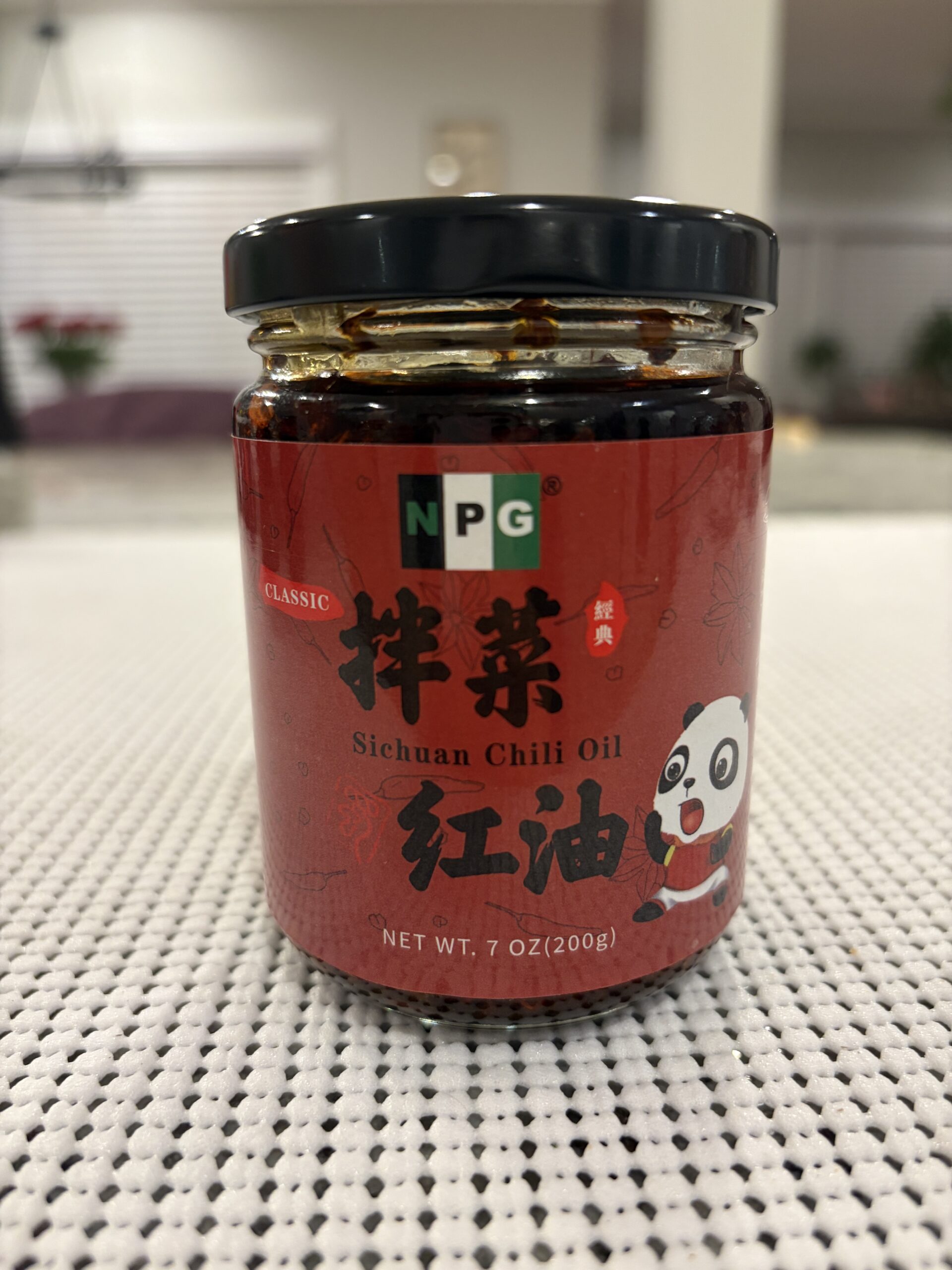
This NPG Sichuan chili oil review covers a product I’ve been curious about since it started showing up in grocery stores. NPG stands for Natural Plus Green Inc., based in Flushing, New York. This is their Classic Sichuan Chili Oil — a chili oil marketed as pure Sichuan style, though if you read the ingredient list first (which you should), you’ll notice something interesting. More on that in a moment.
You get seven ounces for $11.99, which works out to $1.71 per ounce. Not cheap, not expensive. Available on Amazon and in most grocery stores where the chili section lives.
Quick Facts
| Field | Value |
|---|---|
| Brand | NPG (Natural Plus Green Inc.) |
| Product | Classic Sichuan Chili Oil (Pure) |
| Category | Chili Oil |
| Style | Sichuan-Chinese |
| Oil | Soybean |
| Heat | 4/5 |
| Price | $11.99 |
| Size | 7 oz |
| Per oz | $1.71/oz |
| Made in | USA / sourced globally |
| Buy | Amazon |
| Tier | GOOD |
Serving Size Note
One tablespoon per serving — I like that. The label is being honest about how much you’ll actually eat. About one gram of added sugar per serving, which is reasonable for something this savory.
Ingredient Quality — The Doubanjiang Angle
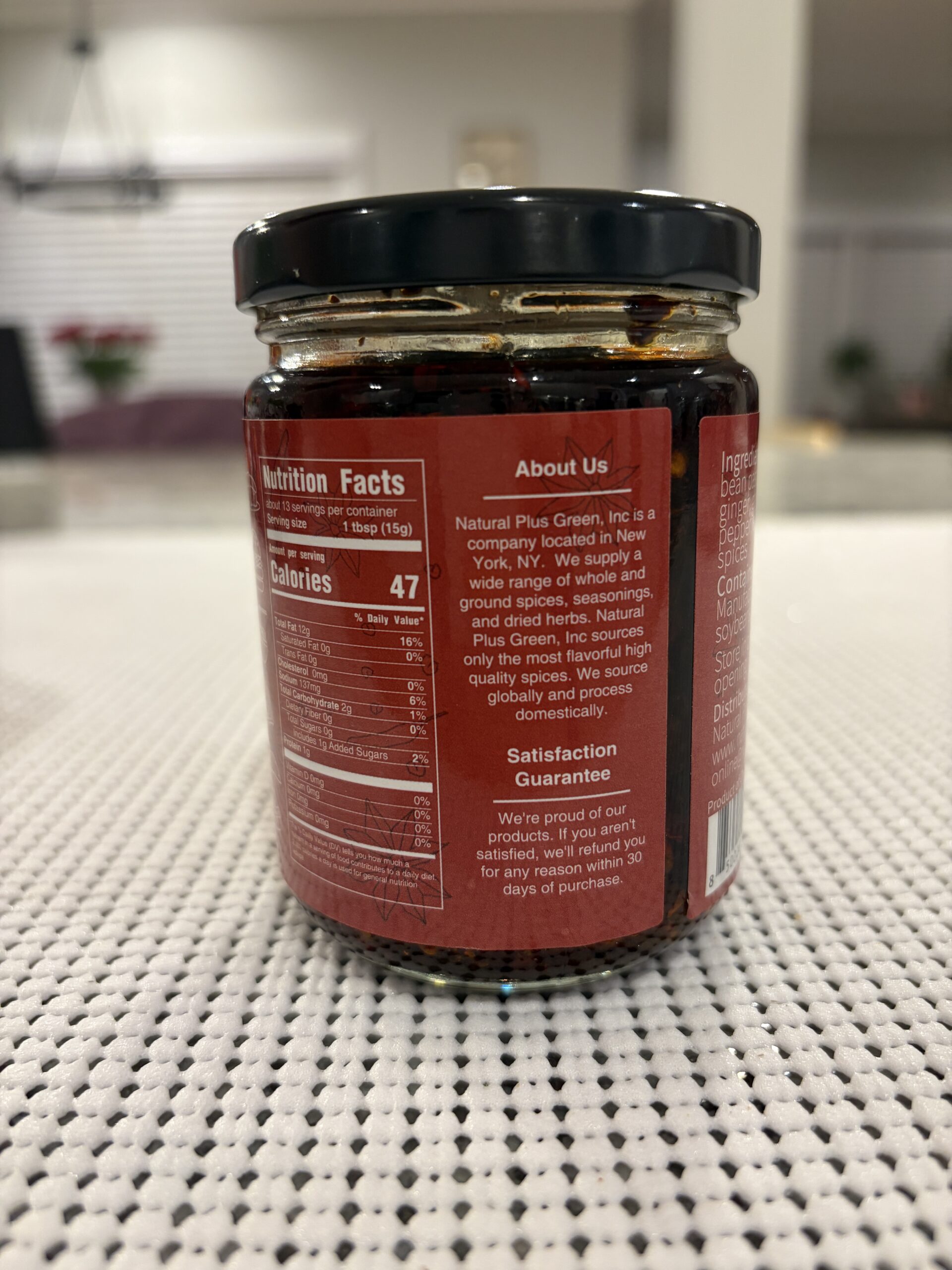
Read this ingredient list and you see what I see: Soybean oil, Pixian broad bean paste, soy sauce, vinegar, peanut, ginger, garlic, sesame seed, Sichuan pepper, Sichuan chili, salt, sugar, MSG, spices.
Pixian broad bean paste — that’s doubanjiang — is number two on the list. This is not a chili oil that happens to have umami background. This is a doubanjiang product disguised as a chili oil. The fermented bean paste is doing more structural work than the chili.
That’s not a complaint. It’s just the reality of what you’re buying. If you’ve had Sichuan-style chili oils before, you know what fermented black bean brings to the table — depth, salinity, a roasted undertone. Here, it’s the foundation. The soy sauce reinforces it. The chili sits on top.
Everything else is where you’d expect it. Ginger and garlic are in there (you’ll taste a sliver of each). Sesame seed for nuttiness. MSG for amplification. Clean ingredient list. No mystery fillers.
Aroma
Immediate hit on the open: Sichuan peppercorn. Toasty, not floral. That roasted note comes through — it’s the soy sauce and the fermented bean paste doing the announcing. Underneath that is roasted peanut. Really nice.
The chili doesn’t lead. If anything, it’s woven into the whole thing. You smell depth before you smell heat.
Appearance & Settlement
Dark red oil, nearly brown. Filled to the brim — bits sticking out above the oil line. Just a thin sliver of oil visible at the top. The fork sits right on top of the settlement, which tells you something: dense solids. Good structure.
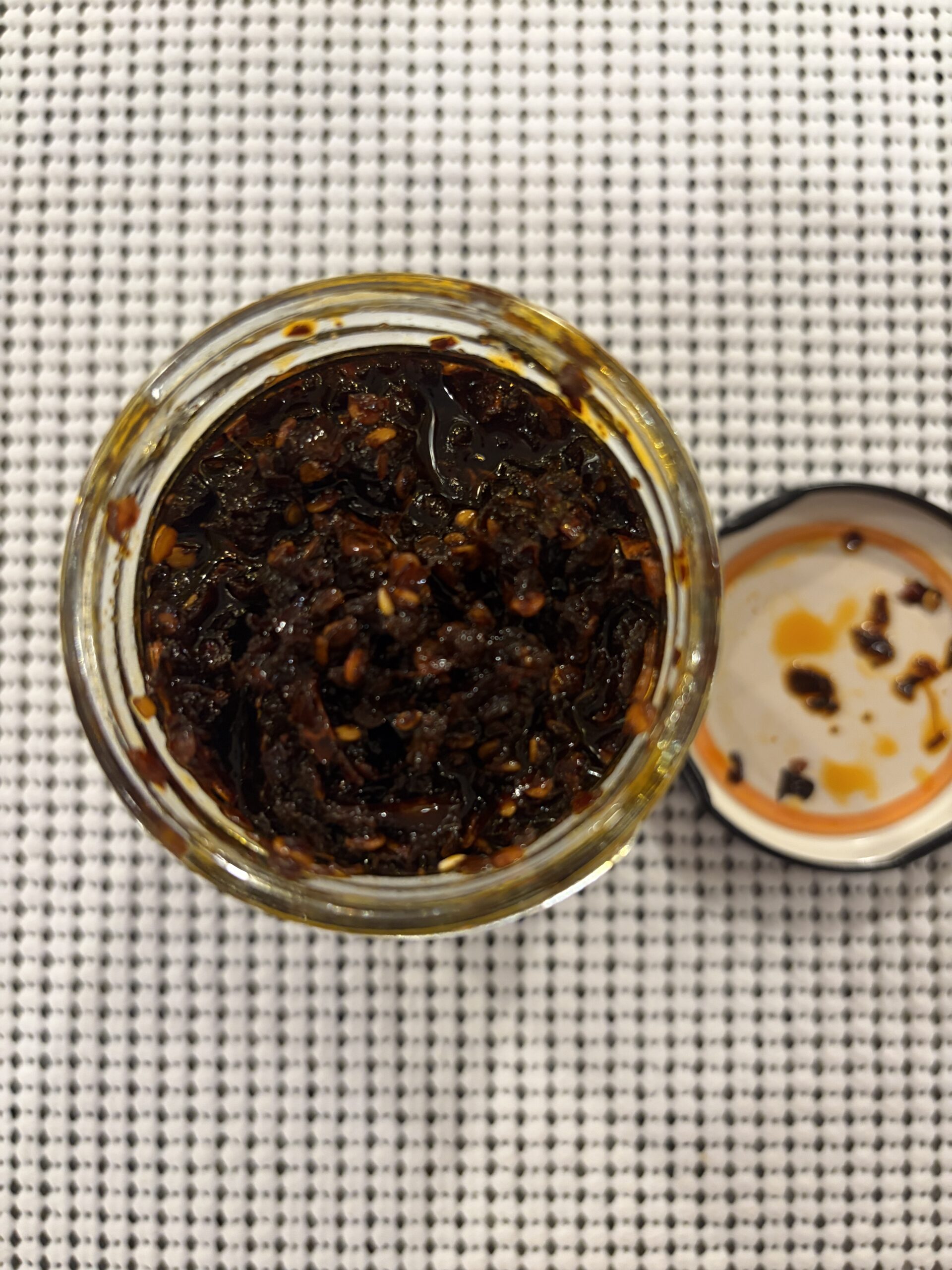
Pieces are fairly uniform with some slightly bigger chunks. You see chili flakes, chili seeds, Sichuan pepper chunks. Stirs up nicely. The consistency is chewy — more suspension than crispness. That’s the oil doing its job, letting the solids move through.
Texture & Settlement
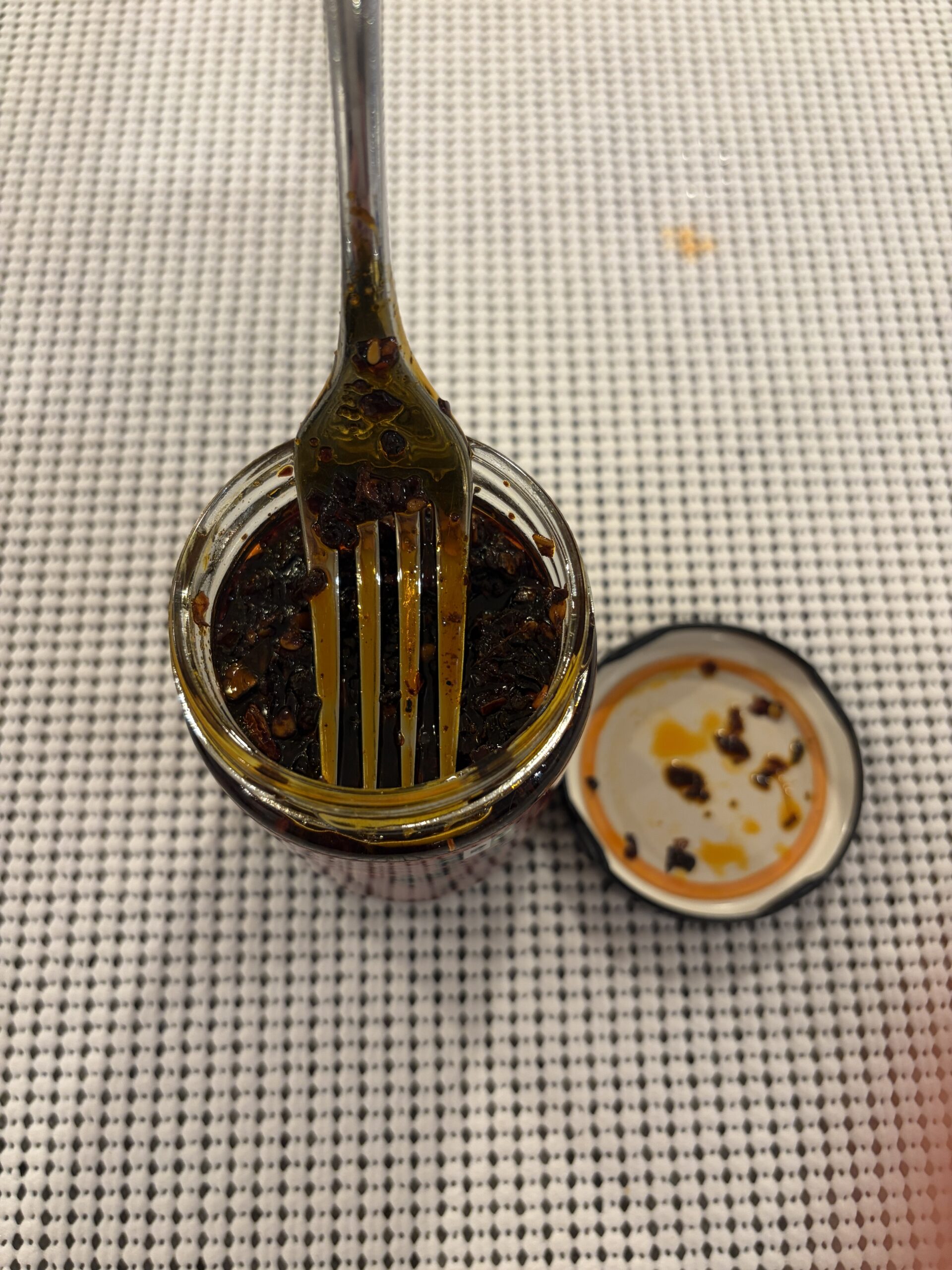
The fork sits on top before the stir — that’s the density signal I mentioned. The solids here have weight. Post-stir, pulling the fork out shows bits clinging to the tines with oil trailing behind. More chewy than crunchy, which is what I like in a chili oil. The bits don’t dissolve immediately on warm food, which means they’ll travel.
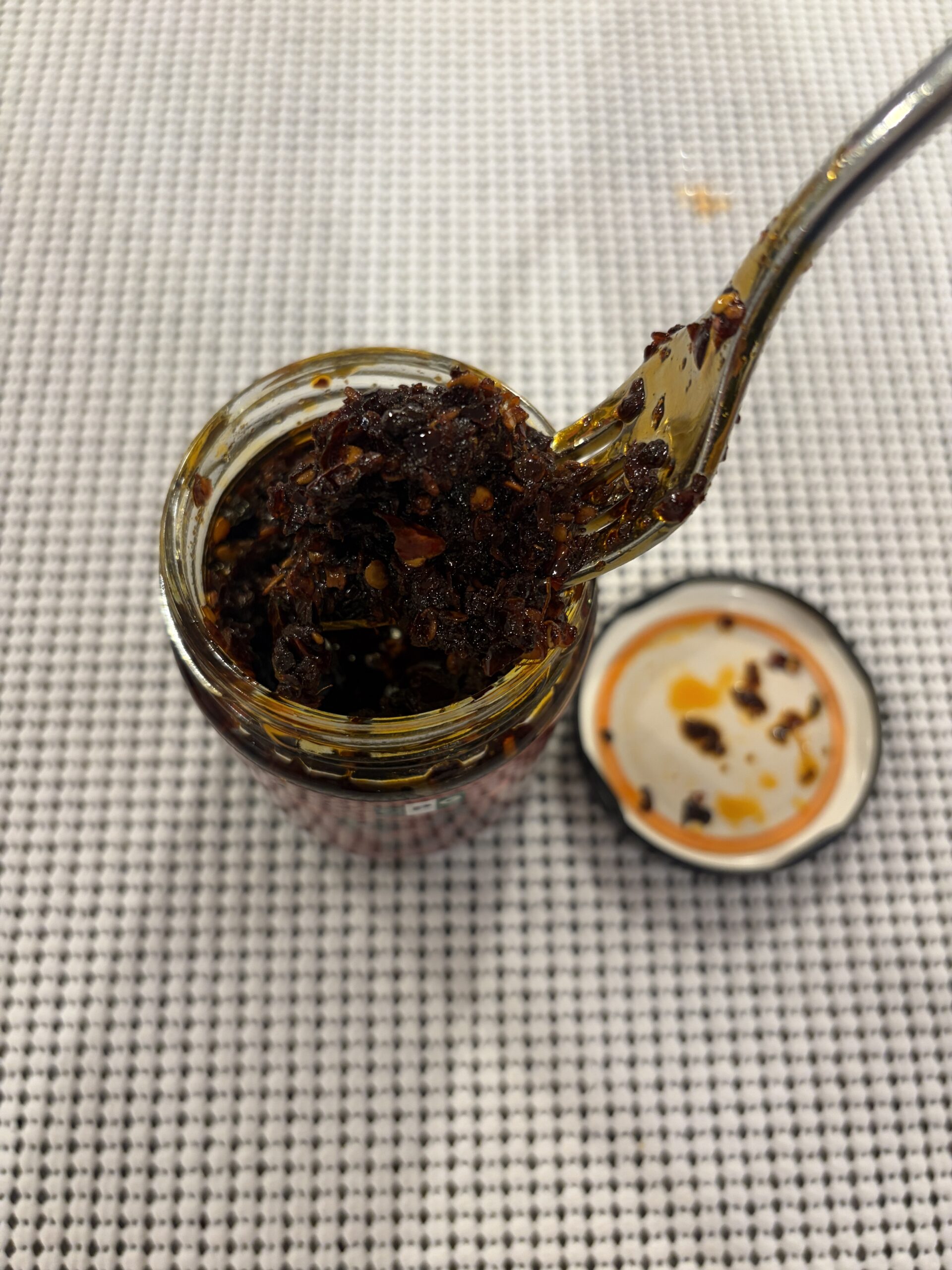
The texture is fine. You’re not fighting soggy paste or dry crumbs. Everything moves together as intended.
Flavor Complexity
First taste — mixed fork, oil and bits together. It chewy. Sichuan peppercorn chewy. The bean paste presence shows up immediately. Heat very much up front, right on the tongue. Sweetness and MSG follow. Spicy. Very tasty.
The flavor timeline is compressed — it all arrives at once, then the heat builds. The oil alone is where you notice the fermented base most. Dip a fork, get just oil, and you taste the roasted soy and bean paste loudly. The chili bits are the vehicle carrying that through.
Residual flavors after the heat fades: some sweetness, soy background, umami. You don’t get a lot of peanut in the finish despite it being fourth on the list — it’s there in the aroma more than the taste. Ginger is subtle. Can’t really taste the garlic. The MSG is noticeable (which is the point). The Sichuan chili comes through with the spice.
This is a whole jar concept. The oil and bits work together by design. You could eat this straight from the jar or use it in cooking. They’re not two separate things pretending to be one product. The oil is doing flavor work. The bits are adding both texture and heat. It’s unified.
Heat
Two types of heat here: Sichuan peppercorn numbing and straight chili burn. Both hit right away. The peppercorn tingle packs the tongue. The chili adds a secondary burn that goes to the back of the throat. Not the top of the mouth or the sides — you feel it traveling down.
Heat intensity: 4/5. It’s hot enough that you’re aware of it for a full minute. It doesn’t stick around forever, but it doesn’t fade quickly either. The mouth settles in after that residual burn, which is manageable. This is genuinely spicy but not punishing.
Heat doesn’t kill the other flavors. If anything, it amplifies them. The sweetness reads cleaner. The umami gets sharper. You can handle eating through a whole spoonful without needing a break.
Use Cases & The Mixing Angle
This works on almost everything savory. Eggs, rice, dumplings, noodles, roasted vegetables. I tried it on pizza and it legitimately worked — the oil carries the Sichuan peppercorn flavor, and the chili bits stick to the surface.
This also cooks well — the soybean oil base handles heat, and the fermented flavor deepens when stir-fried into a dish.
For mixing: this is a great candidate to pour into something that needs more depth but less spice. Your classic move is to eat half a large jar of something forgiving (like Lao Gan Ma), then blend in half of NPG. You get the crunch and color of LGM, the depth and fermented umami of NPG. Or if you have a jar like Momoya Rayu that’s all oil and needs more texture, NPG’s bit density helps.
It’s also a standalone jar. You don’t need to blend it. It’s complete on its own terms.
Versatility & Packaging
The jar is a standard condiment bottle — no special pour spout, just a twist cap. The label is cute — panda branding with food icons (sushi, burgers, noodles, pizza, tacos, hot dogs, buns). Does what it needs to.
Practical note: the label includes a 30-day refund guarantee. First one I’ve seen on a chili oil. That’s a confidence signal. It tells me the brand stands behind the product enough to let you try it risk-free. That matters.
The seven-ounce size is practical for home cooking — not so large you’re sitting on an old jar, not so small you’re constantly reordering. Price per ounce is fair for the ingredient quality and the fermented base.
Final Verdict
Tier: GOOD
NPG Sichuan Chili Oil is a solid product. It does what the label promises — it’s a Sichuan-forward oil, doubanjiang-driven, with solid heat and real ingredient work. Not great. Not extraordinary. But genuinely good representation of the style. Available in most grocery stores. Available on Amazon. Worth the money if you want a umami-heavy chili oil that you can use both as a condiment and in cooking.
The doubanjiang angle matters here. If you’re expecting straight chili heat, you’ll be surprised. If you’re looking for fermented umami with a heat backbone, this is what you’re looking for.
Frequently Asked Questions
Is NPG Sichuan chili oil spicy?
Yes. It’s a 4/5 on the heat scale — genuinely hot. The heat comes in two forms: Sichuan peppercorn numbing and chili burn. Both hit immediately and last about a minute, then settle into a manageable residual burn.
What does NPG Sichuan chili oil taste like?
Fermented, umami-forward, and peppery. The Pixian broad bean paste (doubanjiang) is the dominant flavor note. You get roasted soy, fermented depth, then chili heat. Less about straight chili flavor, more about the Sichuan base.
Where can I buy NPG chili oil?
Amazon and most grocery stores. The brand is based in Flushing, New York. Available as a 7 oz jar for $11.99.
Does NPG chili oil contain MSG?
Yes. It’s explicitly listed in the ingredient list. MSG is used as a flavor amplifier, which is common in Sichuan condiments. The amount per serving is standard.
Is NPG chili oil better than Lao Gan Ma?
Different approach. LGM is chili-forward with soy undertones. NPG is doubanjiang-forward with chili as the secondary. Both are GOOD tier. NPG is better if you want fermented umami. LGM is better if you want pure chili heat.
What is Pixian broad bean paste?
Pixian doubanjiang — a fermented soybean and broad bean paste from China. It’s salty, roasted, and deeply umami. It’s the flavor foundation of many Sichuan condiments. Here, it’s the second ingredient by weight, so it drives the overall character.
Can you cook with NPG chili oil?
Yes. The soybean oil base handles heat well, and the fermented flavor deepens when cooked. Works for stir-fries, soups, noodle dishes, and anything that benefits from Sichuan warmth and umami. Also works as a condiment on finished dishes.