
TL;DR: This Superica Krog Street salsa macha review is different from anything I’ve published before. This isn’t a jar you buy online. It’s a restaurant-made salsa macha served at Superica on Krog Street in Atlanta — and it’s the condiment that started my entire salsa macha obsession. Three named dried chilies, toasted peanuts, sesame seeds, Mexican oregano, and a preparation method that no shelf-stable jar can replicate. EXCELLENT.
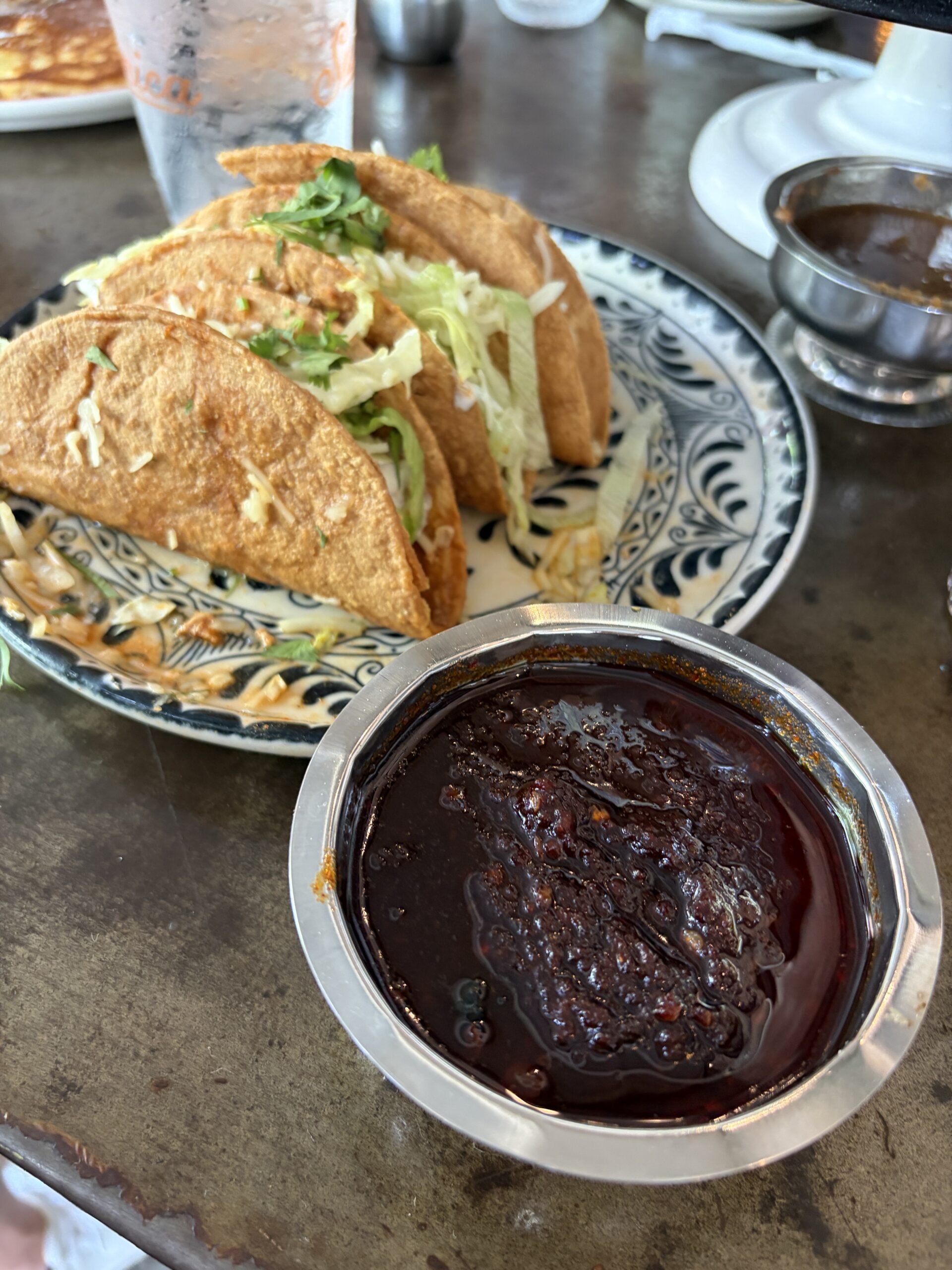
The One That Started It All
Every reviewer has a product that cracked open a category for them. For me and salsa macha, it was a metal ramekin at a Tex-Mex restaurant in Atlanta.
I’ve been going to Superica on Krog Street for years. It’s part of Rocket Farm Restaurants, the group behind some of Atlanta’s best spots. One visit, I noticed a dark, thick condiment served alongside their tacos. I tried it. Then I tried more of it. Then I asked the kitchen about it. That was the beginning.
What I tasted that day was smoky, sweet without any sugar, and the heat built in layers. I reached for my margarita, then reached right back for another bite. It was so far from the chili crisps I’d been reviewing that I had to understand what it was. The kitchen was generous enough to share the actual recipe card. I’ve been chasing that experience in every jarred salsa macha I’ve reviewed since.
This review is the origin story. Not a retail product. Not available on Amazon. A restaurant condiment made in 16.5-quart batches with a seven-day shelf life, served at one specific location in Atlanta. I’m reviewing it because it deserves to be documented. Every jarred salsa macha I’ve tested since has been measured against this one, whether I meant to or not.
Quick Facts
| Brand | Superica (Rocket Farm Restaurants, LLC) |
| Product | Salsa Macha |
| Category | Salsa Macha |
| Style | Mexican (restaurant-made) |
| Oil | Canola Oil |
| Heat | 3/5 (Medium: layered, building) |
| Price | N/A (restaurant condiment) |
| Size | Made in 16.5 qt batches / 7-day shelf life |
| Per oz | N/A |
| Made in | Atlanta, GA (Superica Krog Street kitchen) |
| Buy | In-person only — Superica Krog Street, Atlanta |
| Tier | EXCELLENT |
No serving size on a label because there is no label. It arrives in a small metal ramekin alongside your food. You use as much as you want. Hard to argue with that.
About Superica and Rocket Farm Restaurants
Superica is part of Rocket Farm Restaurants, LLC, the Atlanta-based group behind several well-known restaurants in the city. The Krog Street location sits in the Krog Street Market area — one of Atlanta’s best food corridors. The menu is Tex-Mex with serious kitchen chops. The salsa macha isn’t a menu headliner. It shows up as a condiment, paired with dishes like their cauliflower tacos and diablo shrimp. But it’s the best thing on the table.
Here’s why that matters for a site like this. Superica’s kitchen team is making this from scratch, in-house, in large batches. They shared their recipe card with me when I asked, which tells you something about how they operate. No trade secrets, no posturing. They handed me the recipe card. The difference is in the execution.
Superica Krog Street Salsa Macha: Ingredient Quality
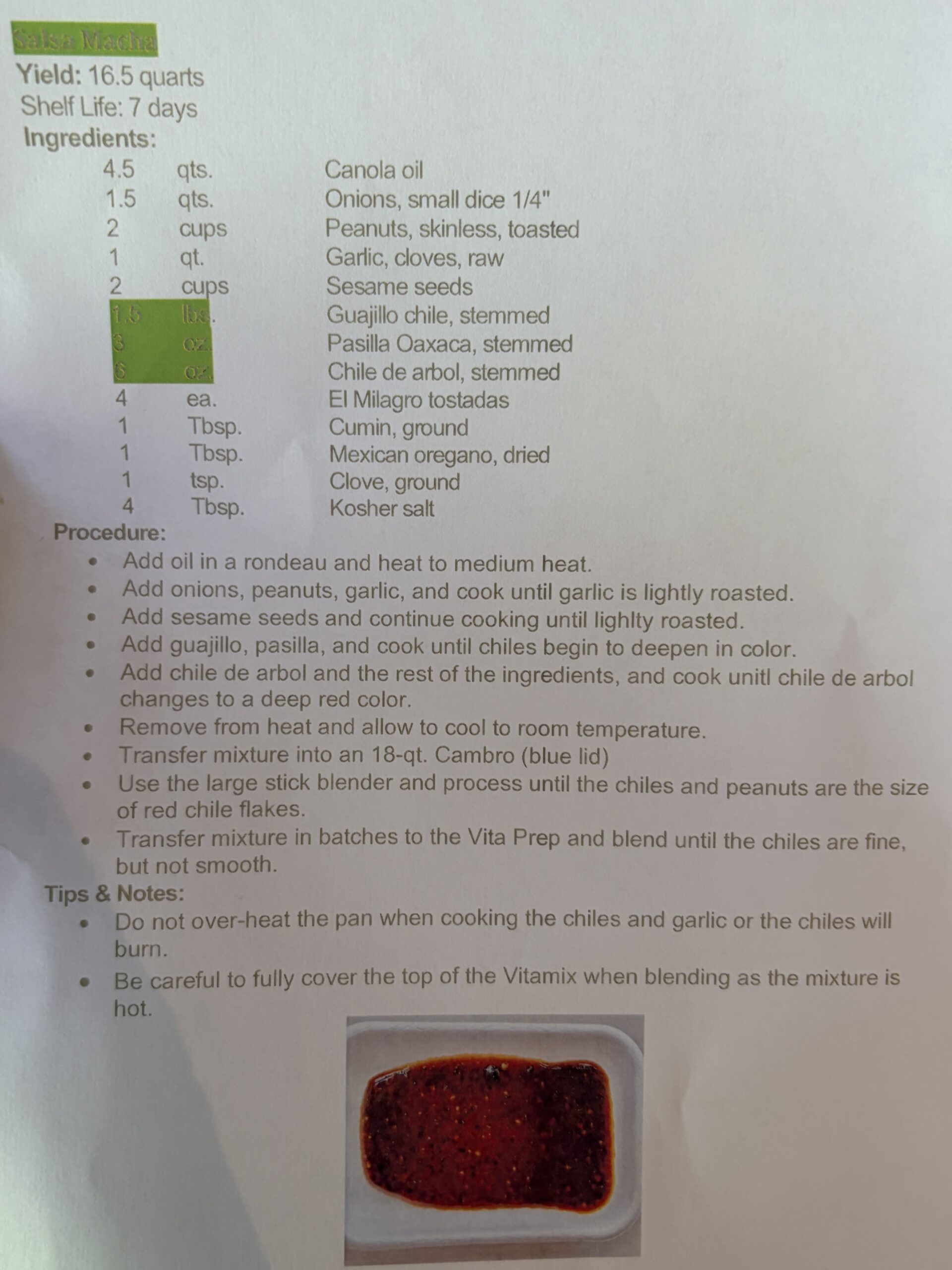
This is where a restaurant-made salsa macha separates itself from what sits on a store shelf. I have the actual recipe card from the Superica kitchen, and the ingredient list is serious.
The full list, in order of volume: canola oil, onions (small diced), peanuts (skinless, toasted), garlic cloves (raw), sesame seeds, guajillo chile, pasilla Oaxaca, chile de árbol, El Milagro tostadas, cumin, Mexican oregano, clove, and kosher salt.
Three things stand out.
First: three named dried chili varieties. Guajillo, pasilla Oaxaca, and chile de árbol. That’s not “dried chilies” as a catch-all — that’s a deliberate selection. Guajillo brings mild, fruity warmth. Chile de árbol delivers sharp, direct heat. And pasilla Oaxaca — that’s the one that sets this apart. It’s a smoked chili from Oaxaca, and it’s not something you see in commercial salsa macha. The Veracruz tradition typically leans on árbol and morita. Pasilla Oaxaca is a choice, and it’s a good one. It brings a smokiness that runs deeper than chipotle or morita.
Second: El Milagro tostadas. Corn tortillas as an ingredient. I’ve seen this technique before — Don Pepe uses corn tortilla for body and texture in their morita macha. Both use it for structure and a toasted corn undertone. One’s a restaurant in Atlanta, the other a small brand out of Dallas. Same technique. It works. The tostada breaks down during blending and becomes part of the paste’s body — you don’t taste “tortilla,” but you feel the thickness it creates.
Third: Mexican oregano and clove. Mexican oregano is not the oregano in your spice rack. It’s earthier, slightly citrusy, and it plays differently with chili than Mediterranean oregano does. Clove is an unexpected addition — you see it in some mole recipes. In small amounts it adds a warmth that sits underneath everything else. A teaspoon in a 16.5-quart batch is subtle by design. It’s there to deepen, not to announce itself.
The onions are small-diced, not fried shallots. That’s a traditional Mexican approach — diced onion roasted in oil rather than the shallot-crisp technique you see in Asian-influenced products. The peanuts are skinless and toasted before they go in. The garlic is raw cloves, which means it roasts in the oil alongside everything else and develops flavor during the cook rather than arriving pre-fried.
No sugar. No preservatives. No MSG. No mystery ingredients. A seven-day shelf life because there’s nothing in here designed to extend one. That’s the trade-off of fresh production — and it’s exactly why this tastes the way it does.
How It’s Made — And Why It Matters
The recipe card includes the full preparation method, and it’s worth understanding because it explains the flavor.
Everything starts in a rondeau: a wide, shallow pan — with canola oil at medium heat. The onions, peanuts, and garlic go in together and roast until the garlic is lightly golden. Then the sesame seeds join and continue roasting. Then the guajillo and pasilla Oaxaca go in, cooking until the chilies deepen in color — that’s when dried chilies release their oils and the flavor concentrates. The chile de árbol goes in last with the remaining dry ingredients, cooking until the árbol turns a deep red.
After cooling, everything transfers to a Cambro and gets hit with a stick blender until the chilies and peanuts are the size of red chile flakes. Then it goes through a Vita Prep in batches: blended fine, but not smooth.
The two-stage blending is what does it. The stick blender breaks things down. The Vita Prep refines the texture without turning it into a paste. The result is a salsa macha that’s uniformly fine-grained — no big chunks, no whole peanut halves — but still has grit and body. It’s not a sauce. It’s not a chunky condiment. It’s something in between, and it’s a texture you don’t get from jarred products that either go too smooth or leave the pieces too coarse.
The other thing that matters: everything roasts together. This isn’t the chili crisp approach, where aromatics are fried separately and layered into oil. Here, the onions, peanuts, garlic, and chilies all share the same oil, the same heat, the same pan. Their flavors merge during cooking, not after. That’s why it tastes unified. The components were never separate to begin with.
Aroma
You smell it before you taste it. Roasted dried chilies — the smoky, almost chocolatey depth of the pasilla Oaxaca — blended with toasted peanut and sesame. There’s a warm quality underneath from the clove and Mexican oregano, but they don’t show up individually. It smells like something that’s been cooked slowly and carefully, not assembled from separate ingredients.
If you’ve only smelled jarred salsa machas, this is a different register. The freshness of a seven-day product means the volatile aromatics haven’t had time to flatten. Everything is still alive in there.
Appearance and Settlement
This isn’t a jar, so there’s no traditional settlement check. What arrives at your table is a small metal ramekin filled with a dark, thick condiment. The color is deep reddish-brown, almost mahogany — darker than most jarred machas I’ve tested. The consistency is visibly dense. Not a lot of oil pooling on top. The body holds together when you drag a spoon through it.
The fine-grind texture is immediately apparent. No large visible chunks of peanut or chili. Instead, it looks uniformly blended with a slightly gritty surface — like wet sand made from roasted chilies. The oil is integrated into the paste rather than sitting on top of it, which tells you the blend was processed to the right consistency.
Texture and Consistency
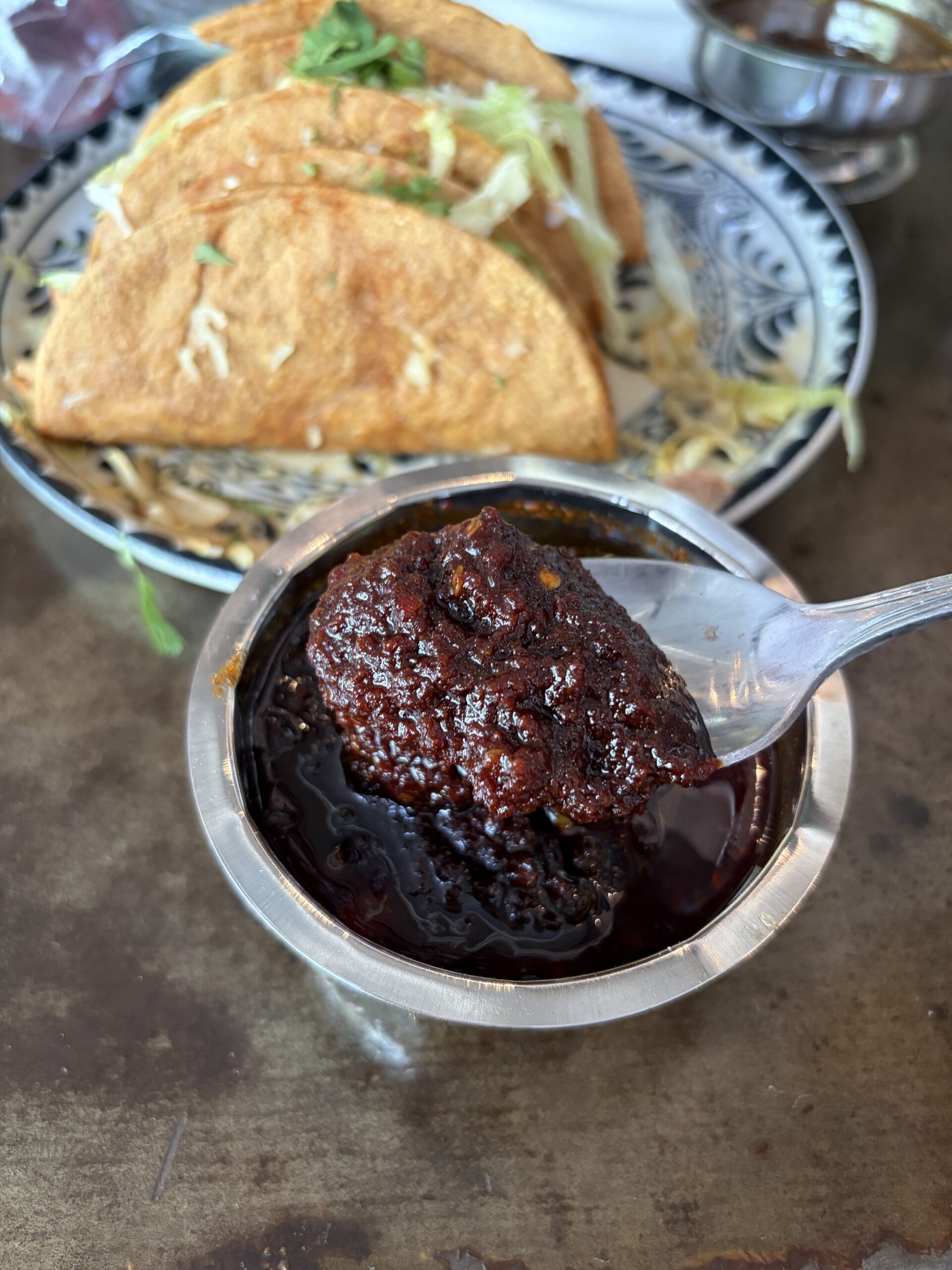
Thick. Really thick. That’s the first thing. This salsa macha has body — real, structural body. The fine grind from the two-stage blending gives it a dense, paste-like consistency that still has enough particulate texture to feel like a condiment, not a sauce.
It’s dippable on a chip without falling off. It clings to a spoon. When you pull a spoonful out, it holds its shape rather than dripping back into the bowl. That’s a different texture experience than most jarred salsa machas, which tend toward either chunky-in-oil or smooth-and-pourable. This sits in a category of its own — thick enough to spread, textured enough to chew.
The peanuts and sesame seeds have been processed down to fine grit. You feel them — there’s a sandy, nutty resistance between your teeth — but you don’t have to crunch through whole pieces. The corn tostada contributes to the body without adding any identifiable texture of its own. It’s structural, not textural. The overall effect is a salsa macha that rewards chewing but doesn’t demand it the way a chunky-style product does.
Flavor Complexity
The first thing that arrives is sweetness. Not sugar sweetness — there’s none in the recipe. This is the natural sweetness of roasted onion, toasted peanut, and sesame, all concentrated by the cooking method. It’s warm and round, and it sets the table for everything that follows.
Mid-palate, the dried chilies take over. The guajillo brings a fruity, mild warmth. The pasilla Oaxaca lays a smoky depth underneath that’s unmistakable — it’s the flavor signature of this particular salsa macha, the thing that separates it from árbol-dominant jars. The chile de árbol provides the sharpness, the edge that keeps everything from settling into soft warmth. Together, the three chilies create a layered heat profile that builds rather than hits.
The cumin, Mexican oregano, and clove work in the background. You don’t taste them as individual spices. You taste them as a collective depth — an aromatic warmth that sits beneath the chili and nut flavors and makes the whole thing feel more developed than the ingredient count would suggest. The garlic is there, roasted down into the oil, contributing savory weight without any sharpness.
What makes this work — and what makes it an EXCELLENT — is that nothing dominates. I’ve reviewed salsa machas where cumin runs the show. I’ve reviewed salsa machas where the peanuts are all you taste. Here, every ingredient is present and accounted for, but the roast-everything-together method has fused them into something that works as one thing. The sweetness balances the heat. The smokiness anchors the brightness. The nuts add body without burying the chilies. It’s the whole jar concept applied to a bowl.
The thing I keep coming back to: this is what salsa macha can be when it doesn’t need to survive six months on a shelf. No preservatives. No stabilizers. No compromises for shelf life. A seven-day shelf life means the kitchen makes it fresh, regularly, and the product you taste today is the product they intended.
Heat
Pretty spicy, but not too spicy. There’s a difference. The heat builds in layers rather than arriving all at once. Chile de árbol provides the front-of-mouth sharpness that you feel on the tongue immediately. The guajillo and pasilla Oaxaca fill in with a warmer, slower burn that spreads across the palate and lingers.
The heat is the kind that pairs with a margarita — it makes you want a sip, but it doesn’t make you need one. There’s no throat burn, no aggressive capsaicin sting. It’s a medium heat with depth, which is harder to achieve than a one-dimensional burn. The sweetness from the natural ingredients provides a counterbalance that keeps the heat from overwhelming the flavor. You can keep eating. You want to keep eating. That’s the mark of well-calibrated heat.
Duration is notable. The heat sticks around longer than most jarred machas I’ve tested. Several minutes after my last bite, I could still feel a gentle warmth on the tongue. That’s the árbol doing sustained work while the pasilla Oaxaca’s smokiness fades into the background.
Use Cases
I’ve eaten this on Superica’s cauliflower tacos and their diablo shrimp tacos. Both were transformed by it. The salsa macha didn’t compete with the protein or the toppings — it amplified them. That’s the versatility test: does the condiment support or steer? This one supports.
Based on the flavor profile, I’d put this on grilled chicken, scrambled eggs, roasted vegetables, chips (obviously), black beans, carnitas, and — hear me out — a simple cheese quesadilla. The smokiness and nuttiness would complement melted cheese the way a good mole does. I’d also use it as a finishing condiment on a bowl of pozole or chicken tortilla soup.
What I wouldn’t do is cook with it. The fine texture and balanced flavor are designed for tableside use. Heating it further would push the dried chilies toward bitter and flatten the aromatic complexity. This is a finishing condiment, not a cooking ingredient.
This is a standalone. It doesn’t need anything added, blended, or supplemented. Unlike some jarred machas where I want to mix in a more chili-forward product or add crunch from another jar, Superica’s version is complete. The preparation method and fresh ingredients create a finished product that doesn’t have gaps to fill. If anything, other salsa machas are what I’d mix to get closer to this.
What a Restaurant Kitchen Can Do That a Jar Can’t
I’ve now reviewed salsa machas from Don Chilio, Tia Lupita, CHiNGONAs, Sauce Up, Don Emilio, and Don Pepe. Some are good. A few are great. None of them taste like this.
That’s not a knock on jarred products. It’s just what fresh, small-batch kitchen production can do. When your shelf life is seven days instead of twelve months, you don’t need to make ingredient compromises. When your batch size is 16.5 quarts instead of 16,000, you can roast everything together in a rondeau instead of processing at scale. When your chilies are whole, stemmed, and cooked to order rather than pre-ground and shelf-stable, the flavor depth is different.
The best jarred salsa machas I’ve tested — Don Pepe’s morita, Don Chilio’s chipotle — get close in specific dimensions. Don Pepe nails the smoke. Don Chilio nails the heat. But the unified flavor that comes from the roast-together method, the fresh aromatics, and the zero-preservative approach? That’s what a restaurant kitchen can do. And it’s what Superica’s team does every time they make a new batch.
Availability and Access
Here’s the caveat. You can’t order this online. You can’t buy a jar to take home in the traditional sense — though I’ve asked for and received a quart container to go, and I’d encourage you to do the same if you’re there. It’s available in-person at the Superica Krog Street location in Atlanta. Not all Superica locations carry the salsa macha, so Krog Street specifically is where you want to go.
I can’t give you a price per ounce or an Amazon link. That’s not what this review is about. This is about documenting an experience that shaped how I evaluate every other salsa macha that crosses my table. If you’re in Atlanta — or passing through — it’s worth the trip.
Final Verdict — EXCELLENT
Superica’s Krog Street salsa macha is the condiment that started my exploration of the entire category. I’ve tested a dozen jarred alternatives since then. It’s still one of the best I’ve had.
Three named dried chilies — guajillo, pasilla Oaxaca, chile de árbol — handled with care and roasted alongside toasted peanuts, sesame seeds, garlic, and diced onion. Mexican oregano and clove for aromatic depth. El Milagro tostadas for body. No sugar, no preservatives, no shortcuts. A seven-day shelf life because nothing in there is designed to last longer.
The flavor is sweet without sweetener, smoky without being heavy, and layered in heat that builds and lingers. The texture is unlike any jarred macha — fine-ground, dense, paste-like but still gritty enough to feel like a condiment. Every ingredient contributes. Nothing dominates. It’s a whole-bowl experience.
EXCELLENT. This is what salsa macha can be when a kitchen has no shelf-life constraints, no packaging compromises, and the skill to execute a traditional method at a high level. Full credit to the team at Rocket Farm Restaurants and the Superica Krog Street kitchen for making something that deserves to be known beyond their dining room.
If you’re in Atlanta, go. Ask for the salsa macha. Ask for a quart to take home. You won’t regret it.
- Best Chili Crisp: Everything We’ve Tested — See where every jar ranks.
- What to Eat with Chili Crisp — A field guide to pairing by jar style.
- How to Build a Chili Crisp Starter Kit — Three jars, no overlap.
Frequently Asked Questions
What is Superica’s salsa macha?
Superica’s salsa macha is a restaurant-made condiment served at their Krog Street location in Atlanta, GA. It’s made from canola oil, toasted peanuts, sesame seeds, three types of dried chilies (guajillo, pasilla Oaxaca, chile de árbol), corn tostadas, Mexican oregano, cumin, clove, garlic, onion, and kosher salt. It’s produced in small batches with a seven-day shelf life.
Can you buy Superica salsa macha online?
No. Superica’s salsa macha is only available in-person at the Superica Krog Street location in Atlanta, Georgia. It is not sold in jars, online, or at retail stores. You can ask the restaurant for a to-go container.
What makes restaurant salsa macha different from jarred salsa macha?
Restaurant salsa macha is made fresh in small batches with no preservatives, giving it a short shelf life (seven days at Superica) but more vibrant flavor. The roast-everything-together method fuses ingredients during cooking, creating a unified flavor that shelf-stable jarred products — which need preservatives and longer production timelines — can’t fully replicate.
What is salsa macha?
Salsa macha is a Mexican oil-based condiment traditionally made with dried chilies, nuts (usually peanuts), sesame seeds, garlic, and oil. It originated in Veracruz and is known for its smoky, nutty, and slightly spicy flavor. Learn more in our guide: What Is Salsa Macha?
Is Superica salsa macha spicy?
Superica’s salsa macha has a medium heat level (3/5). The heat comes from three dried chili varieties — chile de árbol for sharpness, guajillo for mild warmth, and pasilla Oaxaca for smoky depth. The heat builds in layers and lingers, balanced by natural sweetness from roasted onions and peanuts.
Who owns Superica restaurant?
Superica is part of Rocket Farm Restaurants, LLC, an Atlanta-based restaurant group. The Krog Street location — where the salsa macha is served — is in the Krog Street Market area of Atlanta, Georgia.
What foods pair well with salsa macha?
Salsa macha pairs well with tacos, scrambled eggs, grilled chicken, black beans, roasted vegetables, quesadillas, chips, and soups like pozole or tortilla soup. At Superica, it’s served alongside their cauliflower tacos and diablo shrimp tacos.